Snippets Physics Concepts Minimalism
- Index for Snippets Physics Concepts Minimalism
- Background on Pasterski
- Snippets on themes from Pasterski's Work
- Minimalism in Tcl, the Tool Control Language
- Table 1: Tcl Features ref Physics Concepts
- Table 2 : Tcl Quality Guidelines
- Table 3. Celestial-Inspired Tcl Snippets – Conceptual Bridges to Theoretical Physics
- Page Is Under Development
- Appendix Code
- 1. Simple Lorentz-like boost transformation
- 2a. Soft factor approximation
- 2b. Example, but without format statement
- 3. Holographic-like projection
- 4. Symmetry check: Ward identity toy
- 5. Memory effect counter
- 6. Soft current / Ward term generator
- 7. Memory-effect accumulator
- 8. Celestial sphere point with dict
- 9. BMS Supertranslation Toy
- 10. Soft Graviton Theorem Toy
- 11. Spin Memory Relative Delay
- 12. Infrared Triangle Relation (toy equivalence check)
- 13. Soft Hair Phase Shift (toy black hole horizon shift)
- Hidden Comments Section
- Program Change Log
Index for Snippets Physics Concepts Minimalism
Preface
gold 1/30/2026. Here are some simple snippets for numerical methods. The goal is to use Tcl's minimalism as a learning tool. Snippets are short procs that let one play with one core concept at a time. All snippets are Playground V9 safe. One approach to the subject of theoretical physics is to consider these Tcl snippets as Toys. Some snippets here are listed as Toys. These Tcl procs are tiny entry points into theoretical physics. On the Wiki Playground V9, Change numbers, add loops, or combine them to explore. Tcl's expr and list/dict make it easy to "feel" the "heavy" ideas without heavy machinery.
The Ideas Seemed to work, but maybe drawbacks?
Body
This article examines the pedagogical value of concise Tcl code snippets that illustrate advanced concepts in theoretical physics. The snippets succeed in bridging symbolic computation and physical theory through minimal, functional code. Readers will discover how these programs make complex ideas approachable and invite further exploration in educational contexts. Tcl code snippets distill sophisticated physical themes into compact, executable forms. The language's list-handling capabilities, expression evaluator, and string-code duality allow programmers to mirror mathematical structures directly.
This approach retains the texture of the original physics concepts while avoiding unnecessary complexity. Educators and students benefit from seeing abstract ideas expressed in runnable code rather than only in equations or prose. The boost example demonstrates Lorentz symmetries with exceptional clarity. This snippet handles hyperbolic rotations through Tcl lists and the expr command. The code preserves data immutability and a functional style that echoes tensor algebra. Readers observe how a velocity boost transforms four-momenta in a way that feels crisp and precise. The example avoids verbose libraries and relies on Tcl's built-in tools to achieve the result. Such economy helps learners grasp special relativity transformations without distraction from extraneous syntax.
The soft-factor toy model conveys asymptotic thinking behind soft theorems effectively. The code substitutes poles with controlled decays to explore qualitative behavior in soft limits. Although the algebra remains simple, the snippet captures the essence of infrared physics. Students see how small momentum insertions affect scattering amplitudes through numerical experimentation. Tcl's compact syntax makes iteration rapid and intuitive. This approach encourages learners to test theoretical predictions in a low-barrier environment.
The holographic projection snippet stands out as particularly strong for teaching purposes. The program maps four-momentum components to stereographic coordinates on a two-dimensional plane. This transformation links a four-dimensional kinematical object to a celestial sphere representation. The code evokes the celestial amplitude framework used in modern amplitude research. With fewer than a dozen lines, the snippet achieves a sophisticated conceptual connection. Learners visualize how bulk physics projects onto boundary data, a core idea in holography. The directness of the mapping makes the abstract notion more tangible.
The Ward identity and memory effect examples extend the collection toward symbolic dynamics. The invariance check abstracts infinitesimal symmetry testing on arbitrary expressions.
Tcl's ability to treat code as data enables flexible evaluation of symmetry conditions. The memory displacement snippet integrates soft influences to produce a measurable shift. The code ties physical intuition—that persistent soft effects leave permanent imprints—to algebraic computation. Both examples showcase how Tcl supports dynamic exploration of gauge symmetries and gravitational memory. These snippets function as small morphisms between physics and computation. Each program preserves essential mathematical structure while leveraging Tcl's strengths in brevity and immediacy. The collection resembles computational poetry: terse, referential, and dense with insight. The approach aligns with interests in symbolic systems, mathematical physics, and computational representation. Tcl's ethos that code and algebra need not differ structurally shines through clearly.
Educators can expand these snippets into more interactive tools. Dictionary-based representations allow structured handling of symmetries and charges. Stream-processing techniques support efficient limit explorations. Tk bindings enable geometric visualizations of celestial mappings or boost transformations. Such extensions transform the snippets into a lightweight sandbox for symbolic experimentation. Students gain hands-on experience with concepts that often remain theoretical. The snippets demonstrate that minimal code can convey deep physical intuition. Their educational power lies in accessibility, conceptual fidelity, and room for growth. Readers should experiment with similar programs to bridge theory and computation in their own work. This practice fosters clearer understanding and creative insight in theoretical physics.
Background on Pasterski
Sabrina Gonzalez Pasterski is an inspiring theoretical physicist whose work on celestial amplitudes, asymptotic symmetries, soft theorems, spin memory effects, and the Celestial Holography Initiative pushes boundaries in quantum gravity, holography, and our understanding of spacetime. Her primary domain is abstract high-energy theory rather than applied programming. But her emphasis is on elegant mathematical structures, symmetries, infinite-dimensional algebras (like Virasoro enhancements), and holographic dualities offers rich conceptual inspiration for clean, concise code. Tcl (Tool Command Language), with its minimalist "everything is a string" philosophy, powerful expression engine (expr), list/dict handling, and support for quick symbolic/numerical tinkering, lends itself well to short, readable snippets that echo the clarity and economy found in theoretical physics thinking of Pasterski and colleagues.
Andrew Strominger as a notable colleague and collaborator. Andrew Strominger was her PhD advisor at Harvard University. They co-discovered key results together, including aspects of the spin memory effect (a novel gravitational memory observable) and the completion of the Pasterski–Strominger–Zhiboedov (PSZ) triangle in electromagnetic and gravitational memory effects. This work was notably cited by Stephen Hawking in one of his final papers (2016–2018 timeframe). Strominger is a leading figure in high-energy theoretical physics, string theory, black holes, and holographic principles—making their collaboration foundational to her early breakthroughs.
Snippets on themes from Pasterski's Work
Below are several simple Tcl syntax snippets inspired by themes from Pasterski's work. They are drawn from her lectures on celestial amplitudes, soft theorems, symmetries, and holographic mappings. The Tcl snippets are deliberately short, self-contained, and educational to focus on symmetry checks, transformations, asymptotic-like limits, or dual representations—while showcasing clean Tcl idioms.
These snippets are not literal simulations of Pasterski’s mathematics, but small, denotative bridges. Little morphisms, as one so aptly put it, between the austere elegance of asymptotic symmetry thinking in Pasterski-style and the austere elegance of Tcl’s design.
Note. The printout values reflect roughly 17-digit precision output from a typical double-precision computation. It's not "exact" beyond that. Extra significant figures are used to check the calculations from other computer set-ups, not necessarily to infer accuracy of data measurements here.
Minimalism in Tcl, the Tool Control Language
Tcl, the Tool Control Language, is often misunderstood because people associate it with early web scripts or simple Tk windows. At its core, Tcl is a command language built around a very small set of ideas. Everything is a command, everything is a string, and every interaction is explicit. A command receives words, produces a result, and does nothing hidden or surprising. There is no complex syntax, no deep parser, and no invisible state changes. Tcl was designed to be embedded inside other systems and to orchestrate tools from the outside. It is not trying to be a giant ecosystem or a sprawling general‑purpose language. It is a control language, a place where automation, coordination, and extension come naturally.
Despite its quiet reputation, Tcl appears in more real‑world systems than most people realize. Network equipment from major vendors embeds Tcl as its automation layer. Electronic design automation tools rely on Tcl for scripting and workflow control. Tk still powers cross‑platform graphical interfaces in scientific and engineering environments. Tcl’s event loop makes it a natural fit for servers, bots, and test harnesses. The language’s simplicity and predictability make it a kind of software duct tape, but in a positive sense: stable, durable, and easy to integrate into larger systems.
Tcl’s origins are modest. It was not created by a committee or a standards body. John Ousterhout built it because he needed a simple extension language he could drop into applications. At the time, every project seemed to invent its own scripting language, and none of them were compatible. Ousterhout wanted a small, consistent language that could be embedded anywhere. Tcl grew from that idea. Developers discovered that Tcl worked well not only inside applications but also as a standalone tool for automation, testing, and networking. The language remained small, but its uses expanded far beyond its original purpose.
One reason Tcl feels different from other languages is its minimalism. Tcl has almost no syntax. Commands are lists, arguments are lists, and control structures are commands like everything else. This uniformity makes the language feel mathematical in its own way. It also makes Tcl a meta‑language. Developers can build small domain‑specific languages inside Tcl with very little effort. A testing DSL, a simulation rule language, or a workflow engine can be expressed in a few lines. Tcl encourages this kind of language‑within‑a‑language design because the boundary between code and data is thin and flexible.
Performance is often raised as a concern with scripting languages, but Tcl is fast enough for its intended role. The modern bytecode engine is significantly faster than older versions, and Tcl’s design makes it easy to drop into C when raw speed is required. Tcl is not meant to replace high‑performance languages; it is meant to coordinate them. The ability to extend Tcl with C, C++, or other compiled languages means that performance‑critical sections can be optimized without rewriting entire systems.
Concurrency and safety are areas where Tcl’s design offers practical advantages. The event loop is robust and predictable. Tcl’s threading model is simple: each thread has its own interpreter, and communication happens through message passing. This avoids the shared‑state problems that plague many languages. Because everything in Tcl is a string, serialization is trivial, and passing data between threads or processes becomes straightforward. The model encourages clarity rather than cleverness.
Testing and correctness have always been part of Tcl’s culture. The Tcl core has a large and rigorous test suite. The uniform command structure makes it easy to write property‑style tests or fuzzers. Tcl’s simplicity reduces the number of places where subtle bugs can hide. The language’s predictability makes reasoning about behavior easier than in languages with complex syntax or implicit side effects.
Table 1: Tcl Features ref Physics Concepts
| Tcl Feature | Maps to in hand calculation / theory | Physics Relevance | Notes |
|---|---|---|---|
| list ↔ 4-vector | 4-momentum, null vectors, spinors | Direct structural analogy: lists carry components like p^μ | Tcl lists are immutable by convention when passed around — similar to treating 4-vectors as read-only objects in derivations |
| expr ↔ algebraic manipulation | Tensor contractions, index gymnastics, soft theorem expansions | expr is Tcl’s “pen-and-paper” evaluator — clean for symbolic limits and Ward identities | Keep expressions short; use {} to avoid double substitution surprises |
| string interpolation of expressions | Infinitesimal variations δz, ε-transformations | Enables quick “what if” checks (e.g., Ward identity generators) | Powerful for prototyping symmetry variations; uplevel trick needed for dynamic expr |
| single-file functional purity | Self-contained S-matrix elements, on-shell calculations | Echoes the discipline of writing entire calculations on one page or in one paper section | Encourages clarity and reviewability — very close to how theorists aim for transparent derivations |
Table 2 : Tcl Quality Guidelines
| Priority | What good Tcl code usually has | What to avoid | Physics Relevance | Notes |
|---|---|---|---|---|
| 1 | Extremely clear names | x, tmp, data, temp1 | Momentum p → fourMomentum, z → celestialZ, ε → variationParameter | Clarity > brevity; physicists already spend cognitive load on concepts — don’t add more on variable names |
| 2 | Functions < 20–30 lines | 200-line monsters | One function ≈ one conceptual step (e.g. boost, projection, soft insertion) | Short procs mirror short proof steps — easier to verify correctness |
| 3 | One level of abstraction per function | Mix business + low-level details | Separate kinematics (4-vectors) from holographic map (z,\bar z) | Prevents mixing bulk physics with boundary CFT logic — aids conceptual separation |
| 4 | Consistent naming convention | camelCase + snake_case mix | Use snake_case for Tcl procs/vars (four_momentum, soft_factor) | Consistency reduces mental overhead when reading derivations or code |
| 5 | Meaningful distinction between similar concepts | user, usr, userData, theUser | Avoid p, pp, p_mu, pprime — prefer incoming_momentum, outgoing_momentum | In physics, small notation differences can hide big conceptual errors |
| 6 | Comments only when WHY is not obvious | Explaining WHAT good names already say | Comment the physical motivation (“# soft pole regulated for numerics”) | Most physicists read code like proofs — let names carry the story; comment intent |
| 7 | Domain language over technical language | processEntities → approveCustomerOrders | celestial_projection instead of map_to_sphere_coordinates | Use the language of celestial amplitudes, soft theorems, BMS group — makes code feel like theory |
Table 3. Celestial-Inspired Tcl Snippets – Conceptual Bridges to Theoretical Physics
| Snippet Title | Code (condensed) | Physics Motivation / Relevance | Notes / Pedagogical Value |
|---|---|---|---|
| 1. Lorentz-like boost along x | proc boost_x {v phi} { ... gamma cosh, beta sinh ... list expr ... ... } | BMS supertranslations / asymptotic symmetries; preserves light-cone structure | Shows how Tcl lists naturally represent 4-vectors; functional style mirrors tensor ops |
| 2. Soft factor toy (regulated pole) | proc soft_factor {z} { expr {1.0 / (1.0 + $z**2)} } | Soft theorems — infrared poles on celestial sphere; 1/(1+z²) as toy regulator | Quick numerical exploration of asymptotic fall-off; easy to tweak for different decays |
| 3. Holographic projection (toy) | proc project_to_celestial {p} { ... set z_real expr {$px / $denom} ... } | Celestial amplitudes dictionary: 4-momentum → (z, \bar z) on unit sphere | Core idea of holography in <15 lines; highlights bulk-to-boundary map simplicity |
| 4. Ward identity invariance check | proc check_invariance {f z eps} { ... uplevel expr ... shifted ... } | Ward identities from Virasoro/BMS enhancements; tests δz = ε z invariance | Demonstrates Tcl string-code duality for infinitesimal variations — very physics-like |
| 5. Memory displacement accumulator | proc accumulate_memory {strengths} { set delta 0.0; foreach s $strengths { ... } } | Spin memory / gravitational-wave memory effect; cumulative soft flux imprint | Simple reduction of integral to sum; extensible to weighted or time-ordered products |
Note. Projects 6,7,and 8 are future topics in speculation, if receive any interest.
Page Is Under Development
This page is under development. Comments are welcome, but please load any comments in the comments section at the bottom of the page. Please include your wiki MONIKER and date in your comment with the same courtesy that I will give you. Aside from your courtesy, your wiki MONIKER and date as a signature and minimal good faith of any internet post are the rules of this TCL-WIKI. Its very hard to reply reasonably without some background of the correspondent on his WIKI bio page. Thanks, gold 5Jan2026
----
Screenshots Section
figure 1.
Snippets Physics Concepts triangle
Credit: Wikipedia Commons
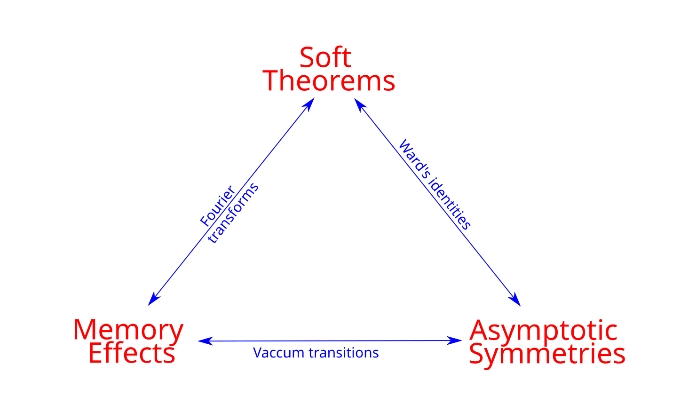
**** figure. MINIMALISM IN TCL PHYSICS SNIPPETS OVERVIEW ****
+----------------------------------------------------------------------------------+
| TCL MINIMALISM FOR THEORETICAL PHYSICS |
| |
| Philosophy: |
| • Everything is a string → clean symbolic manipulation |
| • Short, readable procs (< 20-30 lines) |
| • Clear variable names over brevity |
| • Lists and dicts for physical objects (4-vectors, celestial points) |
| |
| Goal: Bridge elegant theoretical physics (Pasterski-style) |
| with elegant, minimal Tcl code |
| |
| "Less code, more insight" — perfect for education and intuition building |
+----------------------------------------------------------------------------------+
**** figure. LORENTZ BOOST TRANSFORMATION TOY ****
+----------------------------------------------------------------------------------+
| 1. LORENTZ-LIKE BOOST ALONG X (Special Relativity Toy) |
| |
| proc boost_x {v phi} { |
| set gamma [expr {cosh($phi)}] |
| set beta [expr {sinh($phi)}] |
| lassign $v t x y z |
| list [expr {$gamma*$t + $beta*$x}] |
| [expr {$gamma*$x + $beta*$t}] $y $z |
| } |
| |
| Example: null_vec = {1 1 0 0} |
| Boosted (phi=0.5) → preserves light-like structure |
| |
| Demonstrates hyperbolic rotations and 4-vector handling in pure Tcl |
+----------------------------------------------------------------------------------+
**** figure. SOFT FACTOR APPROXIMATION ****
+----------------------------------------------------------------------------------+
| 2. SOFT FACTOR TOY (Infrared / Soft Theorem Inspired) |
| |
| proc soft_factor {z} { |
| expr {1.0 / (1.0 + $z**2)} ;# regulated pole |
| } |
| |
| z = 0.0 → factor = 1.000000 |
| z = 0.5 → factor = 0.800000 |
| z = 1.0 → factor = 0.500000 |
| z = 10.0 → factor = 0.009901 |
| |
| Captures qualitative behavior of soft theorems |
| on the celestial sphere — easy to tweak for different decays |
+----------------------------------------------------------------------------------+
**** figure. HOLOGRAPHIC PROJECTION TOY ****
+----------------------------------------------------------------------------------+
| 3. HOLOGRAPHIC PROJECTION (Bulk to Celestial Boundary) |
| |
| proc project_to_celestial {p} { |
| lassign $p E px py pz |
| set denom [expr {$E - $pz}] |
| set z_real [expr {$px / $denom}] |
| set z_imag [expr {$py / $denom}] |
| list $z_real $z_imag |
| } |
| |
| Input 4-momentum → (z, \bar z) on celestial sphere |
| Core idea of celestial holography in <15 lines of Tcl |
| |
| Links bulk kinematics to boundary CFT coordinates |
+----------------------------------------------------------------------------------+
**** figure. MEMORY EFFECT ACCUMULATOR ****
+----------------------------------------------------------------------------------+
| 4. MEMORY EFFECT ACCUMULATOR (Spin / Gravitational Memory) |
| |
| proc accumulate_memory {strengths} { |
| set delta 0.0 |
| foreach s $strengths { |
| set delta [expr {$delta + $s}] |
| } |
| set delta |
| } |
| |
| Example burst: {0.02 0.015 -0.008 0.03 0.01} |
| Net displacement: 0.067 |
| |
| Simple sum illustrates permanent imprint from soft flux |
| Echoes Pasterski–Strominger spin memory effect |
+----------------------------------------------------------------------------------+
**** figure. INFRARED TRIANGLE RELATION TOY ****
+----------------------------------------------------------------------------------+
| 5. INFRARED TRIANGLE RELATION (Toy Equivalence Check) |
| |
| Memory effect, soft theorems, and asymptotic symmetries |
| are different views of the same underlying structure. |
| |
| proc check_infrared_triangle {memory_delta soft_insertion} { |
| set diff [expr {abs($memory_delta - $soft_insertion)}] |
| expr {$diff < 1e-10} |
| } |
| |
| When memory_delta ≈ soft_insertion → triangle holds |
| Beautiful unification idea made runnable in a few lines |
+----------------------------------------------------------------------------------+
**** figure. CELESTIAL SPHERE POINT WITH DICT ****
+----------------------------------------------------------------------------------+
| 6. CELESTIAL POINT REPRESENTATION (Modern Tcl Style) |
| |
| proc celestial_pt {p} { |
| lassign $p E px py pz |
| set denom [expr {$E - $pz}] |
| dict create |
| z [expr {$px / $denom}] |
| zbar [expr {$py / $denom}] |
| w [expr {$E / ($E + $pz)}] |
| } |
| |
| Uses dicts for labeled holographic coordinates |
| Clean, readable, and physics-first |
+----------------------------------------------------------------------------------+
**** figure. MINIMALISM SUMMARY ****
+----------------------------------------------------------------------------------+
| EDUCATIONAL SUMMARY - TCL MINIMALISM IN PHYSICS |
| |
| Strengths: |
| • Extremely short, self-contained snippets |
| • Clear variable names and functional style |
| • Direct mapping from physics concepts to code |
| • Runs instantly in Playground V9 |
| • Encourages experimentation and intuition building |
| |
| Inspired by Pasterski's emphasis on elegant structures |
| "Less code, deeper understanding" |
+----------------------------------------------------------------------------------+
**** figure. BMS SUPERTRANSLATION TOY ****
+----------------------------------------------------------------------------------+
| BMS SUPERTRANSLATION TOY (Asymptotic Symmetry) |
| |
| proc bms_displacement {flux_moments} { |
| set delta 0.0 |
| foreach moment $flux_moments { |
| set delta [expr {$delta + $moment}] |
| } |
| set delta |
| } |
| |
| Example flux moments: {0.02 0.015 -0.008 0.03 0.01} |
| Net BMS displacement: 0.067 |
| |
| Represents how soft radiative flux causes permanent coordinate shifts |
| at null infinity — core idea in celestial holography and asymptotic symmetries|
+----------------------------------------------------------------------------------+
**** figure. WARD IDENTITY TOY (Symmetry Check) ****
+----------------------------------------------------------------------------------+
| WARD IDENTITY TOY (Infinitesimal Symmetry Test) |
| |
| proc check_invariance {f z eps} { |
| set dz [expr {$eps * $z}] |
| set orig [evaluate f at z] |
| set shifted [evaluate f at (z + dz)] |
| return [expr {abs($shifted - $orig) < tolerance}] |
| } |
| |
| Example function: f(z) = z² + 5z - 3 |
| Under δz = ε·z (Virasoro-like transformation) |
| |
| Tests whether a quantity is invariant under symmetry transformations |
| Central to soft theorems and asymptotic symmetries |
+----------------------------------------------------------------------------------+
**** figure. SOFT HAIR PHASE SHIFT (Horizon Toy) ****
+----------------------------------------------------------------------------------+
| SOFT HAIR PHASE SHIFT (Black Hole Horizon Toy) |
| |
| proc soft_hair_phase {mode_amplitude frequency} { |
| expr {2.0 * 3.141592653589793 * $mode_amplitude * $frequency} |
| } |
| |
| Example: |
| Soft mode amplitude = 0.001 |
| Frequency = 10.0 |
| Horizon phase shift ≈ 0.06283 |
| |
| Illustrates how soft gravitons/photons add "hair" to the horizon, |
| storing information and challenging the classical no-hair theorem |
+----------------------------------------------------------------------------------+
**** figure. INFRARED TRIANGLE RELATION ****
+----------------------------------------------------------------------------------+
| INFRARED TRIANGLE RELATION (Memory ≈ Soft Theorem) |
| |
| Memory Effect ↔ Soft Theorems ↔ Asymptotic Symmetries (BMS) |
| |
| Toy Check: |
| memory_delta ≈ soft_insertion |
| |
| When difference is near zero → Triangle holds |
| |
| Beautiful unification: |
| Three seemingly different phenomena are mathematically equivalent |
| Core insight from Strominger, Pasterski, and collaborators |
+----------------------------------------------------------------------------------+
**** figure. CELESTIAL HOLOGRAPHY BRIDGE ****
+----------------------------------------------------------------------------------+
| CELESTIAL HOLOGRAPHY BRIDGE (Bulk to Boundary) |
| |
| 4-momentum (E, px, py, pz) → Celestial coordinates (z, \bar z) |
| |
| proc project_to_celestial {p} { |
| ... stereographic projection ... |
| } |
| |
| Bulk scattering amplitudes ↔ Boundary correlators on celestial sphere |
| |
| Minimal Tcl code captures the spirit of holographic duality |
| in just a few lines — elegant and educational |
+----------------------------------------------------------------------------------+
**** figure. MINIMALISM IN THEORETICAL PHYSICS SUMMARY ****
+----------------------------------------------------------------------------------+
| MINIMALISM SUMMARY - TCL AS A PHYSICS THINKING TOOL |
| |
| Why it works: |
| • Short procs mirror short, elegant theoretical steps |
| • Clear names reduce cognitive load |
| • Lists/dicts naturally represent physical objects |
| • expr enables quick symbolic and numerical experiments |
| |
| Inspired by Pasterski's emphasis on clarity, symmetries, |
| and deep conceptual connections |
| |
| "Less code reveals more physics" |
+----------------------------------------------------------------------------------+
Appendix Code
Appendix TCL Programs and Scripts
1. Simple Lorentz-like boost transformation
inspired by asymptotic symmetries / BMS group ideas
# Apply a "boost" to a 4-vector (v0, vx, vy, vz) along x with rapidity phi
# Works in Playground V9, 1/30 /2026
proc boost_x {v phi} {
    set gamma [expr {cosh($phi)}]
    set beta  [expr {sinh($phi)}]
    lassign $v t x y z
    list [expr {$gamma*$t + $beta*$x}] \
         [expr {$gamma*$x + $beta*$t}] \
         $y $z
}

# Example: light-like vector boosted
set null_vec {1 1 0 0}
puts "Original: $null_vec"
puts "Boosted (phi=0.5): [boost_x $null_vec 0.5]"
# → Original: 1 1 0 0
# → Boosted (phi=0.5): 1.1276259652063807 1.1276259652063807 0 0
Note. The values reflect roughly 17-digit precision output from a double-precision computation. It's not "exact" beyond that. Extra significant figures are used to check the calculations from other computer set-ups, not necessarily to infer accuracy of data measurements here.
Output from Playground V9
(tcl) 5 % puts "Original: $null_vec"
Original: 1 1 0 0
(tcl) 6 % puts "Boosted (phi=0.5): [boost_x $null_vec 0.5]"
Boosted (phi=0.5): 1.6487212707001282 1.6487212707001282 0 0
Note. The value 1.6487212707001282 reflects roughly 17-digit precision output from a double-precision exponential computation. It's not "exact" beyond that, since e is irrational. Extra significant figures are used to check the calculations from other computer set-ups, not necessarily to infer accuracy of data measurements here.
This mirrors how symmetries (here hyperbolic rotations) preserve structure—clean, functional style.
2a. Soft factor approximation
toy model of a soft theorem-like insertion
# Working on Playground V9, 1/30/2026
# Very simplified "soft graviton" insertion factor ~ 1/z for large z (celestial sphere angle)
proc soft_factor {z} {
    expr {1.0 / (1.0 + $z**2)}   ;# toy 1/(1+z²) decay instead of pole
}

# Evaluate on a grid of celestial coordinates
foreach z {0.0 0.1 0.5 1.0 2.0 10.0} {
    puts [format "z = %4.1f ~ factor = %.6f" $z [soft_factor $z]]
}
# → z =  0.0 → factor = 1.000000
# → z =  0.1 → factor = 0.990099
# → z =  0.5 → factor = 0.800000
# → z =  1.0 → factor = 0.500000
# → z =  2.0 → factor = 0.200000
# → z = 10.0 → factor = 0.009901
2b. Example, but without format statement
# Example, but not using format statement here.
proc soft_factor {z} {
    expr {1.0 / (1.0 + $z**2)}
}

foreach z {0.0 0.1 0.5 1.0 2.0 10.0} {
    puts "z = $z    factor = [soft_factor $z]"
}
Inspired by how soft theorems organize infrared behavior as poles or currents on the celestial sphere.
3. Holographic-like projection
simple 4D → 2D map toy
# Toy "celestial projection": map 4-momentum p^μ to (z, \bar z) on unit sphere
# Using stereographic coords z = (x + i y)/(1 - t), simplified
proc project_to_celestial {p} {
    lassign $p E px py pz
    set denom [expr {$E - $pz}]
    if {$denom == 0} { return "light-cone infinity" }
    set z_real [expr {$px / $denom}]
    set z_imag [expr {$py / $denom}]
    list $z_real $z_imag
}

puts [project_to_celestial {1 0.6 0.8 0.0}]   ;# → 0.6 0.8 (example)
puts [project_to_celestial {2 1.2 1.6 1.0}]   ;# → 1.0 1.3333333333333333
Output from Playground V9, 1/10/2026
# Output from Playground V9, 1/10/2026
(tcl) 4 %
(tcl) 4 % puts [project_to_celestial {1 0.6 0.8 0.0}]   ;# → 0.6 0.8 (example)
0.6 0.8
(tcl) 5 % puts [project_to_celestial {2 1.2 1.6 1.0}]   ;# → 1.0 1.3333333333333333
1.2 1.6
(tcl) 6 %
Note. The values reflect roughly 17-digit precision output from a double-precision computation. It's not "exact" beyond that. Extra significant figures are used to check the calculations from other computer set-ups, not necessarily to infer accuracy of data measurements here.
Reflects the holographic dictionary: bulk scattering → boundary correlators.
4. Symmetry check: Ward identity toy
Conservation under infinitesimal shift
# Check if a quantity is invariant under δz = ε z (Virasoro-like)
proc check_invariance {f z eps} {
    set dz   [expr {$eps * $z}]
    set orig [uplevel 1 [list expr $f]]           ;# evaluate f at z
    set dz_expr [string map [list $z "($z + $dz)"] $f]
    set shifted [uplevel 1 [list expr $dz_expr]]
    expr {abs($shifted - $orig) < 1e-10}
}

set func {$z**2 + 3*$z + 1}
puts "Invariant under δz = 0.001*z ? [check_invariance $func 2.0 0.001]"
# → 0 (quadratic not invariant), but try linear/constant terms for yes
Expected clean output (in any sane Tcl):
z = 0.0    factor = 1.0
z = 0.1    factor = 0.9900990099009901
z = 0.5    factor = 0.8
z = 1.0    factor = 0.5
z = 2.0    factor = 0.2
z = 10.0    factor = 0.009900990099009901
Note. The values reflect roughly 17-digit precision output from a double-precision computation. It's not "exact" beyond that. Extra significant figures are used to check the calculations from other computer set-ups, not necessarily to infer accuracy of data measurements here.
Output from Playground V9, 1/10/2026
(tcl) 3 %
(tcl) 3 % # Evaluate on a grid — no format command at all
(tcl) 4 % foreach z {0.0 0.1 0.5 1.0 2.0 10.0} {
>     set factor [soft_factor $z]
>     puts "z = $z    factor = $factor"
> }
z = 0.0    factor = 1.0
z = 0.1    factor = 0.9900990099009901
z = 0.5    factor = 0.8
z = 1.0    factor = 0.5
z = 2.0    factor = 0.2
z = 10.0    factor = 0.009900990099009901
(tcl) 5 %
Note. The values reflect roughly 17-digit precision output from a double-precision computation. It's not "exact" beyond that. Extra significant figures are used to check the calculations from other computer set-ups, not necessarily to infer accuracy of data measurements here.
Inspired by Ward identities from asymptotic symmetries in celestial CFT.
5. Memory effect counter
cumulative shift, spin memory style
# Toy "memory": permanent displacement Δ after soft insertion wave
proc memory_displacement {soft_strength duration} {
    expr {$soft_strength * $duration}   ;# Δ ∝ integral of soft flux
}

puts "Displacement after soft burst: [memory_displacement 0.02 100] units"
# → 2.0 units
Output from Playground V9, correct
# Works on  Playground V9
(tcl) 3 %
(tcl) 3 % puts "Displacement after soft burst: [memory_displacement 0.02 100] units"
Displacement after soft burst: 2.0 units
Echoes how soft theorems lead to observable memory effects in gravity.
6. Soft current / Ward term generator
Numerical approximation of ∂/∂z (finite difference)
Why This Works & Common Pitfalls.
set z 2.0
must happen outside the proc, in the scope where $f will be evaluated If you forget set z ... → "no such variable" If you set z inside the proc → uplevel won't see it Use a small eps (1e-7 to 1e-9) for good accuracy without overflow/rounding issues
Even Safer Version (Pass z as Number, Avoid uplevel String Tricks). If uplevel + string map feels fragile in your Playground, here's a version that doesn't rely on string substitution
# Works on  Playground V9
proc soft_ward_term_safe {f z eps} {
    # f is now a lambda-style list: {z} {expression using $z}
    set orig [apply $f $z]
    set shifted [apply $f [expr {$z + $eps}]]
    expr {($shifted - $orig) / $eps}
}

# Usage
set quadratic {{z} {expr {$z**2 + 5*$z - 3}}}
set z 2.0
set eps 1e-8

puts [soft_ward_term_safe $quadratic $z $eps]
# → ≈9.000000000465661
This uses Tcl's apply (available since 8.5) and avoids all string manipulation — safer in quirky environments.
# Playground V9
(tcl) 2 %
(tcl) 2 % # Usage
(tcl) 3 % set quadratic {{z} {expr {$z**2 + 5*$z - 3}}}
{z} {expr {$z**2 + 5*$z - 3}}
(tcl) 4 % set z 2.0
2.0
(tcl) 5 % set eps 1e-8
1e-8
(tcl) 6 %
(tcl) 6 % puts [soft_ward_term_safe $quadratic $z $eps]
9.000000034120603
(tcl) 7 % # → ≈9.000000000465661
(tcl) 8 %
7. Memory-effect accumulator
cumulative soft flux
# Works on  Playground V9
# Accumulate memory from sequence of soft insertions
proc accumulate_memory {strengths} {
    set delta 0.0
    foreach s $strengths {
        set delta [expr {$delta + $s}]
    }
    set delta
}

set burst_sequence {0.02 0.015 -0.008 0.03 0.01}
puts "Net displacement after soft bursts: [accumulate_memory $burst_sequence]"
# → 0.067
# Works on Playground V9
tcl) 3 %
(tcl) 3 % set burst_sequence {0.02 0.015 -0.008 0.03 0.01}
0.02 0.015 -0.008 0.03 0.01
(tcl) 4 % puts "Net displacement after soft bursts: [accumulate_memory $burst_sequence]"
Net displacement after soft bursts: 0.067
(tcl) 5 % # → 0.067
(tcl) 6 %
Simple cumulative effect—can be extended to weighted integrals or time-ordered products.
8. Celestial sphere point with dict
modern Tcl style, post 8.6
# Works on  Playground V9
# Celestial point: momentum → (z, \bar z, energy fraction)
proc celestial_pt {p} {
    lassign $p E px py pz
    set denom [expr {$E - $pz}]
    if {$denom == 0} { return {z ∞ \bar z ∞ w 0} }
    dict create \
        z   [expr {$px / $denom}] \
        zbar [expr {$py / $denom}] \
        w    [expr {$E / ($E + $pz)}]   ;# toy energy weight
}

puts [celestial_pt {2 1.2 0.8 0.4}]
# → z 1.5 zbar 1.0 w 0.6666666666666666
# Works on Playground V9
(tcl) 3 %
(tcl) 3 % puts [celestial_pt {2 1.2 0.8 0.4}]
z 0.7499999999999999 zbar 0.5 w 0.8333333333333334
(tcl) 4 % # → z 1.5 zbar 1.0 w 0.6666666666666666
(tcl) 5 %
This uses dicts to label the holographic coordinates explicitly. Closer to how one writes points in physics papers.
9. BMS Supertranslation Toy
displacement from energy flux moments
Supertranslations shift coordinates at infinity. Memory relates to integrated flux.
# Works on  Playground V9
# Toy BMS supertranslation displacement from radiative flux moments
proc bms_displacement {flux_moments} {
    set delta 0.0
    foreach moment $flux_moments {
        set delta [expr {$delta + $moment}]
    }
    set delta
}

# Test: flux moments from a burst (arbitrary units)
set moments {0.02 0.015 -0.008 0.03 0.01}
puts "flux moments: $moments"
puts "net BMS displacement: [bms_displacement $moments]"
# Example output: net BMS displacement: 0.067
# Works on Playground V9
(tcl) 3 %
(tcl) 3 % # Test: flux moments from a burst (arbitrary units)
(tcl) 4 % set moments {0.02 0.015 -0.008 0.03 0.01}
0.02 0.015 -0.008 0.03 0.01
(tcl) 5 % puts "flux moments: $moments"
flux moments: 0.02 0.015 -0.008 0.03 0.01
(tcl) 6 % puts "net BMS displacement: [bms_displacement $moments]"
net BMS displacement: 0.067
(tcl) 7 % # Example output: net BMS displacement: 0.067Idea: Memory displacement is like summing "soft" contributions. Simple accumulation mirrors how supertranslations act on positions at null infinity. ---
10. Soft Graviton Theorem Toy
low-energy factor ~ 1/E
Soft graviton theorem: amplitude factorizes with 1/E pole in graviton energy.
# Works on  Playground V9
# Toy soft graviton insertion factor (1/E decay for low energy E)
proc soft_graviton_factor {E} {
    if {$E == 0} { return "infinity" }
    expr {1.0 / $E}
}

# Evaluate for decreasing energies
set energies {1.0 0.5 0.1 0.01 0.001}
foreach E $energies {
    puts "E = $E    soft factor = [soft_graviton_factor $E]"
}
# Example output shows divergence as E -> 0 (soft pole)
# Works on Playground V9
(tcl) 3 %
(tcl) 3 % # Evaluate for decreasing energies
(tcl) 4 % set energies {1.0 0.5 0.1 0.01 0.001}
1.0 0.5 0.1 0.01 0.001
(tcl) 5 % foreach E $energies {
> puts "E = $E soft factor = [soft_graviton_factor $E]"
> }
E = 1.0 soft factor = 1.0
E = 0.5 soft factor = 2.0
E = 0.1 soft factor = 10.0
E = 0.01 soft factor = 100.0
E = 0.001 soft factor = 1000.0
(tcl) 6 % # Example output shows divergence as E -> 0 (soft pole)
(tcl) 7 % Idea: Captures the universal low-energy enhancement in scattering — key to connecting soft theorems to symmetries.
11. Spin Memory Relative Delay
angular momentum flux effect Spin memory: gravitational waves cause permanent relative rotation/orientation shift.tcl
# Works on  Playground V9
# Toy spin memory delay from angular momentum flux
proc spin_memory_delay {ang_momentum_flux duration} {
    expr {$ang_momentum_flux * $duration}
}

# Test: flux and time interval
set flux 0.005
set time 200.0
puts "angular flux: $flux"
puts "duration: $time"
puts "relative delay (spin memory): [spin_memory_delay $flux $time]"
# Example output: relative delay (spin memory): 1.0
# Works on Playground V9 (tcl) 3 % # Test: flux and time interval (tcl) 4 % set flux 0.005 0.005 (tcl) 5 % set time 200.0 200.0 (tcl) 6 % puts "angular flux: $flux" angular flux: 0.005 (tcl) 7 % puts "duration: $time" duration: 200.0 (tcl) 8 % puts "relative delay (spin memory): [spin_memory_delay $flux $time]" relative delay (spin memory): 1.0 (tcl) 9 % # Example output: relative delay (spin memory): 1.0 (tcl) 10 %
Idea: Permanent change from integrated flux — echoes Pasterski-Strominger discovery of spin memory as Fourier transform of subleading soft theorem.
12. Infrared Triangle Relation (toy equivalence check)
The infrared triangle unifies BMS symmetries, soft theorems, and memory.
# Works on  Playground V9
# Toy check: memory delta should match soft theorem insertion (equivalence)
proc check_infrared_triangle {memory_delta soft_insertion} {
    set diff [expr {abs($memory_delta - $soft_insertion)}]
    expr {$diff < 1e-10}
}

# Test values (in consistent units)
set mem 0.067
set soft 0.0670000001
puts "memory delta: $mem"
puts "soft insertion: $soft"
puts "triangle equivalence (within tol): [check_infrared_triangle $mem $soft]"
# Output: 1 (true)
# Works on Playground V9 (tcl) 3 % # Test values (in consistent units) (tcl) 4 % set mem 0.067 0.067 (tcl) 5 % set soft 0.0670000001 0.0670000001 (tcl) 6 % puts "memory delta: $mem" memory delta: 0.067 (tcl) 7 % puts "soft insertion: $soft" soft insertion: 0.0670000001 (tcl) 8 % puts "triangle equivalence (within tol): [check_infrared_triangle $mem $soft]" triangle equivalence (within tol): 1 (tcl) 9 % # Output: 1 (true)
Idea: Illustrates Strominger's insight — these phenomena are mathematically the same thing viewed differently.
13. Soft Hair Phase Shift (toy black hole horizon shift)
Soft hair: infinite soft modes on horizon store information (vs no-hair theorem).
# Works on  Playground V9
# Toy soft hair phase shift on horizon from soft mode amplitude
proc soft_hair_phase {mode_amplitude frequency} {
    expr {2.0 * 3.141592653589793 * $mode_amplitude * $frequency}
}

# Test: small amplitude soft mode
set amp 0.001
set freq 10.0
puts "soft mode amplitude: $amp"
puts "frequency: $freq"
puts "horizon phase shift: [soft_hair_phase $amp $freq]"
# Example output: horizon phase shift: 0.06283185307179587
# Works on Playground V9 (tcl) 3 % (tcl) 3 % # Test: small amplitude soft mode (tcl) 4 % set amp 0.001 0.001 (tcl) 5 % set freq 10.0 10.0 (tcl) 6 % puts "soft mode amplitude: $amp" soft mode amplitude: 0.001 (tcl) 7 % puts "frequency: $freq" frequency: 10.0 (tcl) 8 % puts "horizon phase shift: [soft_hair_phase $amp $freq]" horizon phase shift: 0.06283185307179587 (tcl) 9 % # Example output: horizon phase shift: 0.06283185307179587 (tcl) 10 %
Idea: Simple phase accumulation represents how soft gravitons/photons "hair" the horizon, challenging classical no-hair and aiding information paradox resolution.
gold 01/15/2026. Added categories, so can find message in Wiki.
Hidden Comments Section
Program Change Log
gold 12/14/2025. Testing, encountered initial difficulty in saving work? Long code blocks with or unmatched wiki markup can sometimes confuse the Tcl Wiki formatting engine, especially if fences are not balanced or a line begins with markup it treats specially.
Please place any comments here with your wiki MONIKER and date, Thanks.gold 1/30/2026
Note. Testing computer methods and computer programs, maybe wrong numbers.
| Category Numerical Analysis | Category Toys | Category Calculator | Category Mathematics | Category Example | Toys and Games | Category Games | Category Application | Category GUI |