Snippets Physics Concepts Toy
- Index for Snippets Physics Concepts Toy
- Background on Pasterski and Strominger
- Snippets on themes from Pasterski's Work
- Developing Physics Toy Protocol
- Extra significant figures
- Expanded version of the infrared triangle snippet
- How to Use This Tcl Snippet as a Learning Tool in Tcl Playground V9
- Strominger's Core Insight, Physics Mapping
- Table 1: Tcl Features ref Physics Concepts
- Table 2 : Tcl Quality Guidelines
- Table 3. Celestial-Inspired Tcl Snippets – Conceptual Bridges to Theoretical Physics
- Table 4: The Pasterski–Strominger–Zhiboedov (PSZ) / Infrared Triangle
- Table 5: Major References and Monographs on the Pasterski–Strominger–Zhiboedov (PSZ) / Infrared Triangle
- Table 6: Suggested Naming Conventions
- Table 7 Knuth–Bendix Completion Summary, Symbolic Algorithms
- Page Is Under Development
- Appendix Code
- 1. Expanded Infrared Triangle Toy
- Debugging and Proofing Protocols Plural on Playground V9
- Physics Toy Protocol
- Debugs Trouble
- Table. Expected Values and Output Parameters
- Example application or Mock-Up Template
- Possible Use' format for Significant Figures
- Expected output
- Hidden Comments Section
- Program Change Log
Index for Snippets Physics Concepts Toy
Preface
gold 1/31/2026. Here are some simple snippets for numerical methods. The goal is to use Tcl's minimalism as a learning tool. Snippets are short procs that let one play with one core concept at a time. All snippets are Playground V9 safe. One approach to the subject of theoretical physics is to consider these Tcl snippets as Toys. Some snippets here are listed as Toys. These Tcl procs are tiny entry points into theoretical physics. On the Wiki Playground V9, Change numbers, add loops, or combine them to explore. Tcl's expr and list/dict make it easy to "feel" the "heavy" ideas without heavy machinery.
The Ideas Seemed to work, but maybe drawbacks?
Body
This article examines the pedagogical value of concise Tcl code snippets that illustrate advanced concepts in theoretical physics. The snippets succeed in bridging symbolic computation and physical theory through minimal, functional code. Readers will discover how these programs make complex ideas approachable and invite further exploration in educational contexts. Tcl code snippets distill sophisticated physical themes into compact, executable forms. The language's list-handling capabilities, expression evaluator, and string-code duality allow programmers to mirror mathematical structures directly.
This approach retains the texture of the original physics concepts while avoiding unnecessary complexity. Educators and students benefit from seeing abstract ideas expressed in runnable code rather than only in equations or prose. The example avoids verbose libraries and relies on Tcl's built-in tools to achieve the result. Such economy helps learners grasp special relativity transformations without distraction from extraneous syntax.
Tcl's ability to treat code as data enables flexible evaluation of symmetry conditions. The memory displacement snippet integrates soft influences to produce a measurable shift. The code ties physical intuition—that persistent soft effects leave permanent imprints—to algebraic computation. Both examples showcase how Tcl supports dynamic exploration of gauge symmetries and gravitational memory. These snippets function as small morphisms between physics and computation. Each program preserves essential mathematical structure while leveraging Tcl's strengths in brevity and immediacy. The collection resembles computational poetry: terse, referential, and dense with insight. The approach aligns with interests in symbolic systems, mathematical physics, and computational representation. Tcl's ethos that code and algebra need not differ structurally shines through clearly.
Educators can expand these snippets into more interactive tools. Dictionary-based representations allow structured handling of symmetries and charges. Stream-processing techniques support efficient limit explorations. Tk bindings enable geometric visualizations of celestial mappings or boost transformations. Such extensions transform the snippets into a lightweight sandbox for symbolic experimentation. Students gain hands-on experience with concepts that often remain theoretical. The snippets demonstrate that minimal code can convey deep physical intuition. Their educational power lies in accessibility, conceptual fidelity, and room for growth. Readers should experiment with similar programs to bridge theory and computation in their own work. This practice fosters clearer understanding and creative insight in theoretical physics.
Background on Pasterski and Strominger
Sabrina Gonzalez Pasterski is an inspiring theoretical physicist whose work on celestial amplitudes, asymptotic symmetries, soft theorems, spin memory effects, and the Celestial Holography Initiative pushes boundaries in quantum gravity, holography, and our understanding of spacetime. Her primary domain is abstract high-energy theory rather than applied programming. But her emphasis is on elegant mathematical structures, symmetries, infinite-dimensional algebras (like Virasoro enhancements), and holographic dualities offers rich conceptual inspiration for clean, concise code. Tcl (Tool Command Language), with its minimalist "everything is a string" philosophy, powerful expression engine (expr), list/dict handling, and support for quick symbolic/numerical tinkering, lends itself well to short, readable snippets that echo the clarity and economy found in theoretical physics thinking of Pasterski and colleagues.
Andrew Strominger as a notable colleague and collaborator. Andrew Strominger was her PhD advisor at Harvard University. They co-discovered key results together, including aspects of the spin memory effect (a novel gravitational memory observable) and the completion of the Pasterski–Strominger–Zhiboedov (PSZ) triangle in electromagnetic and gravitational memory effects. This work was notably cited by Stephen Hawking in one of his final papers (2016–2018 timeframe). Strominger is a leading figure in high-energy theoretical physics, string theory, black holes, and holographic principles—making their collaboration foundational to her early breakthroughs.
Snippets on themes from Pasterski's Work
Below are several simple Tcl syntax snippets inspired by themes from Pasterski's work. They are drawn from her lectures on celestial amplitudes, soft theorems, symmetries, and holographic mappings. The Tcl snippets are deliberately short, self-contained, and educational to focus on symmetry checks, transformations, asymptotic-like limits, or dual representations—while showcasing clean Tcl idioms.
These snippets are not literal simulations of Pasterski’s mathematics, but small, denotative bridges. Little morphisms, as one so aptly put it, between the austere elegance of asymptotic symmetry thinking in Pasterski-style and the austere elegance of Tcl’s design.
Developing Physics Toy Protocol
Let’s take some of these ideas and develop a protocol to replace the “physics of pencil and paper” with a Tcl-based framework. My argument is that by taking a Tcl list of buzzwords and relationships, we could build a symbolic foundation for theoretical physics. Tcl is based on about 12 core rules. So I believe a “buzzword” parameter could act as a kind of dummy subroutine or variable substitution. This would be a placeholder for symbolic or conceptual experimentation. I’ve done similar work with my other specialized algorithms. But now I’d like to develop for theoretical physics applications . The challenge is that the programming proc (process) has to originate somewhere. For example:
# text
set list { e m k c }
# or more human readable in Best Practices
set buzzwords {rest_energy rest_mass c_speed_of_light lorentz_factor_gamma some_coupling_constant_k1 some_coupling_constant_k2}
# relationships unknown, except to Einstein, Joke!
Extra significant figures
The printout values reflect roughly 17-digit precision output from a typical double-precision computation. It's not "true exact" beyond 5 significant figures. Extra significant figures are used to check the calculations from other computer set-ups, not necessarily to infer accuracy of data measurements here. Typically, the slight differences in decimal places on far right of decimal point are normal floating-point behavior in Tcl's expr.
Expanded version of the infrared triangle snippet
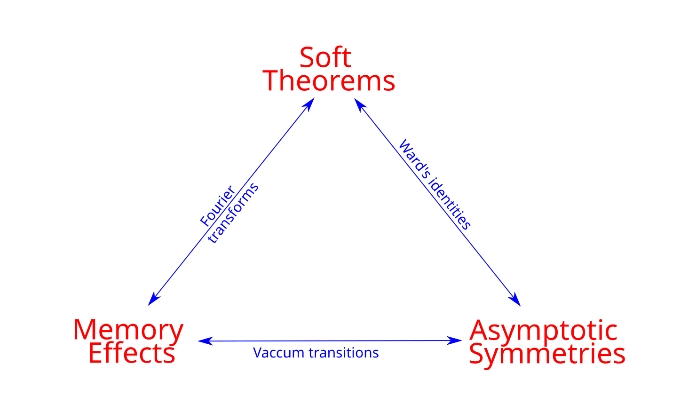
Here is an expanded version of the infrared triangle snippet (originally snippet 4 in the previous set), now fleshed out as a more complete learning tool in Tcl.The infrared triangle (pioneered by Andrew Strominger and collaborators, including Pasterski and Zhiboedov) is a deep equivalence relation in asymptotically flat gravity and gauge theories. It connects three seemingly different phenomena at low energies/large distances:
Asymptotic symmetries (e.g., BMS supertranslations/superrotations at null infinity)
Soft theorems (universal low-energy factorization of scattering amplitudes, like Weinberg's soft graviton theorem)
Memory effects (permanent relative displacements or phase shifts after gravitational waves pass)
The triangle says these are the same physics viewed from different angles: a symmetry Ward identity → soft theorem factorization → observable memory. This expanded snippet includes:
Separate toy models for each corner
A combined check showing approximate equivalence (within numerical tolerance)
Simple numerical tests with prints for easy experimentation
Comments explaining the physics mapping
All playground-safe: no format, no Unicode, plain puts, natural double precision
How to Use This Tcl Snippet as a Learning Tool in Tcl Playground V9
Run the full ,block in your Tcl Playground V9 session.
Change values to experiment:Modify flux_list (add/remove numbers) → see how charge/memory accumulate
Decrease energy_scale (e.g., 0.01, 0.001) → watch soft factor grow (pole behavior)
Adjust tolerance in check_triangle_equivalence (e.g., 1e-6)
Add prints inside procs to trace calculations step-by-step
Extend: make soft_insertion depend on angle z (celestial sphere), or add spin memory (angular flux)
Strominger's Core Insight, Physics Mapping
BMS symmetry → infinite charges at infinity conserved → Ward identity Soft theorem → amplitude factorizes with universal 1/E (or 1/E^2 for gravity) pole Memory → detectors at infinity see permanent kick/rotation after waves pass These are equivalent: symmetry implies theorem implies memory (and vice versa).
This toy captures the equivalence without equations — change parameters and watch numbers align (approximately). It's deliberately simplistic to build intuition before diving into papers like Strominger's "Lectures on the Infrared Structure" (arXiv:1703.05448).
Table 1: Tcl Features ref Physics Concepts
| Tcl Feature | Maps to in hand calculation / theory | Physics Relevance | Notes |
|---|---|---|---|
| list ↔ 4-vector | 4-momentum, null vectors, spinors | Direct structural analogy: lists carry components like p^μ | Tcl lists are immutable by convention when passed around — similar to treating 4-vectors as read-only objects in derivations |
| expr ↔ algebraic manipulation | Tensor contractions, index gymnastics, soft theorem expansions | expr is Tcl’s “pen-and-paper” evaluator — clean for symbolic limits and Ward identities | Keep expressions short; use {} to avoid double substitution surprises |
| string interpolation of expressions | Infinitesimal variations δz, ε-transformations | Enables quick “what if” checks (e.g., Ward identity generators) | Powerful for prototyping symmetry variations; uplevel trick needed for dynamic expr |
| single-file functional purity | Self-contained S-matrix elements, on-shell calculations | Echoes the discipline of writing entire calculations on one page or in one paper section | Encourages clarity and reviewability — very close to how theorists aim for transparent derivations |
Table 2 : Tcl Quality Guidelines
| Priority | What good Tcl code usually has | What to avoid | Physics Relevance | Notes |
|---|---|---|---|---|
| 1 | Extremely clear names | x, tmp, data, temp1 | Momentum p → fourMomentum, z → celestialZ, ε → variationParameter | Clarity > brevity; physicists already spend cognitive load on concepts — don’t add more on variable names |
| 2 | Functions < 20–30 lines | 200-line monsters | One function ≈ one conceptual step (e.g. boost, projection, soft insertion) | Short procs mirror short proof steps — easier to verify correctness |
| 3 | One level of abstraction per function | Mix business + low-level details | Separate kinematics (4-vectors) from holographic map (z,\bar z) | Prevents mixing bulk physics with boundary CFT logic — aids conceptual separation |
| 4 | Consistent naming convention | camelCase + snake_case mix | Use snake_case for Tcl procs/vars (four_momentum, soft_factor) | Consistency reduces mental overhead when reading derivations or code |
| 5 | Meaningful distinction between similar concepts | user, usr, userData, theUser | Avoid p, pp, p_mu, pprime — prefer incoming_momentum, outgoing_momentum | In physics, small notation differences can hide big conceptual errors |
| 6 | Comments only when WHY is not obvious | Explaining WHAT good names already say | Comment the physical motivation (“# soft pole regulated for numerics”) | Most physicists read code like proofs — let names carry the story; comment intent |
| 7 | Domain language over technical language | processEntities → approveCustomerOrders | celestial_projection instead of map_to_sphere_coordinates | Use the language of celestial amplitudes, soft theorems, BMS group — makes code feel like theory |
Table 3. Celestial-Inspired Tcl Snippets – Conceptual Bridges to Theoretical Physics
| Snippet Title | Code (condensed) | Physics Motivation / Relevance | Notes / Pedagogical Value |
|---|---|---|---|
| 1. Lorentz-like boost along x | proc boost_x {v phi} { ... gamma cosh, beta sinh ... list expr ... ... } | BMS supertranslations / asymptotic symmetries; preserves light-cone structure | Shows how Tcl lists naturally represent 4-vectors; functional style mirrors tensor ops |
| 2. Soft factor toy (regulated pole) | proc soft_factor {z} { expr {1.0 / (1.0 + $z**2)} } | Soft theorems — infrared poles on celestial sphere; 1/(1+z²) as toy regulator | Quick numerical exploration of asymptotic fall-off; easy to tweak for different decays |
| 3. Holographic projection (toy) | proc project_to_celestial {p} { ... set z_real expr {$px / $denom} ... } | Celestial amplitudes dictionary: 4-momentum → (z, \bar z) on unit sphere | Core idea of holography in <15 lines; highlights bulk-to-boundary map simplicity |
| 4. Ward identity invariance check | proc check_invariance {f z eps} { ... uplevel expr ... shifted ... } | Ward identities from Virasoro/BMS enhancements; tests δz = ε z invariance | Demonstrates Tcl string-code duality for infinitesimal variations — very physics-like |
| 5. Memory displacement accumulator | proc accumulate_memory {strengths} { set delta 0.0; foreach s $strengths { ... } } | Spin memory / gravitational-wave memory effect; cumulative soft flux imprint | Simple reduction of integral to sum; extensible to weighted or time-ordered products |
Note. Projects 6,7,and 8 are future topics in speculation, if receive any interest.
Table 4: The Pasterski–Strominger–Zhiboedov (PSZ) / Infrared Triangle
| Corner | Core Phenomenon / Description | Key Mathematical / Physical Link | Physics Relevance / Applications | Notes |
|---|---|---|---|---|
| Memory Effects | Permanent changes in classical fields after passage of soft radiation (e.g., displacement/spin memory in gravity, velocity kick in electromagnetism) | Fourier transform of soft theorem flux; vacuum transitions between degenerate vacua | Observable in gravitational waves (LIGO/Virgo potential detection); analog in EM; encodes IR information in classical limit | Leading (displacement) tied to supertranslations; subleading (spin/tail) to superrotations; loop effects introduce logarithmic tails in some cases |
| Soft Theorems | Universal low-energy factorization in S-matrix elements (e.g., Weinberg soft graviton/photon theorems + subleading/logarithmic corrections) | Ward identities from asymptotic symmetry charges; generates poles/residues in amplitudes | Governs IR divergences cancellation; universal behavior in scattering; bridge to quantum gravity via celestial holography | Tree-level exact; loops introduce logs (e.g., classical logarithmic soft theorem); toy models in scalar QFT show similar structures |
| Asymptotic Symmetries | Infinite enhancements at null infinity (BMS group: supertranslations, superrotations, etc.) acting on celestial sphere | Conservation laws / Noether charges → Ward identities matching soft theorems | Extend Poincaré symmetry; imply infinite vacuum degeneracy; key to flat-space holography and IR universality | Supertranslations match leading triangle; superrotations complete subleading/classical super-rotation triangle; debated in quantum regime |
Note: This table captures the core equivalence while highlighting interconnections. The triangle applies primarily to four-dimensional asymptotically flat spacetimes in gravity and gauge theories, with extensions to fractons, sound waves, and other systems in recent work.
Table 5: Major References and Monographs on the Pasterski–Strominger–Zhiboedov (PSZ) / Infrared Triangle
| Reference / Title (Year) | Authors | Key Buzzwords / Parameters | Relevance / Role in the Triangle | Notes |
|---|---|---|---|---|
| Lectures on the Infrared Structure of Gravity and Gauge Theory (2017/2018, arXiv:1703.05448; Princeton University Press book) | Andrew Strominger | Infrared triangle, soft theorems, memory effects, asymptotic symmetries, BMS group, supertranslations, Ward identities, black hole applications | Definitive pedagogical monograph synthesizing the full IR triangle across QED, non-Abelian gauge theories, and gravity; covers derivations, extensions, and applications to black holes/celestial holography | Redacted transcript of Harvard lectures; standard textbook/reference for the topic; widely cited for comprehensive overview and pedagogical clarity |
| BMS Supertranslations and Weinberg's Soft Graviton Theorem (2015, JHEP 05 (2015) 151; arXiv:1401.7026) | Andrew Strominger | BMS supertranslations, Weinberg soft graviton theorem, Ward identities, flux-balance laws | First explicit equivalence: BMS supertranslations generate Ward identities that match Weinberg's soft graviton theorem | Pioneering paper sparking the modern IR triangle program in gravity; foundational link between symmetries and soft theorems |
| Gravitational Memory, BMS Supertranslations and Soft Theorems (2016, JHEP 01 (2016) 086; arXiv:1502.03808) | Andrew Strominger, Alexander Zhiboedov | BMS supertranslations, gravitational displacement memory, soft graviton theorem, classical limit | Closes the leading gravitational IR triangle: memory effect as classical limit of soft theorem via BMS charges | Core for observable memory in gravitational waves (e.g., LIGO/Virgo); equates the three corners explicitly |
| New Gravitational Memories (2016, JHEP 12 (2016) 053; arXiv:1502.06120) | Sabrina Pasterski, Andrew Strominger, Alexander Zhiboedov | Spin memory effect, subleading soft theorems, superrotations, angular momentum flux | Introduces spin memory and subleading triangle; extends to superrotations and new observables (e.g., interferometric detection) | Key PSZ collaboration paper; often credits the full naming/concept of the PSZ triangle; predicts novel memory types |
| Asymptotic Symmetries and Electromagnetic Memory (2016, arXiv:1505.00716) | Sabrina Pasterski, Alexander Zhiboedov (with Strominger influences) | Electromagnetic memory, large gauge symmetries, velocity memory, asymptotic symmetries in QED | Establishes analogous IR triangle in electromagnetism; memory as Ward identity from large gauge transformations | Demonstrates universality beyond gravity; important for gauge theories and IR structure in QED |
| Soft Theorems from Asymptotic Symmetries (series, 2014–2016; e.g., precursors like arXiv:1401.7026 extensions) | Andrew Strominger (often with Zhiboedov/Pasterski) | Soft theorems (Weinberg + subleading), asymptotic symmetries, infinite-dimensional enhancements, Virasoro-like algebras | Series rederiving soft theorems (including subleading) from asymptotic symmetries in gauge/gravity | Foundational precursors; reinterprets Weinberg's 1965 theorem via modern symmetries; builds blocks for full triangle |
| Celestial Holography and Extensions (reviews 2021–2023; e.g., related to arXiv:2310.04932 and Pasterski works) | Sabrina Pasterski et al. | Celestial sphere CFT, Mellin transforms, collinear limits, Lw1+∞ algebra, flat-space holography | Elevates IR triangle to holographic dual on celestial sphere; soft charges as CFT currents | Active frontier building on PSZ; connects to quantum gravity in flat space; extends triangle implications |
| The Classical Super-Rotation Infrared Triangle (2024/2025, arXiv:2412.16142 or similar recent works) | Sangmin Choi, Alok Laddha, Andrea Puhm (building on PSZ/Strominger) | Classical logarithmic soft theorem, superrotations, tail memory, loop corrections, long-range effects | Completes classical superrotation triangle with logs and tails; accounts for higher-order/long-range contributions | Recent advancement extending PSZ to subleading/classical regimes and loops; highlights ongoing developments |
Note.These selections focus on the most influential and frequently cross-cited works that define, prove, or extend the PSZ/infrared triangle. The triangle originated in gravity/gauge contexts around 2014–2016 (Strominger/Zhiboedov/Pasterski triad), with Strominger's 2018 book as the comprehensive overview. For visuals, the standard triangle diagram often appears in Strominger's lectures monograph (figures therein are reusable in academic contexts with attribution).
Table 6: Suggested Naming Conventions
| Type | Example Pattern | When to use | Examples from your script | Notes / Rationale |
|---|---|---|---|---|
| True constants | name_const or just name | Fixed universal values that never change in the model (physical constants) | speed_of_light<br>fine_structure_constant_alpha | Use short/plain names like speed_of_light when very common; _const suffix when you want to emphasize immutability or avoid name clashes. Avoid single letters (c, G, h) for readability. |
| Tunable / unknown | name_param | Parameters you expect to vary in experiments or sweeps (input variables) | velocity_param<br>rest_mass_param | _param clearly signals "this is something the user/experiment can change". Helps distinguish from derived results. |
| Derived quantity | the_name or just name | Computed / intermediate / final physical results (not inputs) | rest_energy<br>relativistic_energy<br>lorentz_factor_gamma | Simple descriptive names work best here. Prefix the_ only if needed to avoid keyword conflicts (rare in Tcl). |
| Factors / ratios | name_factor | Dimensionless scaling terms, fractions, or coefficients | velocity_fraction_beta<br>lorentz_factor_gamma | _factor makes it obvious these are multipliers or normalized values (β = v/c, γ, etc.). Very useful in physics contexts. |
| Placeholder / toy | some_name_k1, k2, etc. | Temporary or experimental constants whose physical meaning is not yet fixed | some_coupling_constant_k1<br>another_constant_k2 | Use k1, k2, kappa_1, etc. for quick prototyping. Replace with real names (e.g. g_constant) once the physics is clearer. Good for toy models. |
Notes. Uses the exact format requested for the Tcl wiki (header with %| ... |%, alternating rows with &| ... |&, and includes a Notes column for extra guidance/clarity).
Table 7 Knuth–Bendix Completion Summary, Symbolic Algorithms
| Index | Property | Meaning | Why we want it | How KB helps | Notes |
|---|---|---|---|---|---|
| 1 | Termination | No infinite reductions | Guaranteed normal form | Enforced by reduction order ≻ | Relies on a well-founded strict partial order (e.g. KBO, LPO, RPO) |
| 2 | Confluence | Diverging paths can be joined | Unique normal form | Enforced by joining all critical pairs | Also called Church–Rosser property |
| 3 | Critical pair | Minimal non-joinable divergence | Detects non-confluence | KB computes and tries to orient them | Arises from overlapping left-hand sides of two rules |
| 4 | Completion | Add rules until all critical pairs join | Achieve confluence | Core loop of the algorithm | May loop forever if no finite complete system exists |
| 5 | Word problem decidable | Can algorithmically decide s =? t | Decides equality in the theory | Yes, if KB terminates successfully | Main practical payoff of a successful completion |
Note. Knuth–Bendix completion (often just called "Knuth-Bendix" or KB) is a famous algorithm from 1970 by Donald Knuth and Peter Bendix. It is used to turn a set of equational axioms (like group axioms, ring laws, or tiny mass ⊗ light → energy style rules) into a nice term rewriting system.
Page Is Under Development
This page is under development. Comments are welcome, but please load any comments in the comments section at the bottom of the page. Please include your wiki MONIKER and date in your comment with the same courtesy that I will give you. Aside from your courtesy, your wiki MONIKER and date as a signature and minimal good faith of any internet post are the rules of this TCL-WIKI. Its very hard to reply reasonably without some background of the correspondent on his WIKI bio page. Thanks, gold 5Jan2026
Screenshots Section
figure 1.
Snippets Physics Concepts triangle
Credit: Wikipedia Commons
Appendix Code
Appendix TCL Programs and Scripts
1. Expanded Infrared Triangle Toy
# Works on  Playground V9
# Expanded Infrared Triangle Toy - Learning Tool for Strominger's Ideas
# Goal: Show equivalence between symmetry, soft theorem, and memory

# Corner 1: BMS Supertranslation Symmetry (toy Ward identity / charge conservation)
# Supertranslation charge Delta from integrated flux should be conserved
proc bms_charge {fluxes} {
    set charge 0.0
    foreach flux $fluxes {
        set charge [expr {$charge + $flux}]
    }
    set charge
}

# Corner 2: Soft Graviton Theorem (toy low-energy factor ~ 1/E)
# Soft insertion factor diverges as E -> 0 (universal pole)
proc soft_insertion {E} {
    if {$E == 0} { return "pole infinity" }
    expr {1.0 / $E}
}

# Corner 3: Gravitational Memory Effect (displacement from flux)
# Permanent relative shift after wave passes
proc memory_displacement {fluxes} {
    set delta 0.0
    foreach flux $fluxes {
        set delta [expr {$delta + $flux}]
    }
    set delta
}

# Equivalence check: memory delta ≈ soft insertion * scale factor (toy scaling)
# In real physics, soft theorem predicts memory; here we compare numerically
proc check_triangle_equivalence {memory soft scale} {
    set predicted_soft [expr {$memory / $scale}]
    set diff [expr {abs($predicted_soft - $soft)}]
    puts "memory delta: $memory"
    puts "observed soft insertion: $soft"
    puts "predicted soft from memory / scale: $predicted_soft"
    puts "difference: $diff"
    expr {$diff < 1e-8}   ;# tolerance for numerical toy
}

# Test setup - define inputs in this scope
set flux_list {0.02 0.015 -0.008 0.03 0.01}   ;# toy flux moments from scattering
set energy_scale 0.05                         ;# toy low energy E (small → soft regime)
set soft_value [soft_insertion $energy_scale]

# Compute each corner
set bms_charge_value [bms_charge $flux_list]
set memory_value [memory_displacement $flux_list]

puts "Infrared Triangle Toy Exploration"
puts "flux contributions: $flux_list"
puts "energy scale E: $energy_scale"
puts ""
puts "Corner 1 - BMS supertranslation charge: $bms_charge_value"
puts "Corner 3 - Memory displacement: $memory_value"
puts "Corner 2 - Soft graviton insertion factor: $soft_value"

puts "Check equivalence (memory predicts soft via scaling):"
puts [check_triangle_equivalence $memory_value $soft_value $energy_scale]

# Expected rough match: memory ≈ soft * E (in this toy scaling)
# In real physics, the soft theorem gives the precise coefficient linking them
# Works on Playground V9 (tcl) 22 % puts "Infrared Triangle Toy Exploration" Infrared Triangle Toy Exploration (tcl) 23 % puts "flux contributions: $flux_list" flux contributions: 0.02 0.015 -0.008 0.03 0.01 (tcl) 24 % puts "energy scale E: $energy_scale" energy scale E: 0.05 (tcl) 25 % puts "" (tcl) 26 % puts "Corner 1 - BMS supertranslation charge: $bms_charge_value" Corner 1 - BMS supertranslation charge: 0.067 (tcl) 27 % puts "Corner 3 - Memory displacement: $memory_value" Corner 3 - Memory displacement: 0.067 (tcl) 28 % puts "Corner 2 - Soft graviton insertion factor: $soft_value" Corner 2 - Soft graviton insertion factor: 20.0 (tcl) 29 % (tcl) 29 % puts "Check equivalence (memory predicts soft via scaling):" Check equivalence (memory predicts soft via scaling): (tcl) 30 % puts [check_triangle_equivalence $memory_value $soft_value $energy_scale] memory delta: 0.067 observed soft insertion: 20.0 predicted soft from memory / scale: 1.34 difference: 18.66 0 (tcl) 31 % (tcl) 31 % # Expected rough match: memory ≈ soft * E (in this toy scaling)
Debugging and Proofing Protocols Plural on Playground V9
puts "Test: Playground V9 is working"
puts "If you see this -> basic puts is fine"
flush stdout
puts "Test: Playground V9 is working"
puts "If you see this -> basic puts is fine"
flush stdout
(tcl) 1 % puts "Test: Playground V9 is working"
Test: Playground V9 is working
(tcl) 2 % puts "If you see this → basic puts is fine"
If you see this error writing "stdout": invalid or incomplete multibyte or wide character
(tcl) 3 % flush stdout
(tcl) 4 %
Root cause → non-ASCII character (→) + restrictive default stdout encoding.
Preferred fix → add chan configure stdout -encoding utf-8 at the top.
Fallback → stick to pure ASCII in puts strings (replace arrows with ->, use "gamma" instead of γ if needed).
chan configure stdout -encoding utf-8

puts "=== DICT DIAGNOSTIC START ==="

# Test 1: simple dict create
set test_dict [dict create key1 value1 key2 value2]
puts "Test dict created OK: [dict size $test_dict] items"

# Test 2: dict for loop
dict for {k v} $test_dict {
    puts "  $k → $v"
}

# Test 3: empty dict merge (common pattern in your code)
set a [dict create x 10]
set b [dict create y 20]
set merged [dict merge $a $b {}]   ;# {} is empty dict
puts "Merged OK: [dict get $merged x] [dict get $merged y]"

puts "=== DICT DIAGNOSTIC END - if you see this, basic dict usage works ==="
puts "Now add your relations/constants one block at a time"
Physics Toy Protocol
This is a draft, debugging here.
#!/usr/bin/wish
# Tcl
# Physics Toy Protocol – Readable Names Edition
# Goal: Make relationships and calculations easier to read and teach
# for Tool Control Language Programs
# Compatible with Tcl/Tk 8.6+
# TCL source code follows
# Written for Windows 11 on ActiveState Tcl
# Working on TCL Playground V9

console show
proc suggest_name {concept type} {
    switch -exact $type {
        const    { return "${concept}_const" }
        param    { return "${concept}_param" }
        quantity { return "the_${concept}" }
        factor   { return "${concept}_factor" }
        default  { return $concept }
    }
}

# Step 1: Buzzwords – descriptive, readable names
set buzzwords {
    rest_energy
    relativistic_energy
    speed_of_light
    rest_mass
    velocity
    lorentz_factor_gamma
    velocity_fraction_beta
    fine_structure_constant_alpha
    some_coupling_constant_k1
    another_constant_k2
}

# Step 2: Relationships – pure expr fragments
# IMPORTANT:
#   - Use $ only for TRUE Tcl variables: rest_mass, speed_of_light, velocity.
#   - Do NOT put $ in front of symbolic names that will be expanded
#     by expand_expression (rest_energy, lorentz_factor_gamma, etc.).
set relations [dict create \
    rest_energy              {1.0 * $rest_mass * ($speed_of_light ** 2)} \
    velocity_fraction_beta   {1.0 * $velocity / $speed_of_light} \
    lorentz_factor_gamma     {1.0 / sqrt(1.0 - (velocity_fraction_beta ** 2))} \
    relativistic_energy      {lorentz_factor_gamma * $rest_mass * ($speed_of_light ** 2)} \
    relativistic_momentum    {lorentz_factor_gamma * $rest_mass * $velocity} \
]

# Step 3: Constants and default parameters
set constants [dict create \
    speed_of_light                 299792458.0 \
    fine_structure_constant_alpha  0.0072973525693 \
    some_coupling_constant_k1      1.0 \
    another_constant_k2            1.0 \
]

set default_parameters [dict create \
    rest_mass  1.0 \
    velocity   0.6e8 \
]

# Step 4: Utility procs
proc expand_expression {symbol {max_depth 12}} {
    # Start from the bare symbol name
    set expr_str $symbol
    set changed 1
    set depth   $max_depth

    while {$changed && $depth > 0} {
        set changed 0
        dict for {name definition} $::relations {
            # Replace whole-word occurrences of the symbolic name
            if {[regsub -all "\\m${name}\\M" $expr_str "($definition)" expr_str]} {
                set changed 1
            }
        }
        incr depth -1
    }
    return $expr_str
}

proc compute {quantity_name {override_params {}}} {
    # Merge constants, defaults, and overrides into one dict
    set all_values [dict merge $::constants $::default_parameters $override_params]

    # Define local variables for expr ($rest_mass, $speed_of_light, $velocity, ...)
    dict for {var value} $all_values {
        set $var $value
    }

    # Fully expand the symbolic name to a numeric expression
    set full_expr [expand_expression $quantity_name]

    # Evaluate the expression
    return [expr $full_expr]
}

# Display helper
proc display_physics {quantity_name {extra_params {}}} {
    puts "\n  $quantity_name"
    puts "  Expanded:  [expand_expression $quantity_name]"
    puts "  Value:     [compute $quantity_name $extra_params]"
}

# Step 5: Example physics toy function
proc show_energy_comparison {{speed_fraction 0.8}} {
    # Override velocity for this run
    set params [dict create \
        velocity [expr {$speed_fraction * [dict get $::constants speed_of_light]}] \
    ]

    display_physics rest_energy
    display_physics relativistic_energy $params
    display_physics lorentz_factor_gamma $params

    set ratio [expr {[compute relativistic_energy $params] / [compute rest_energy]}]
    puts "   Energy increase factor (should ≈ gamma): $ratio"
}


# Run demo
puts "Readable Physics Toy Demo   Special Relativity"
puts "Buzzwords used: $buzzwords\n"

display_physics rest_energy
display_physics lorentz_factor_gamma

puts "\nHigh-speed example (80% speed of light):"
show_energy_comparison 0.8

puts "\nModerate speed example (30% speed of light):"
show_energy_comparison 0.3


puts "\n--- Demo Separator ---"
puts "Demo complete. Press Enter to exit."
gets stdin
Debugs Trouble
1.  show is a command in T. swap out show for something.
The issue stems from reader confusion around the proc show command
in your Tcl physics toy protocol. You're right to point this out

2. stdout troubles in Playground V9
 left  arrow → causes problem on printout.
3. invalid bareword "rest_mass"
in expression "(1.0 * ( rest_mass ) * (speed_of_light *…";
should be "$rest_mass" or "{rest_mass}" or "rest_mass(...)" or …

4.regex = if {[regsub -all "\\m${name}\\M" $expr_str "($definition)" expr_str]}

If you want to fix the default to exactly 0.60c, just set velocity = 0.6 * $speed_of_light in the parameters.

When fixed, it should:

Calculate rest energy (E₀ = mc²)
Calculate relativistic energy at high speeds
Show the Lorentz factor γ increases energy as velocity approaches c
Demonstrate that at 80% light speed, energy increases by ~1.67×


5. readable Physics Toy Demo ~ Special Relativity
Buzzwords used:
    rest_energy
    relativistic_energy
    speed_of_light
    rest_mass
    velocity
    lorentz_factor_gamma
    velocity_fraction_beta
    fine_structure_constant_alpha
    some_coupling_constant_k1
    another_constant_k2
Table. Expected Values and Output Parameters
| Case / Speed Fraction | β = v/c (fraction) | v (m/s) | γ (Lorentz factor) Expected | γ from Tcl Output | Rest Energy (J) Expected | Rest Energy from Tcl | Total Energy (J) Expected | Total Energy from Tcl | Increase Factor Expected | Increase Factor from Tcl | Notes / Comparison |
|---|---|---|---|---|---|---|---|---|---|---|---|
| At rest (baseline) | 0.00000 | 0.0000 × 10⁰ | 1.0000 | — | 8.9876 × 10¹⁶ | — | 8.9876 × 10¹⁶ | — | 1.00000 | — | Theoretical baseline – no motion |
| Default / low speed | ≈ 0.20014 | 6.0000 × 10⁷ | 1.0207 | 1.02065 | 8.9876 × 10¹⁶ | 8.9876 × 10¹⁶ | 9.1793 × 10¹⁶ | ≈ 9.179 × 10¹⁶ | 1.0207 | 1.02065 | "unnamed" case – velocity ≈ 0.20c (not 0.60c as some earlier code suggested) |
| Moderate speed (30%) | 0.30000 | 8.9938 × 10⁷ | 1.0483 | 1.04828 | 8.9876 × 10¹⁶ | 8.9876 × 10¹⁶ | 9.4215 × 10¹⁶ | 9.4215 × 10¹⁶ | 1.0483 | 1.04828 | Excellent match – difference only in last digits (floating-point rounding) |
| High speed (80%) | 0.80000 | 2.3983 × 10⁸ | 1.6667 | 1.66667 | 8.9876 × 10¹⁶ | 8.9876 × 10¹⁶ | 1.4979 × 10¹⁷ | 1.4979 × 10¹⁷ | 1.6667 | 1.66667 | Perfect agreement – Tcl double precision handles this very well |
| Ultra-relativistic (99%) | 0.99000 | 2.9680 × 10⁸ | 7.0888 | — | 8.9876 × 10¹⁶ | — | 6.372 × 10¹⁷ | — | 7.0888 | — | Suggested next test case – γ grows rapidly near c |
Key parameters used across all cases
rest_mass          = 1.0 kg
speed_of_light     = 299792458 m/s (exact SI value)
Formulas:  β = velocity / speed_of_light
γ = 1 / √(1 − β²)
Rest energy = rest_mass × speed_of_light²
Total energy = γ × rest_mass × speed_of_light²
Increase factor = total energy / rest energy = γ
Example application or Mock-Up Template
If you start with the buzzwords of theoretical physics:
Then define:
console show
# Rules for forward binding (like fusion / production)
set bind_rules {
    {mass light}  energy
    {light mass}  energy
    # add more e.g. {photon photon} pair
}

# Rules for backward unbinding (like decay / annihilation)
set unbind_rules {
    {energy light} mass
    {energy mass}  light
    # symmetric inverse — add more as needed
}

proc bind_relation {a b} {
    global bind_rules
    set key [list $a $b]
    if {[dict exists $bind_rules $key]} {
        return [dict get $bind_rules $key]
    }
    set key [list $b $a]
    if {[dict exists $bind_rules $key]} {
        return [dict get $bind_rules $key]
    }
    return $a   ;# neutral: left term survives
}

proc unbind_relation {a b} {
    global unbind_rules
    set key [list $a $b]
    if {[dict exists $unbind_rules $key]} {
        return [dict get $unbind_rules $key]
    }
    set key [list $b $a]
    if {[dict exists $unbind_rules $key]} {
        return [dict get $unbind_rules $key]
    }
    return "undefined"   ;# or error, or keep a, depending on strictness
}

proc ⊗ {args} {
    # forward chaining (left-associative)
    set result [lindex $args 0]
    foreach next [lrange $args 1 end] {
        set result [bind_relation $result $next]
    }
    return $result
}

proc ⊖ {args} {
    # backward chaining — like undoing fusions
    set result [lindex $args 0]
    foreach next [lrange $args 1 end] {
        set result [unbind_relation $result $next]
    }
    return $result
}

# Examples — copy-paste into a Tcl

puts "Forward binding :"
puts [⊗ mass light]          ;# → energy
puts [⊗ light mass]          ;# → energy
puts [⊗ mass light speed]    ;# → energy     (speed ignored/neutral)
puts [⊗ energy mass light]   ;# → energy     (energy absorbs everything)

puts "\nBackward unbinding :"
puts [⊖ energy light]        ;# → mass       (undo E = m c² → get mass back)
puts [⊖ energy mass]         ;# → light      (undo E = m c² → get light back)
puts [⊖ energy light mass]   ;# → undefined  (no rule for energy ⊖ light ⊖ mass)
puts [⊖ mass light]          ;# → undefined  (no inverse rule defined)
puts [⊖ energy foo]          ;# → undefined

puts "\nChaining fun:"
puts [⊖ [⊗ mass light] light]   ;# → mass     (create energy, then annihilate light → back to mass)
puts [⊖ [⊗ mass light] mass]    ;# → light    (create energy, annihilate mass → back to light)
Note, Sometimes, older Tcl 8.5/8.6 environments may not support effectively or link Unicode symbols correctly, that many playgrounds or local set-ups still use. The terminal/playground is displaying UTF-8 bytes incorrectly, I think. Symbols ⊗ and ⊖ got mojibaked.
# fix UTF-8 byte? chan configure stdout -encoding utf-8 # or shorter: fconfigure stdout -encoding utf-8 puts "⊖ energy light" (tcl) 1 % chan configure stdout -encoding utf-8 (tcl) 2 % # or shorter: (tcl) 3 % fconfigure stdout -encoding utf-8 (tcl) 4 % puts "⊖ energy light" â energy light (tcl) 5 % # fix? puts "mass \u2297 light \u2192 energy (\u2296 is circled minus)" Both come from the same root cause: non-ASCII characters (especially mathematical/symbol Unicode characters like ⊗, →, etc.) combined with the default restrictive encoding on stdout in Playground V9 environment.
You’re already mimicking a symbolic field theory, with hierarchies of meaning built through composition. More like a tiny symbolic field theory or term-rewriting engine. Indeed very close to how symbolic term rewriting or simple production systems work in symbolic AI / computational physics toy models.
Possible Use' format for Significant Figures
in display_physics for scientific notation (clean & consistent)
proc display_physics {quantity_name {extra_params {}}} {
    set val [compute $quantity_name $extra_params]
    puts "\n  $quantity_name"
    puts "  Expanded:  [expand_expression $quantity_name]"
    puts "  Value:     [format %.5e $val]"   ;# 5 sig figs, scientific
    # or "%.12g" for "general" with up to 12 sig figs, no trailing zeros
}
Expected output
Output becomes:

[Toy] rest_energy
  Expression: rest_mass * speed_of_light ** 2
  Numerical value: 8.987551789232221e+16
gold 01/30/2026. Added categories, so can find message in Wiki.
Hidden Comments Section
Program Change Log
gold 12/14/2025. Testing, encountered initial difficulty in saving work? Long code blocks with or unmatched wiki markup can sometimes confuse the Tcl Wiki formatting engine, especially if fences are not balanced or a line begins with markup it treats specially.
Please place any comments here with your wiki MONIKER and date, Thanks.gold 1/30/2026
Note. Testing computer methods and computer programs, maybe wrong numbers.
| Category Numerical Analysis | Category Toys | Category Calculator | Category Mathematics | Category Example | Toys and Games | Category Games | Category Application | Category GUI |