Bwise block of the month
Well, not really, but that sounds funny, of the year, more likely!
Anyhow, anyone wanting to share a bwise block: by all means!
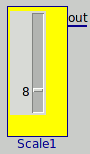
Didn't know which page, of the several dozen bwise pages, to put this on. A slider input for bwise.
 proc newscale { {width  {60}} {height  {130}} {tags  {}} {name  {}} {x  {0}} {y  {0}} {in  {}} {out  {out}}  } {
   if {$name == {}} {
       uplevel #0 {if {[info exists entrycount] == "0"} {set entrycount 0} ;}
      global entrycount
      incr entrycount
      set name Scale$entrycount
   }
   set t [blockfunc $name]
   global mc $t;
   newblock $name $x $y $width $height $in $out $tags
   blockclear $name
   set lc [string tolower $name]
   set cmd " uplevel #0 run $name"
   scale $mc.$lc -from 0 -to 10 -length 100 -sliderlength 5 -width 10 -tickinterval 0 -variable $name.out -command $cmd
   $mc create window [expr $x+3] [expr $y+5]  -window $mc.$lc   -tags "{$name}" -anchor nw
   if {$in == "in"} {
      set $name.bfunc "set $name.out \${$name.in}"
   }
   return $name
 }
TV Looks nice.
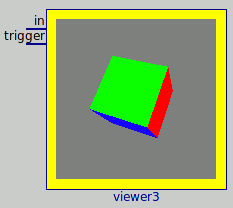
I'm working on a bwise 3D graphics viewer block :
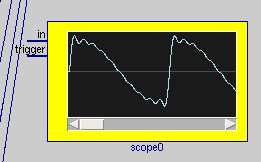
Using these lines:
  time {set r [domaxima float(makelist(subst(y/44100,x,subst((1/2),v,${mult11.out})),y,0,170))]}
  eval ${scope0.bfunc_init} ;foreach i [split [string range $r 1 end-1] ,] { set scope0.in [expr 300*$i] ; eval ${scope0.bfunc} }
(see Creating wave formulas with BWise for the context and procs required) this is a mathematically correct waveform, without use of expr or libc or even doubles until the very last rounding step in the computations, so suitable for numerically 'dificult' waves:
This one's nice to remember:
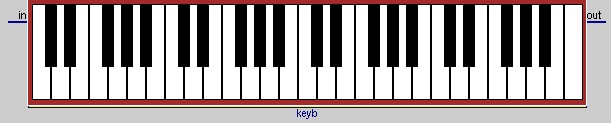
from A musical keyboard for BWise and Midi connections.