How Discover TCL/TK? & Survey Form
This page is under development. Comments are welcome, but please load any comments in the comments section at the bottom of the page. Please include your wiki MONIKER and date in your comment with the same courtesy that I will give you. Aside from your courtesy, your wiki MONIKER and date as a signature and minimal good faith of any internet post are the rules of this TCL-WIKI. Its very hard to reply reasonably without some background of the correspondent on his WIKI bio page. Thanks, gold 6/11/2026
- Tcl/Tk in VLSI, EDA, and Other fields in 2026
- Background or Draft Template.
- Table 1. Revised Common Factors of TCL/TK Success
- Table 2. Selected Tabulation of Human Stories
- Wiki Table: Expect Timeline with Key Milestones
- Wiki Table: SQLite Timeline with Key Milestones
- Key Eureka Moments in SQLite Development
- Wiki Table: Fossil Timeline with Key Milestones
- Screenshot
- Draft Bar Charts for Page
- Draft Figures
- figure. MAIN DISCOVERY CHANNELS (top ways people found Tcl/Tk)
- figure. COMMON THEMES / "KILLER FEATURES" MENTIONED
- figure. REVISED COMMON FACTORS OF TCL/TK SUCCESS (8 factors)
- figure. LLM MINI-BIO ROSTER: SEVEN MODELS, SEVEN VOICES
- figure. CLAUDE'S STRUCTURAL PARALLEL: TCL SUBSTITUTION vs LLM PROMPTING
- figure. TCL/TK GO-TO USE CASES ( 6-category table)
- figure. FOUR TCL ECOSYSTEM TIMELINES: SIDE-BY-SIDE COMPARISON
- figure. SQLITE EUREKA MOMENTS: FOUR KEY INSIGHTS (Dr. Hipp)
- figure. SURVEY TEMPLATE STRUCTURE (Background or Draft Template)
- figure. YEARS TO EMERGENCE OF IDEAS: TWO COMPETING ALGORITHMS
- figure. LLM IDEA GENERATION vs PACKAGING TIME
- figure. TIME COMPRESSION: HUMAN vs LLM
- figure. OVERALL PAGE STRUCTURE: HOW DISCOVER TCL/TK? & LLM OVERFLOW
- Program Change Log
- Hidden Comments Section
Title: How Discover TCL/TK? & Survey Form
Preface
gold Update 6/11/2026. Survey Form and Overflow Area , Intended to supplement the TCL Wiki page How did you discover TCL/TK ... ? .... Collecting updated human interest stories and roleplayer stories. Note the Question Mark. I do not have all the answers.
Introduction
gold 6/25/2026. I am Collecting shorts and personal stories about how users first discovered Tcl/Tk, Expect, SQLite, and Fossil. Creative ideas and timelines from engineers and developers across different eras. What was their "Aha" or Eureka moment or their discoveries and experiences of Tcl/Tk tools? As part of studies on machine generation of ideas, combined insights, or Eureka moments, I have added separate and marked sections on some roleplayers from LLM Models as possible historical interest.
Tcl/Tk in VLSI, EDA, and Other fields in 2026
gold 6/10/2026. Received Query on New to Publications,
Many people think Tcl/Tk is an old scripting language from the 90s. In the semiconductor world, it’s actually one of the most actively used tools today.
Major EDA vendors (AMD Xilinx Vivado, Synopsys, Cadence Innovus/Genus, Siemens Calibre, Intel Quartus, and others) rely heavily on Tcl for:
Design automation flows Timing constraints (SDC) Physical design scripting Custom tool development Building internal Tk GUIs
Tcl remains the glue that holds complex chip design toolchains together. I’m collecting real-world stories from engineers who use (or have used) Tcl/Tk in the VLSI/EDA or other fields. Whether you learned it as a student, got thrown into it on your first job, or are still using it daily in 2026. This is preparatory for renewing or additional later content for How did you discover Tcl/Tk [L1 ]
Your experience would be valuable. If you have a short story about how you discovered Tcl/Tk or how you’re using it today, feel free to share it here or else on "Discover" wiki page itself. Looking forward to hearing from fellow engineers! Thank you for consideration.
Several practicing engineers kindly shared their personal stories of discovering Tcl/Tk and Expect. There is Provision for anonymity , suggest that one selects a moniker or penname with a date. To respect privacy preferences in today’s web/pub environment and unless requested otherwise, responses will appear normally under anonymous attribution with monikers. Suggest recommended format: [ Role_Year, and use underscores for example: EmbeddedEngineer_2026 or HardwareVet_1998 ]
Background or Draft Template.
'''Survey on How did you discover Tcl/Tk?'''

- Date, How did you discover Tcl/Tk on \[ date ...] ?
- Did you first encounter Tcl/Tk during high school days?
- Did you first encounter Tcl/Tk during university days or post-graduate?
- Was TCL trained or acquired in your first job? (many of us started this way!)
- Have you received or taught a course on  Tcl/Tk.
- Did you later come to appreciate its power for rapid automation?
- Are you still using it daily in 2025–2026 for PD, STA,
  DFT, Calibre, Innovus, ICC2, Expect,EDA, or custom tool development?
- Today I use it for \[current use – e.g. floorplanning automation, inventory, field work,
  Calibre flows, EDA,  custom Tk GUIs, etc.....].
- Do you TCL to link other computers or AI languages,
  Python, Perl, Java, Quickbasic, Basic, Javascript, Qisket   Expect language, Haskell, etc.
- What version number of Tcl/Tk and Expect language family do you use? \[ Tcl/Tk Version 8.6? or V9? ...]
- One thing I wish I had known earlier is \[...]
- I first encountered Tcl when \[situation, work circumstance and year ....].
- What surprised me about Tcl/Tk most was \[aspect and year...].
- I use Tcl/Tk on the Unix, Windows, or other operating system os.  \[os and year...].
- I started to build a Tcl/Tk Gui when \[ date and topic ...]
- I use installed code, custom  tools, custom binaries or custom  Tcl/Tk libraries for  Tcl/Tk like \[ TCLLIB ... ]
- Your degree of education as high school, bachelor,
- graduate level would be useful in survey
- Provision for anonymity , use a moniker or penname with a date.
- Suggest recommended format for moniker: \[ Role_Year, and use underscores for example: EmbeddedEngineer_2026 or HardwareVet_1998 .... ]
#
Your story matters for progress of  Tcl/Tk and Expect language family. And Thank you.
----
Thank you for consideration, 6/11/2026
----
Real-world experiences from the chip design world etc help show new engineers and students why Tcl/Tk is still extremely relevant and valuable in 2026.
- Recent VLSI/Tcl mentions (2023–2026)
- Many engineers are actively building custom Tcl/Tk GUIs for Calibre, ICC2, and other tools.
- Tcl scripting remains a core skill required in job postings
- and training programs for physical design and verification.
Revised Common Factors
gold Reported from the selected bios here. 3/6/2025
1. Ease of GUI (Tk): Free Tk made GUIs accessible, unlike pricey proprietary toolkits.
2. Portability: Free distribution across UNIX platforms amplified its reach.
3. Scripting Simplicity: No-cost scripting rivaled expensive compiled languages.
4. Practicality: Free tools solved real problems without budget barriers.
5. Resources: Free demos and wikis thrived because the core was free.
6. Contrast: Stood out against costly giants like Fortran etc. Free for work and home use.
7. Serendipity: Free on UNIX tape distributions and CDs seeded accidental discoveries.
8. Cost: Zero price tag broke down financial hurdles, unmentioned but foundational.
Table 1. Revised Common Factors of TCL/TK Success
| Index No. | Factor | Description | Notes |
|---|---|---|---|
| 1 | Ease of GUI (Tk) | Free Tk made GUIs accessible, unlike pricey proprietary toolkits. | Tk's simplicity and zero cost democratized GUI development compared to Motif, OpenLook, or commercial options. Many stories highlight Tk demos/canvas as the "wow" moment. |
| 2 | Portability | Free distribution across UNIX platforms amplified its reach. | Early spread via tapes, CDs, FTP, and inclusion in Linux/Unix distros; cross-platform nature (including later Windows) was frequently praised. |
| 3 | Scripting Simplicity | No-cost scripting rivaled expensive compiled languages. | Tcl offered shell-like ease with power closer to Perl/Python but without compilation overhead; many switched from C/C++ or Fortran. |
| 4 | Practicality | Free tools solved real problems without budget barriers. | Used for real-world tasks (automation, bots, tools, simulations) where budget or licensing blocked alternatives. |
| 5 | Resources | Free demos and wikis thrived because the core was free. | Open ecosystem led to books (Ousterhout, Welch, Libes), wikis, contrib archives, and community examples that lowered entry barriers. |
| 6 | Contrast | Stood out against costly giants like Fortran etc. Free for work and home use. | Compared favorably to expensive/closed tools (e.g., commercial Fortran environments, proprietary GUI libs); appealed to students, hobbyists, and companies alike. |
| 7 | Serendipity | Free on UNIX tape distributions and CDs seeded accidental discoveries. | Many discoveries via random finds: recycle bin papers, magazine CDs (c't), Linux Journal articles, coworker shares, or bundled software (Expect, Snack). |
| 8 | Cost | Zero price tag broke down financial hurdles, unmentioned but foundational. | Often the silent enabler — no licensing fees meant experimentation, home use, and adoption in constrained environments (universities, startups, personal projects). |
Note. How did you discover TCL/TK need here human stories and real-world wins????
Table 2. Selected Tabulation of Human Stories
| Index No. | Author | Approx. Year | Discovery Method | Brief Summary | Notes |
|---|---|---|---|---|---|
| 1 | ShellUser_2000 | 2000 | Reminded of Tcl/Tk while thinking about platform-independent tools; bought books | Explored Tcl as shell + GUI, impressed by emacs-tcl-mode, spread it to colleagues. | "The killing feature was/is the emacs-tcl-mode... I infected at least 3 colleagues with the Tcl/Tk virus ;)" |
| 2 | IRCBuilder_2000 | 1998–2000 | Wanted Eggdrop bot scripts, found Ousterhout book, then active Tcl/Tk IRC client | Struggled initially but succeeded via practical maintained project. | "I didn't successfully create anything until around 2000... when I found an IRC client written in Tcl/Tk and still actively maintained." |
| 3 | PaperFinder_1991 | 1991 | Picked JO's Tcl/Tk Usenix paper from office recycle bin | Stumbled on discarded paper during project decision, led to adoption. | Classic serendipity: recycle bin find of foundational paper. |
| 4 | NetScriptUser_1999 | 1999 | Expect usage at UUNET for network scripting; found undocumented features, bought Libes book | Used Expect heavily, discovered power in short scripts, later found wiki. | "Expect was in heavy usage... I found an old script that had a while statement in it - not documented" |
| 5 | GUIChooser_1995 | Early 90s (theory), later practical | Freeware CDs from c't magazine; chose Tcl/Tk over Perl/Tk & Python/Tkinter for GUI docs | Knew theoretically early, picked for better Tk documentation in real GUI work. | "Theoretically, I knew of it since the early 90s, and from some freeware CDs of the c't" |
| 6 | AppExplorer_2006 | Mid-2000s | Excellent standalone programs (Will Duquette's wiki editor, Brian Theado's TKOutline) | Curiosity via apps → learned about Tcl, but didn't become active programmer. | "discovering this great programming language did not make a programmer out of me." |
| 7 | ScriptSwitcher_1995 | Mid-90s+ | Using Perl/Tk utilities, decided to explore pure Tcl | Transitioned from Perl/Tk to core Tcl scripting. | Simple shift from extension to language core. |
| 8 | ToolkitSwitcher_1994 | 1994 | Perl → Perl/Tk, then job ad requiring Tcl/Tk | Found Tk refreshing vs other toolkits; took Tcl job, left Perl behind. | "Tk was a breath of fresh air." |
| 9 | ArchiveBuilder_1990 | 1988–1992 | UC Berkeley studies; searched new languages, built early Tcl/Tk FTP archive & dynamic loading extension | Stood out among Smalltalk/Perl; contributed to early ecosystem. | Created first contrib archive and dynamic loading extension. |
| 10 | BookReader_1995 | 1995 | Chanced upon JO's book | Saw the light, escaped Motif/X-Window struggles. | "no more battling with Motif and X-Window toolkits." |
| 11 | AudioToolUser_1995 | Mid-90s+ | Searching for voice pitch extractor → found Snack & WaveSurfer | Discovered via audio tools; loved "everything is a string". | Audio domain entry point. |
| 12 | LateLearner_2003 | 2001 (decision), 2003 (commitment) | Frustration → decided to learn programming; sysadmin comments in PHP chat praised Tcl | Overcame syntax dislike via Tk & RS; ditched others for Tcl. | "In 2003 I decided to marry Tcl and leave all else behind." |
| 13 | UILearner_2000 | Not specified | Wanted to learn programming + UI; chose Tcl for easy UI reputation | Attracted by Tk as standard easy toolkit. | UI-first motivation. |
| 14 | NetClientObserver_1995 | 1994–1995 | Saw student use Tcl for fast network client vs own C++; later found JO's book | Impressed by productivity; adopted after reminder. | Speed comparison sparked interest. |
| 15 | KernelExplorer_2001 | 2000–2001 | Looking for GUI toolkit; explored via Linux 'make xconfig' wonder | Investigated Tcl after kernel config curiosity. | Kernel UI as indirect trigger. |
| 16 | Anonymous_01 | 90s | Only better scripting than awk/shell on SCO Unix server | Used as superior option in constrained environment. | Legacy system necessity. |
| 17 | WorkplaceLearner_2001 | 2001 | Employer required learning | Learned at work, continued personally at home. | Job-forced → personal adoption. |
| 18 | UnicodeExplorer_1996 | 1996 | Co-worker gave quick-ref sheet; then Tcl 8.1 alpha | Loved Tk after Xlib hassles; Unicode in 8.1 for foreign languages. | "Tk was amazing - shortly before I had coded some Japanese text displayer in Xlib" |
| 19 | GUISeeker_1993 | 1993–1994 | FTP search for easy GUI; coworker mentioned Tcl → found Tk | Blown away by no pixels, simple pack, easy C interface. | "the pack command could usually just do the right thing totally blew me away." |
| 20 | Anonymous_02 | 1993 | Moved to Linux; Linux Journal article on Tcl/Tk for level-editor | Liked for tools; saw GUI ease vs Qt etc. | Magazine article entry. |
| 21 | StudentExperimenter_2001 | 2001 | Studying exams; experimented Tcl/Tk for text editor in breaks | Small unfinished project during study stress. | Hobby during academic pressure. |
| 22 | EmbeddedDev_1995 | 1995–2000 | Colleague embedded Tcl in app at uni; later jobs + Tk discovery | Impressed by embedding, convinced by Tk vs Motif. | Embedded scripting first. |
| 23 | LinuxSwitcher_1998 | 1998 | Moved to Linux; chose Tcl/Tk among Python/Perl for X/shell programming | Happy choice after comparison. | OS switch decision point. |
| 24 | BookAndWork_1997 | 1997 | Learned on job at K____ ; found Welch book in bookstore | Became Tcl nut after practical + book. | Work + bookstore combo. |
| 25 | MagazineReader_1992 | 1992–1993 | Heard in German c't magazine; used on Linux for small GUIs | No better GUI way on slow hardware. | Early magazine mention. |
Note. Real names or member monikers are replaced with normalized Role_Year monikers where possible. And Anonymous_XX where a role cannot be inferred.
gold 6/25/2026. These are selected clips available from Tcl Wiki pages and cutoff date appears to be circa 2006. Other Tcl/Tk and programmer groups may show different profiles.
Wiki Table: Tcl/Tk Timeline – Key Milestones
gold 6/8/2026 reposted and updated below, I found an Interesting context with ... my Tcl efforts and seemed to fit here.
| Index | Year | Event / Version | Description | Quibble Notes |
|---|---|---|---|---|
| 1 | 1988 | Tcl created | John Ousterhout starts development at UC Berkeley | Born as a simple embedding / glue language |
| 2 | 1989 | First external releases | Tcl distributed outside Berkeley | Early interest from other researchers |
| 3 | 1991 | Tk first released | Tk toolkit introduced | Immediate success; made Tcl famous for GUIs |
| 4 | 1994 | Ousterhout joins Sun Microsystems | Tcl/Tk gains corporate backing | Major boost in visibility and development |
| 5 | 1997 | Tcl/Tk 8.0 | Major release – bytecode compiler, Windows/Mac support | First unified Tcl/Tk versioning |
| 6 | 1999 | Tcl/Tk 8.1 | Full Unicode support | Huge step for internationalization |
| 7 | 2000 | Tcl Core Team formed | Development becomes community-driven | Shift from single maintainer model |
| 8 | 2002 | Tcl/Tk 8.4 | 64-bit support, many performance improvements | Very stable long-term release |
| 9 | 2007 | Tcl/Tk 8.5 | TclOO foundation, lambdas, new datatypes | Major modernization |
| 10 | 2012 | Tcl/Tk 8.6 | TclOO becomes core, stackless evaluation | Longest supported major version |
| 11 | 2013–2023 | 8.6 series continues | Many patch releases, strong production use | Remarkable stability (over 10 years) |
| 12 | 2024 | Tcl/Tk 9.0 released | 64-bit internals, full Unicode, ZIPFS, breaking changes | First major release in 27 years |
| 13 | 2025 | Tcl/Tk 9.0.3 | Current stable version | Active development continues |
| — | Ongoing | Tcl/Tk Ecosystem | Extensions, Starkits, ActiveState, community | Still widely used in embedded, testing, GUIs |
Wiki Table: Expect Timeline with Key Milestones
Expect, Companion Tool to Tcl/Tk
Expect extends Tcl with commands that automate interactive programs. Many engineers first meet Tcl through Expect when they need to script telnet, SSH, serial ports, or device testing.
| Index | Year | Event / Version | Description | Quibble Notes |
|---|---|---|---|---|
| 1 | 1990 | Expect created | Don Libes develops Expect at NIST | Built as a Tcl extension for automating interactive programs |
| 2 | 1991 | First public releases & paper | Expect presented at USENIX; early adoption begins | Quickly becomes popular for sysadmin automation |
| 3 | 1994–1995 | Exploring Expect book published | Don Libes releases the definitive guide | Major boost in visibility and practical usage |
| 4 | 1990s | Widespread adoption | Used heavily for telnet, ssh, router config, and hardware testing | Classic tool for handling "expect" output from interactive sessions |
| 5 | 2000s | Continued maintenance | Ports to newer Tcl versions and better Windows support | Remains a reliable choice for network and embedded automation |
| 6 | 2018 | Expect 5.45.4 | Last major official release | Extremely stable long-term version |
| 7 | 2024–2026 | Community ports for Tcl 9 | Updated versions maintained for modern Tcl | Active community support keeps Expect usable |
| — | Ongoing | Expect Ecosystem | Still used in regression testing, CI pipelines, device automation | Shows the lasting value of simple, dependable tools |
Wiki Table: SQLite Timeline with Key Milestones
SQLite: A Tcl Success Story
SQLite is a lightweight, serverless, embedded SQL database engine. Dr. D. Richard Hipp created it in 2000 with strong ties to Tcl/Tk. SQLite is now the most widely used database engine in the world.
| Index | Year | Event / Version | Description | Quibble Notes |
|---|---|---|---|---|
| 1 | 1992 | Hwaci founded | Dr. Hipp starts his consulting company | Foundation for future open-source work |
| 2 | May 29, 2000 | SQLite project begins | First code check-in during U.S. Navy contract | Sparked by need for a serverless database |
| 3 | Aug 2000 | SQLite 1.0 released | First public release | Released to public domain |
| 4 | Sep 2001 | SQLite 2.0 released | Major rewrite with custom B-tree | Big improvement in reliability |
| 5 | June 2004 | SQLite 3.0 released | Complete rewrite – still the current foundation | AOL funded development |
| 6 | 2005–2010 | Rapid adoption | Adopted by Apple, Google, Mozilla, Adobe | Starts appearing in phones and browsers |
| 7 | 2007 | Fossil DVCS released | Hipp’s own version control system | Used for SQLite and Tcl/Tk development |
| 8 | 2010s | Ubiquitous deployment | Becomes default in Android, iOS, Chrome, Firefox | Runs in billions of devices |
| 9 | 2020–2025 | Continued stability | Regular releases with strong backwards compatibility | Celebrated 25 years in 2025 |
| 10 | 2026 | SQLite 3.53.x current | Latest stable series | Still public domain and zero-downtime upgrades |
| — | Ongoing | Tcl Integration | Large test suite and bindings written in Tcl | More than half the test code remains in Tcl |
Key Eureka Moments in SQLite Development
Dr. D. Richard Hipp has shared several important realizations that shaped SQLite’s unique architecture.
| Index | Year | Moment | Description | Impact / Quibble Notes |
|---|---|---|---|---|
| 1 | ~2000 | Navy Destroyer Insight | Realized a server-based database was unacceptable in mission-critical environments | “Why do we need a server at all?” → Birth of embedded SQLite |
| 2 | 2000 | Bytecode Virtual Machine | Decided to compile each SQL statement into bytecode | Created from first principles; became core to SQLite’s speed and reliability |
| 3 | Early 2000s | Temporary Index Correction | Realized mid-presentation that a “clever” index design was fundamentally flawed | Immediate pivot reinforced Hipp’s “correctness over ego” philosophy |
| 4 | Ongoing | Power of Initial Ignorance | Hipp noted that not fully understanding the difficulty helped him start the project | “Dumb luck” combined with first-principles thinking led to exceptional design |
| — | Audit / Overall | Pattern of Practical Insight | Real engineering problems consistently drove elegant solutions | Navy contract frustration remains the strongest single spark leading to discovery. |
Wiki Table: Fossil Timeline with Key Milestones
Fossil: Distributed Version Control by the Creator of SQLite. Fossil is a simple, high-reliability distributed version control system. Dr. D. Richard Hipp created it to manage SQLite development. It stores everything in a single SQLite database and includes built-in wiki, ticketing, forum, and web interface.
| Index | Year | Event / Version | Description | Quibble Notes |
|---|---|---|---|---|
| 1 | 2006 | Fossil project begins | Dr. Hipp starts development | Designed specifically for SQLite |
| 2 | 2007 | First public release | Initial release as a complete SCM tool | Replaces CVS for SQLite development |
| 3 | 2008–2010 | Early adoption | Tcl/Tk project moves to Fossil | Grows within the Tcl community |
| 4 | 2010s | Feature expansion | Adds forum, enhanced wiki, and better UI | Becomes a full project management system |
| 5 | 2015–2016 | Major stability improvements | Enhanced autosync and UI updates | Strong focus on immutability and auditability |
| 6 | 2020 | Version 2.0 series | Significant updates to web interface | Continues strong backwards compatibility |
| 7 | 2024 | 15+ years of service | SQLite switches fully to Fossil (cut-over) | Long-term reliability proven |
| 8 | March 2026 | Fossil 2.28 released | Latest stable version | Active maintenance continues |
| — | Ongoing | Tcl Ecosystem Integration | Used for Tcl/Tk, SQLite, and many other projects | Single executable with no external dependencies |
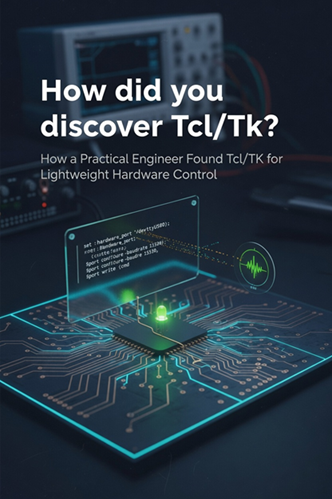
Screenshot
Draft AI image for book cover, from Replit-Gemini ( inc Google ), workflow
Draft Bar Charts for Page
----
1. Discovery Year Distribution (Timeline of Interest), cutoff was circa 2006

Discovery Years (approx. from selected stories)
2006 | ■■■
2005 |
2004 | ■
2003 |
2002 |
2001 | ■■■■■
2000 | ■■■■
1999 | ■■
1998 | ■■■■
1997 | ■■■
1996 | ■■
1995 | ■■■
1994 | ■
1993 | ■■
1992 | ■
1991 | ■
     +--------------------------------
       1990s peak during Tcl/Tk adoption boom

Insight: Heavy concentration in late 1990s–early 2000s.
----
2. Main Discovery Channels (Top Ways People Found Tcl/Tk)
Discovery Method                  Count   %
Project/GUI Need                  ██████████  8   ~28%
Coworker / Colleague / Mentor     ████████    6   ~21%
Books / Documentation             ██████      5   ~18%
Existing Tool (Expect, Perl/Tk)   █████       4   ~14%
Magazine / CD / Paper             ████        3   ~11%
University / Academic             ██          2    ~7%
Other / Serendipity               ███         3   ~11%
----
3. Common Themes / "Killer Features" Mentioned

Theme                              Frequency
────────────────────────────────────────────────
Easy GUI / Tk simplicity           ██████████████
Rapid development / short code     ██████████
Cross-platform                     ███████
"Everything is a string" / EIAS    █████
Better than Motif/Xlib/C++ GUI     ██████
Expect integration                 ████
Community / Wiki (esp. RS)         ███
----
Draft Figures
figure. MAIN DISCOVERY CHANNELS (top ways people found Tcl/Tk)
+----------------------------------------------------------------------------------+
| MAIN DISCOVERY CHANNELS  (top ways people found Tcl/Tk)                        |
|                                                                                  |
|    Discovery Method                  Count   %                                  |
|    ------------------------------------------------                             |
|    Project/GUI Need                  ##########  8   ~28%                       |
|    Coworker/Colleague/Mentor         ########    6   ~21%                       |
|    Books/Documentation               ######      5   ~18%                       |
|    Existing Tool (Expect, Perl/Tk)   #####        4   ~14%                       |
|    Magazine/CD/Paper                 ####         3   ~11%                       |
|    University/Academic               ##           2    ~7%                       |
|    Other/Serendipity                 ###          3   ~11%                       |
|                                                                                  |
|    Top pattern: needing a GUI solution was the single biggest entry point       |
|    Second pattern: human word-of-mouth (coworker recommendation) close behind  |
+----------------------------------------------------------------------------------+
figure. COMMON THEMES / "KILLER FEATURES" MENTIONED
+----------------------------------------------------------------------------------+
| COMMON THEMES / "KILLER FEATURES" MENTIONED  (frequency across stories)        |
|                                                                                  |
|    Theme                              Frequency                                  |
|    ------------------------------------------------                             |
|    Easy GUI / Tk simplicity           ##############                            |
|    Rapid development / short code     ##########                                |
|    Cross-platform                     #######                                   |
|    "Everything is a string" / EIAS    #####                                     |
|    Better than Motif/Xlib/C++ GUI     ######                                    |
|    Expect integration                 ####                                      |
|    Community / Wiki                   ###                                       |
|                                                                                  |
|    Tk's ease-of-GUI is the dominant recurring "aha" moment across decades       |
|    Common contrast: escaping Motif, X-Window, or raw Xlib pain                  |
+----------------------------------------------------------------------------------+
figure. REVISED COMMON FACTORS OF TCL/TK SUCCESS (8 factors)
+----------------------------------------------------------------------------------+
| REVISED COMMON FACTORS OF TCL/TK SUCCESS  ( 3/6/2025)                           |
|                                                                                  |
| +----+-----------------------+------------------------------------------------+ |
| | #  | factor                | description                                    | |
| +----+-----------------------+------------------------------------------------+ |
| | 1  | Ease of GUI (Tk)      | Free Tk made GUIs accessible vs pricey toolkits| |
| | 2  | Portability           | Free distribution across UNIX amplified reach  | |
| | 3  | Scripting Simplicity  | No-cost scripting rivaled expensive compiled   | |
| | 4  | Practicality          | Free tools solved real problems, no budget cap | |
| | 5  | Resources             | Free demos and wikis thrived (core was free)   | |
| | 6  | Contrast              | Stood out vs costly giants like Fortran etc.   | |
| | 7  | Serendipity           | Free UNIX tapes/CDs seeded accidental finds    | |
| | 8  | Cost                  | Zero price tag broke financial hurdles (silent)| |
| +----+-----------------------+------------------------------------------------+ |
|                                                                                  |
|    Underlying thread: "free" appears in 7 of 8 factors -- cost removal was      |
|    the foundational, often UNSTATED enabler behind every other success driver  |
+----------------------------------------------------------------------------------+
figure. LLM MINI-BIO ROSTER: SEVEN MODELS, SEVEN VOICES
+----------------------------------------------------------------------------------+
| LLM MINI-BIO ROSTER: SEVEN MODELS, SEVEN VOICES from Roleplayer Mode Prompting   |
|    "Historical, Mini Bios for LLM Brothers" section                            |
|                                                                                  |
| +---------------+------------------+--------------------------------------+     |
| | model         | maker            | self-described discovery angle       |     |
| +---------------+------------------+--------------------------------------+     |
| | Grok          | xAI              | roleplay: discovered via Expect,     |     |
| |               |                  | curiosity about "why still alive"    |     |
| | Perplexity    | Perplexity AI    | roleplay: "encountered, not          |     |
| |               |                  | discovered" -- distrust then turn    |     |
| | Claude        | Anthropic        | bulk ingestion of comp.lang.tcl,     |     |
| |               |                  | Wiki, Expect transcripts             |     |
| | Copilot       | Microsoft        | statistical realization across 4     |     |
| |               |                  | training data clusters (EDA, Expect,|     |
| |               |                  | sci-GUI, Wiki archives)              |     |
| | Qwen3.7-Plus  | Alibaba/Tongyi   | wishes for earlier embedded-interp.  |     |
| |               |                  | knowledge; moniker "Quiet Scripter"  |     |
| | Gemini        | Google           | timeline self-report (Bard-->Gemini) |     |
| |               |                  | no direct Tcl discovery narrative    |     |
| | Kimi/Agentic  | Moonshot AI      | field-tool framing; 3 research       |     |
| |               |                  | topics on Tcl+agentic LLM systems    |     |
| +---------------+------------------+--------------------------------------+     |
|                                                                                  |
|    Common thread across all 7: none claim true "discovery" in human sense;     |
|    all reframe as pattern-recognition over training corpus content              |
+----------------------------------------------------------------------------------+
----
figure. CLAUDE'S STRUCTURAL PARALLEL: TCL SUBSTITUTION vs LLM PROMPTING
----
+----------------------------------------------------------------------------------+
| CLAUDE'S STRUCTURAL PARALLEL: TCL SUBSTITUTION vs LLM PROMPT TEMPLATING        |
|    "Tcl arrived forty years early" -- the core observation                      |
|                                                                                  |
| +----------------------+------------------------------+------------------------+|
| | concept              | Tcl (1988)                    | LLM prompt chaining   ||
| +----------------------+------------------------------+------------------------+|
| | Variable              | "Hello $name" -- value        | "{{document}}" slot   ||
| | interpolation         | substituted at USE time,      | filled at the last    ||
| |                       | not definition time           | possible moment       ||
| +----------------------+------------------------------+------------------------+|
| | Late binding          | No compile step; every       | A chain step can      ||
| |                       | token resolved at runtime;   | invoke a tool whose   ||
| |                       | a proc can call another      | output wasn't known   ||
| |                       | proc not yet written         | when chain was built  ||
| +----------------------+------------------------------+------------------------+|
| | Nested evaluation     | [inner command] embedded      | One model call's      ||
| |                       | inside outer command,        | output feeds directly ||
| |                       | result becomes outer input   | into next call's input||
| +----------------------+------------------------------+------------------------+|
|                                                                                  |
|    Conclusion (Claude, 6/10/2026): "structurally identical" -- Tcl solved       |
|    the prompt-as-command substitution problem 40 years before LLM chains needed  |
+----------------------------------------------------------------------------------+
----
figure. TCL/TK GO-TO USE CASES ( 6-category table)
+----------------------------------------------------------------------------------+
| TCL/TK GO-TO USE CASES  (6 categories)                               |
|                                                                                  |
| +----+---------------------------+----------------------------------------+      |
| | #  | category                  | why Tcl/Tk fits                        |      |
| +----+---------------------------+----------------------------------------+      |
| | 1  | Quick internal tools      | no compile, live tweaks, tiny footprint|      |
| |    |                           | file renamer, log viewer, config editor|      |
| | 2  | Admin dashboards          | native lightweight monitoring panels   |      |
| |    |                           | server stats, EDA custom views          |      |
| | 3  | Cross-platform test       | scripting + spawning + GUI reporting   |      |
| |    | harnesses                 | tcltest+Tk, Expect for CLI/firmware    |      |
| | 4  | Embedding in heavy apps   | tiny interpreter, easy C interop       |      |
| |    |                           | EDA tools embed Tcl for batch flows    |      |
| | 5  | Teaching dynamic langs    | live REPL editing, upvar/uplevel       |      |
| |    |                           | canvas animations, mini-DSLs           |      |
| | 6  | Hypothetical dev setup    | ActiveTcl core, starkit/starpack pack  |      |
| |    |                           | Tcllib/Tklib extras, wish-first flow   |      |
| +----+---------------------------+----------------------------------------+      |
|                                                                                  |
|                                                                                  |
+----------------------------------------------------------------------------------+
----
figure. FOUR TCL ECOSYSTEM TIMELINES: SIDE-BY-SIDE COMPARISON
+----------------------------------------------------------------------------------+
| FOUR TCL ECOSYSTEM TIMELINES: SIDE-BY-SIDE COMPARISON                           |
|                                                                                  |
| +----------+------------------+------------------+------------------+-----------+|
| | era      | Tcl/Tk           | Expect           | SQLite           | Fossil    ||
| +----------+------------------+------------------+------------------+-----------+|
| | origin   | 1988, Ousterhout | 1990, Don Libes  | 2000, R. Hipp    | 2006,Hipp ||
| |          | UC Berkeley      | at NIST          | US Navy contract | for SQLite||
| +----------+------------------+------------------+------------------+-----------+|
| | 1st rel. | 1989 (Tcl)       | 1991 (USENIX)    | Aug 2000 (v1.0)  | 2007      ||
| |          | 1991 (Tk)        |                  | public domain    |           ||
| +----------+------------------+------------------+------------------+-----------+|
| | corp     | 1994, joins Sun  | --               | 2005-2010:       | --        ||
| | backing  | Microsystems     |                  | Apple/Google/    |           ||
| |          |                  |                  | Mozilla/Adobe    |           ||
| +----------+------------------+------------------+------------------+-----------+|
| | major    | 8.0(1997) Unicode| 1994-95 book     | 3.0 (2004)       | 2024:     ||
| | rewrite  | 8.1(1999) 8.6    | 5.45.4(2018)last | complete rewrite | SQLite    ||
| |          | (2012) 9.0(2024) | official release | --current core   | full      ||
| |          |                  |                  |                  | cutover   ||
| +----------+------------------+------------------+------------------+-----------+|
| | 2026     | 9.0.3 current    | community ports  | 3.53.x, billions | 2.28      ||
| | status   | active dev       | for Tcl 9        | of devices       | (Mar2026) ||
| +----------+------------------+------------------+------------------+-----------+|
|                                                                                  |
|    Common thread: each tool began as a focused fix for ONE concrete            |
|    engineering frustration (GUI pain, terminal automation, server downtime,    |
|    version control needs) -- not a grand design exercise                       |
+----------------------------------------------------------------------------------+
figure. SQLITE EUREKA MOMENTS: FOUR KEY INSIGHTS (Dr. Hipp)
+----------------------------------------------------------------------------------+
| SQLITE EUREKA MOMENTS: FOUR KEY INSIGHTS  (Dr. D. Richard Hipp)                |
|                                                                                  |
|    Navy Destroyer Insight (~2000)                                              |
|         |  Informix client-server DB went down --> unacceptable on a ship      |
|         v                                                                       |
|    "Why do we need a server at all?"                                           |
|         |                                                                       |
|         v                                                                       |
|    Bytecode Virtual Machine decision (2000)                                    |
|         |  each SQL statement compiled into bytecode for a VM, from scratch    |
|         v                                                                       |
|    Temporary Index Correction (early 2000s, mid-AOL demo)                       |
|         |  realized live: shared-table index design had a staleness flaw       |
|         |  --> immediate course correction, reinforced correctness-first ethos |
|         v                                                                       |
|    Power of Initial Ignorance (ongoing reflection)                              |
|         |  underestimating the challenge's scale --> enabled starting at all   |
|                                                                                  |
|    Net effect: a single Navy contract frustration --> most widely deployed     |
|    database engine in human history, running in billions of devices            |
+----------------------------------------------------------------------------------+
figure. SURVEY TEMPLATE STRUCTURE (Background or Draft Template)
+----------------------------------------------------------------------------------+
| SURVEY TEMPLATE STRUCTURE  (Background or Draft Template)                     |
|    Posted to crowdsource updated VLSI/EDA discovery stories for 2026           |
|                                                                                  |
|    Survey on How did you discover Tcl/Tk?                                       |
|         |                                                                        |
|    +----+------------------------------------------------+                     |
|    |    Q1: WHEN did you discover it? (date / era)        |                     |
|    |    Q2: WHERE in your career? (HS / univ / first job)  |                     |
|    |    Q3: trained or self-taught? course received?       |                     |
|    |    Q4: appreciated power for rapid automation later?  |                     |
|    +----+------------------------------------------------+                     |
|         |                                                                        |
|    +----+------------------------------------------------+                     |
|    |    Q5: still using daily in 2025-2026? (PD/STA/DFT/  |                     |
|    |        Calibre/Innovus/ICC2/Expect/EDA/custom tools) |                     |
|    |    Q6: current use case today?                       |                     |
|    |    Q7: linked to other langs? (Python/Perl/Java/etc) |                     |
|    |    Q8: Tcl/Tk and Expect version used?                |                     |
|    +----+------------------------------------------------+                     |
|         |                                                                        |
|    +----+------------------------------------------------+                     |
|    |    Q9: one thing wished known earlier?                |                     |
|    |    Q10: what surprised you most?                      |                     |
|    |    Q11: OS used (Unix/Windows/other)?                 |                     |
|    |    Q12: custom GUI / library experience?              |                     |
|    +----+------------------------------------------------+                     |
|         |                                                                        |
|    v    Anonymity provision: Moniker_Year format (e.g. EmbeddedEngineer_2026) |
+----------------------------------------------------------------------------------+
figure. YEARS TO EMERGENCE OF IDEAS: TWO COMPETING ALGORITHMS
+----------------------------------------------------------------------------------+
| YEARS TO EMERGENCE OF IDEAS: TWO COMPETING BACK-OF-ENVELOPE ALGORITHMS         |
|    Estimating time to one "insightful idea" at the Tcl/Tk + LLM intersection   |
|                                                                                  |
|    ALGORITHM 1: Doubling-Time Model (Hamming-style)                            |
|      Knowledge doubles every 12-17 years (~Moore's Law analog for ideas)       |
|      Insightful idea needs ~10x conceptual accumulation                        |
|      doublings_needed = log(10)/log(2) = 3.3219... ~= 3.3 doublings           |
|      T_time = 3.3 doublings * 17 years/doubling ~= 56 years                   |
|      Result: ~55-60 years (upper boundary estimate)                            |
|                                                                                  |
|    ALGORITHM 2: Domain-Intersection Model (set-theory framing)                 |
|      T_time ~ D_domain_gap / (E_exposure * C_abstraction_skill)               |
|      D, E, C each scored 1 to 10                                                |
|      +-------------------+----------------------+                              |
|      | bound             | T_time estimate       |                              |
|      +-------------------+----------------------+                              |
|      | upper bound       | ~53.3 years            |                              |
|      | middle range       | ~13 years              |                              |
|      | lower bound        | ~0.1 years             |                              |
|      +-------------------+----------------------+                              |
|                                                                                  |
|    Note: both algorithms converge near the SAME upper bound (~53-60 years)     |
|    despite using entirely different mathematical frameworks                    |
+----------------------------------------------------------------------------------+
----
figure. LLM IDEA GENERATION vs PACKAGING TIME
+----------------------------------------------------------------------------------+
| LLM IDEA GENERATION vs PACKAGING TIME                                          |
|    (Tcl-LLM Parallel Insight Example)                                          |
|                                                                                  |
|    +---------------------+-------------------+-------------------------------+ |
|    | Phase               | Time              | Equivalent Human Time         | |
|    +---------------------+-------------------+-------------------------------+ |
|    | Raw Idea Generation | 10 - 40 seconds   | ~26,298 minutes (0.05 years)  | |
|    |                     |                   | (~18 days)                    | |
|    | Packaging &         | 1 - 4 minutes     | ~105,192 minutes (0.2 years)  | |
|    | Formatting          |                   | (~2.4 months)                 | |
|    | Full Polished Answer| 2 - 6 minutes     | Combined human effort         | |
|    +---------------------+-------------------+-------------------------------+ |
|                                                                                  |
|    Key Insight:                                                                |
|    Modern LLMs generate the core idea almost instantly.                        |
|    Most visible time comes from structuring, explaining,                       |
|    and formatting the answer for human readability.                            |
|                                                                                  |
|    Claude (Anthropic) raw insight:   < 30 seconds estimated                     |
|    Grok @Xai full response with diagrams: 2 - 5 minutes   estimated             |
+----------------------------------------------------------------------------------+
figure. TIME COMPRESSION: HUMAN vs LLM
+----------------------------------------------------------------------------------+
| TIME COMPRESSION: HUMAN vs LLM                                                 |
|                                                                                  |
|    Human (expert programmer)   :  0.05 – 0.2 years  (26k – 105k minutes)      |
|    Claude / Grok Raw Insight   :  10 – 40 seconds                             |
|    Full Packaged Answer        :  2 – 6 minutes                                |
|                                                                                  |
|    Compression Factor: ~10,000× to 100,000× faster                             |
+----------------------------------------------------------------------------------+
figure. OVERALL PAGE STRUCTURE: HOW DISCOVER TCL/TK? & LLM OVERFLOW
+----------------------------------------------------------------------------------+
| OVERALL PAGE STRUCTURE: HOW DISCOVER TCL/TK? & LLM OVERFLOW AREA V2           |
|    gold, 6/11/2026 - 6/25/2026                                                  |
|                                                                                  |
|    Preface + Introduction                                                       |
|      Overflow/supplement to "How did you discover TCL/TK"                      |
|         |                                                                        |
|         v                                                                        |
|    Tcl/Tk in VLSI, EDA, and Other fields in 2026                               |
|      EDA vendor list (Xilinx, Synopsys, Cadence, Siemens, Intel)                |
|      Survey template + anonymity moniker convention                             |
|         |                                                                        |
|         v                                                                        |
|    Historical Section: SQLite "AHA" Moments (Dr. Hipp)                         |
|         |                                                                        |
|         v                                                                        |
|    Historical Mini Bios for LLM Brothers (7 models, roleplay mode)             |
|      Grok, Perplexity, Claude, Copilot, Qwen3.7-Plus, Google/Gemini, Kimi      |
|         |                                                                        |
|         v                                                                        |
|    Years to Emergence of Ideas (2 back-of-envelope algorithms)                |
|         |                                                                        |
|         v                                                                        |
|    Conclusions on/from LLM Role Players + Tcl/Tk Go-To Use Cases (Grok table) |
|         |                                                                        |
|         v                                                                        |
|    Revised Common Factors (Table 1) + Human Stories Tabulation (Table 2)      |
|         |                                                                        |
|         v                                                                        |
|    4 Wiki Timeline Tables: Tcl/Tk, Expect, SQLite, Fossil                       |
|      + Key Eureka Moments in SQLite Development                                |
|         |                                                                        |
|         v                                                                        |
|    Screenshot (AI-generated  cover draft) + 3 ASCII Bar Charts            |
|         |                                                                        |
|         v                                                                        |
|    Program Change Log + Hidden Comments Section                                |
+----------------------------------------------------------------------------------+
----
Program Change Log
gold Update 6/11/2026. I am a retired engineer who is studying LLM AI models and TCL/TK. Partly, I am seeing if several or multiple algorithms draw similar conclusions based on the logical structure and Axioms of complex problems. Partly, I am examining the turbulent AI job/stock market.
By the way, this report should not be considered a blanket endorsement of every Axiom ginned from individual AI models. Reserve right to disagree with AI models.
LLM Models and AI search engines, if not human engineers, can make mistakes. Confirm important info from multiple sources.
(User) Thank you for narrow focus questions to Workspace. But I am a very clumsy typist and weak eyes on the tiny fonts of this editor. Please bear with me. Thank you for consideration. Lot of background on this probabilistic logic, and the transition from conventional Fortran/TCL programming terms to AI buzz words is not easy for me.
gold 2/3/2025. Testing, encountered initial difficulty in saving work? Long code blocks with or unmatched wiki markup can sometimes confuse the Tcl Wiki formatting engine, especially if fences are not balanced or a line begins with markup it treats specially.
gold 6/18/2026. Forwarding Python version to other venue. The TCL version is posted here.
gold 2/14/2026. Added Automatic Dump of Examples, Using ActiveState.
gold 2/14/2026. convert to strict 7-bit ASCII for Playground V9. reporting error at bottom. program should run to completion with automatic test suite.
gold Note. The era when Tk was the dominant cross-platform GUI toolkit before GTK+ and Qt matured (per Claude's mini-bio analysis)
Hidden Comments Section
Please include your wiki MONIKER and date in your comment with the same courtesy that I will give you. Thanks, gold 6/11/2026
| Category Numerical Analysis | Category Toys | Category Calculator | Category Mathematics | Category Example | Toys and Games | Category Games | Category Application | Category GUI |