Snippets Concepts Collatz Strings
- Index for Snippets Concepts Collatz Strings
- Preface
- Limitations on Tool and Disclaimer
- Extra Significant Figures, If Any in Debugging
- Introduction
- Wave Packets
- Controversy on Breakpoint Formula, slang
- Conclusions
- Abbreviated Definition of Collatz Symbolic Terms
- References
- Screenshots
- Figure 1. Collatz Length, Points from Collatz Conjecture, N < 500
- Figure 2. Collatz Length, lower region and lower region of solutions
- Figure 3. Collatz Length, curve fit on envelope of lower region
- Figure 4. Collatz Length, Envelope of lower region
- Figure 5. Bankroll over number of games
- Figure 6.Snippets Concepts Collatz staircase
- Appendix Code
- 1. Expanded Toy for Demo
- Experimenting Draft
- Trial Test Program
- Testing Extended deck
- Result in Wiki Tables from Active State
- Wiki table. Expected Output of Gateword Strings, Mockup
- Wiki table. ActiveState Gateword Strings in Conjectured Wave Packet
- Draft Figures, & ASCII Diagrams
- Following Draft Examples and string terminology from Dr. Taylor's paper.
- figure. SYMBOLIC GATEWORD ENCODING: n=11 WORKED EXAMPLE
- figure. SYMBOLIC GATEWORD ENCODING: n=7
- figure. SYMBOLIC GATEWORD ENCODING: n=10
- figure. SYMBOLIC GATEWORD ENCODING: n=20
- figure. SYMBOLIC GATEWORD ENCODING: n=30
- figure. SYMBOLIC GATEWORD ENCODING: n=50
- figure. FIVE EXAMPLES: COMPARATIVE SUMMARY TABLE
- figure. EXAMPLE Mockup
- figure. COLLATZ CONJECTURE: BASIC IDEA FOR ENGINEERS
- figure. QUANTUM TUNNELING: ENGINEERING PERSPECTIVE
- figure. COMPUTATIONAL EXPLORATION OF COLLATZ CONJECTURE
- figure. GLOSSARY OF KEY TERMS
- figure. COLLATZ STRINGS: BASIC CONCEPT
- figure. COLLATZ STRING GENERATION ALGORITHM
- figure. TCL COLLATZ STRING
- figure. COLLATZ STRINGS VS NUMERIC SEQUENCES
- figure. APPLICATIONS OF COLLATZ STRINGS IN PROGRAMMING
- figure. COLLATZ STRING LENGTH DISTRIBUTION
- figure. SUMMARY: COLLATZ STRINGS IN ENGINEERING EDUCATION
- Hidden Comments Section
- Program Change Log
Index for Snippets Concepts Collatz Strings
Preface
gold 7/1/2026. Advisor requests similar to previous snippets, but on topic of Collatz Strings as study of Quantum analogies. The model is intended as an exploratory framework for TCL coding. Snippets are based and follow the paper from Dr. Travis S. Taylor, QuantumFrontier, LLC, Huntsville, AL, Department of Physics, University of Alabama. However, some math aspects of the Dr. Taylor theory and implications on Quantum subjects are interesting from the programmer's standpoint. Adding references to Dr. Chiara Marletto's counterfactual framework from the book "The Science of Can and Can't" along with other perspectives. Diagrams and tables are targeted for engineering students. We are using modular snippets inside modular structured programs.
gold 7/1/2026. Upon review of Wiki Feedback and draft page, ...
I do not have all the answers. The Ideas Seemed to work, but maybe drawbacks? When measured by the Tcl timing statements, completion times and solutions of parameters will differ on different computer set-ups. Assume a future maintainer, either AI Model or human programmer, would have to maintain code with info content and explanatory variable name in program, ref "Snippets Concepts Effects". The Nassi Shneiderman Diagrams NSD or pseudocode Flowcharts pertain to the Tool Command Language TCL computer language, as well as other computer languages like Python 3, pseudocode, word logic problems, and technical reports.
For each logic condition selecting a path or calculation task, we might have one, two, or multiple deterministic branches. Attempting to adapt format to multiple probabilistic branches used in Artificial Intelligence AI Models. Then we may use the >>> lottery algorithm <<< to select the winning pathways or tickets.
The existing program has some dummy subroutines. A full construction seems too complex here. I have limited space on the wiki page, and the fill‑in for the dummy routines has to be pretty brief. In engineering terms, I’m aiming for a “90% solution”, meaning about 90% right and 10% off. Like the simple college formula for a pendulum that is not the exact time series. Call it “fake it ’til you make it” as a college try, but for Quantum Many Worlds. Who is to say? Perhaps you know, TcL specializes in GUI solutions. Maybe try and adapt some starter TcL code for a "quantum worlds slide rule ". Hopefully compatible with the hard-wired classical theory.
Limitations on Tool and Disclaimer
The TCL Snippets illustrate ideal mathematical behavior only and do not perform full simulation, actual measurements, or state vector evolution. The tool only visualizes ideal math structure, whereas no state vector simulation, probabilities, or actual measurement outcomes are derived. This tool for visualization does not simulate actual measurement outcomes or state vector evolution during operations. These are idealized protocols for tutorial purposes. Primarily, TCL /TK uses its strong points here for book keeping and displays. The example tool is not a full emulator. Meaning, limited scope for tutorial purposes.
Disclaimer. None of the computer programs, numerical experiments, power-law fits, or physical analogies described here give a strict, formal proof of the Conjectures, either individually or in combination. The tools and analogies are heuristic models and visualization tools that follow engineering “rules of thumb.” Whereas, pure mathematics has its own shop rules for what counts as a rigorous proof. Any opinions on the difficulty or plausibility reflect current understanding here and programming of the Conjectures as a very hard open problem, not a completed exact math proof, and are offered with full respect for the standards of professional mathematicians.
Extra Significant Figures, If Any in Debugging
In debugging the calculations, some of the printout values reflect roughly 17-digit precision output from a typical double-precision computation. It's not "true exact" beyond 5 significant figures. Extra significant figures are used to check the calculations from other computer set-ups, not necessarily to infer accuracy of data measurements here. Typically, the slight differences in decimal places on far right of decimal point are normal floating-point behavior in Tcl's expr.
Introduction
If "everything is a string" from the TCL/TK logo, there may be symbolic and human readable ways to describe Collatz trajectories as strings. Even if the Collatz conjecture is considered unproven in mathematics, the sequences in Collatz trajectories are convertible to strings of numbers. Obviously, the calculation of Collatz trajectories may be considered binary strings inside the Computer. But Dr. Taylor's work suggests there may be rules for Natural Language Processing NLP operations on the Collatz strings. The page focuses on representation of Collatz strings as analogies in support of Quantum Theory.
Wave Packets
Well, I guess some Collatz analogies to Quantum rules might be numerical coincidence. That is kind of a bug-a-boo around here. Collatz produces rich, fractal-like structure from very simple rules. Human puzzle matchers love finding order in complexity.
Part of my thinking is this joint particle-wave theory . Loosely, particle is Newtonian, wave is Quantum. Is there some other math or analog that would handle a joint particle-wave problem?
Note. Absolute time was an unwritten assumption held by Newton and some contemporaries. Content here is not to imply shedding assumptions or previous misconceptions is easy. Building and proving a new theory from scratch is not a light chore for anyone.
I dimly remember handling the Schoedinger equation in college. The Prof said in theory , the S. wave equation could model a Newtonian cannon ball as a wave packet moving in curved space. This would be equivalent of the joint particle-wave theory. One can view the Collatz trajectories in a similar dual way.
Controversy on Breakpoint Formula, slang
The breakpoint position formula. For the O/E Gatewords, a breakpoint == the 3 symbol window changes most in L&R neighborhoods.
S = candidate split index score
score_S = abs( (O_right - E_right) - (O_left - E_left) )
O_left, E_left, O_right, and E_right are letter counts on each side of S.
Conclusions
Collatz trajectories as strings. Each Collatz trajectory can be studied in a text-based form. Collatz behavior can be represented, compared, and analyzed through string structure.
Testcase 1, Partial Collatz_Sequences for the lower integers
table, printed in TCL format, Partial Collatz Sequences up to 30, omitting long/infinite tails for brevity.
| index | number | steps shown | partial sequence | note |
|---|---|---|---|---|
| 1 | 1 | 0 | 1 | (already at end) |
| 2 | 2 | 1 | 2 1 | |
| 3 | 3 | 7 | 3 10 5 16 8 4 2 1 | |
| 4 | 4 | 3 | 4 2 1 | |
| 5 | 5 | 5 | 5 16 8 4 2 1 | |
| 6 | 6 | 8 | 6 3 10 5 16 8 4 2 1 | |
| 7 | 7 | 16 | 7 22 11 34 17 52 26 13 40 20 10 5 16 8 4 2 1 | |
| 8 | 8 | 3 | 8 4 2 1 | |
| 9 | 9 | 19 | 9 28 14 7 22 11 34 17 52 26 13 40 20 10 5 16 8 4 2 1 | |
| 10 | 10 | 6 | 10 5 16 8 4 2 1 | |
| 11 | 11 | 14 | 11 34 17 52 26 13 40 20 10 5 16 8 4 2 1 | |
| 12 | 12 | 9 | 12 6 3 10 5 16 8 4 2 1 | |
| 13 | 13 | 9 | 13 40 20 10 5 16 8 4 2 1 | |
| 14 | 14 | 17 | 14 7 22 11 34 17 52 26 13 40 20 10 5 16 8 4 2 1 | |
| 15 | 15 | 17 | 15 46 23 70 35 106 53 160 80 40 20 10 5 16 8 4 2 1 | |
| 16 | 16 | 4 | 16 8 4 2 1 | |
| 17 | 17 | 12 | 17 52 26 13 40 20 10 5 16 8 4 2 1 | |
| 18 | 18 | 20 | 18 9 28 14 7 22 11 34 17 52 26 13 40 20 10 5 16 8 4 2 1 | |
| 19 | 19 | 20 | 19 58 29 88 44 22 11 34 17 52 26 13 40 20 10 5 16 8 4 2 1 | |
| 20 | 20 | 7 | 20 10 5 16 8 4 2 1 | |
| 21 | 21 | 7 | 21 64 32 16 8 4 2 1 | |
| 22 | 22 | 15 | 22 11 34 17 52 26 13 40 20 10 5 16 8 4 2 1 | |
| 23 | 23 | 15 | 23 70 35 106 53 160 80 40 20 10 5 16 8 4 2 1 | |
| 24 | 24 | 10 | 24 12 6 3 10 5 16 8 4 2 1 | |
| 25 | 25 | 23 | 25 76 38 19 58 29 88 44 22 11 34 17 52 26 13 40 20 10 5 16 8 4 2 1 | |
| 26 | 26 | 10 | 26 13 40 20 10 5 16 8 4 2 1 | |
| 27 | 27 | 111 | 27 82 41 124 62 31 94 47 142 71 214 107 322 161 484 242 121 364 182 91 274 ... | very long, abbreviated here |
| 28 | 28 | 18 | 28 14 7 22 11 34 17 52 26 13 40 20 10 5 16 8 4 2 1 | |
| 29 | 29 | 18 | 29 88 44 22 11 34 17 52 26 13 40 20 10 5 16 8 4 2 1 | |
| 30 | 30 | 18 | 30 15 46 23 70 35 106 53 160 80 40 20 10 5 16 8 4 2 1 |
Notes:
“Steps shown” counts transitions before hitting 1 (where and if it does).
Integer Sequences such as for 27 grow extremely long — only a partial chain is included.
All integers up to 30 that reduce to 1 have been fully shown to that endpoint; longer or nonterminating cases would be truncated.
Collatz sequences below 2 are not defined fully, at least in terms of >> my << computing algorithms. Listing Integers 1 and 2 for completeness of table, but questions on definition remains here.
Testcase 2, Collatz_Sequence for integer 7
| table 2, Collatz_Sequence for integer 7 | printed in tcl wiki format | ||
|---|---|---|---|
| quantity | value | value | comment, if any |
| 1: | testcase_number | ||
| 7.0 : | initial integer | ||
| 20.0 : | iteration limit , safety maybe cut short : | ||
| 4.0 : | optional index_tails for heads, max values, and tails, usually 4 : | ||
| 17 : | number of calculation steps or optional constant , nominal 1 : | ||
| 17 : | steps_iteration_total: | ||
| 52 34 26 : | collatz_sequence short list of maximum values : | ||
| 7 22 11 34 17 : | collatz_sequence_head : | ||
| 16 8 4 2 1 : | collatz_sequence_tail : | ||
| 17 : | collatz_sequence_length: | ||
| 7 22 11 34 17 52 26 13 40 20 10 5 16 8 4 2 1 : | Collatz_Sequence values : | ||
| Collatz_Sequence : | 7 22 11 34 17 52 26 13 40 20 10 5 16 8 4 2 1 |
Testcase 3 , Collatz_Sequence for integer 27
| table 2 :Collatz_Sequence for integer 27 | printed in tcl wiki format | ||
|---|---|---|---|
| quantity | value | value | comment, if any |
| 2: | testcase_number | ||
| 27.0 : | initial integer | ||
| 200.0 : | iteration limit , safety maybe cut short : | ||
| 4.0 : | optional index_tails for heads, max values, and tails, usually 4 : | ||
| 112 : | optional constant , nominal 1, calc reverts to number of calc steps : | ||
| 112 : | steps_iteration_total: | ||
| 9232 : | collatz_sequence short list of maximum values : | ||
| 27 82 41 124 : | collatz_sequence_head : | ||
| 8 4 2 1 : | collatz_sequence_tail : | ||
| 112 : | collatz_sequence_length: | ||
| 1 2 4 8 : | reverse_Collatz_Sequence head : | ||
| 1 2 4 8 16 5 10 20 40 80 160 53 106 35 70 23 46 92 184 61 122 244 488 976 325 650 1300 433 866 1732 577 1154 2308 4616 9232 3077 6154 2051 4102 1367 2734 911 1822 3644 7288 2429 4858 1619 3238 1079 2158 719 1438 479 958 319 638 1276 425 850 283 566 1132 377 754 251 502 167 334 668 1336 445 890 1780 593 1186 395 790 263 526 175 350 700 233 466 155 310 103 206 412 137 274 91 182 364 121 242 484 161 322 107 214 71 142 47 94 31 62 124 41 82 27 : | reverse_Collatz_Sequence values : | ||
| 27 82 41 124 62 31 94 47 142 71 214 107 322 161 484 242 121 364 182 91 274 137 412 206 103 310 155 466 233 700 350 175 526 263 790 395 1186 593 1780 890 445 1336 668 334 167 502 251 754 377 1132 566 283 850 425 1276 638 319 958 479 1438 719 2158 1079 3238 1619 4858 2429 7288 3644 1822 911 2734 1367 4102 2051 6154 3077 9232 4616 2308 1154 577 1732 866 433 1300 650 325 976 488 244 122 61 184 92 46 23 70 35 106 53 160 80 40 20 10 5 16 8 4 2 1 : | Collatz_Sequence values : |
Testcase 4 , Collatz_Sequence for integer 10
| table , Collatz_Sequence for integer 7 | printed in tcl wiki format | ||
|---|---|---|---|
| quantity | value | value | comment, if any |
| 2: | testcase_number | ||
| 10.0 : | initial integer | ||
| 100.0 : | iteration limit , safety maybe cut short : | ||
| 4.0 : | optional index_tails for heads, max values, and tails, usually 4 : | ||
| 6 : | optional constant , nominal 1, calc reverts to number of calc steps : | ||
| 6 : | steps_iteration_total: | ||
| 10 : | collatz_sequence short list of maximum values : | ||
| 10 5 8 4 : | collatz_sequence_head : | ||
| 8 4 2 1 : | collatz_sequence_tail : | ||
| 6 : | collatz_sequence_length: | ||
| 10 5 8 4 2 1 : | Collatz_Sequence values : | ||
| Collatz_Sequence : | 10 5 8 4 2 1 |
Abbreviated Definition of Collatz Symbolic Terms
These are abbreviated definition of terms and correlations ref Dr. Taylor's paper. We are going to have to look at how an LLM Model Architecture and TCL Syntax Comparisons would handle these Taylor symbols. If TCL features could handle this NLP processing required?
| Index # | Collatz String Term | Simple Meaning | Everyday Analogy | AI Model Arch | TCL Syntax Comparison | Quibble Notes |
|---|---|---|---|---|---|---|
| 1 | Collapse Basin | Shared end-zone where many trajectories have identical suffixes after horizon | Rivers flowing into same lake | Attractor states in embedding space | Global shared suffix dict | Mathematical attractor only |
| 2 | Collatz Sequence | Numerical path n → 3n+1 or n/2 until 1 | Number journey to 1 | Iteration in training | while loop in proc | Underlying numerical process |
| 3 | Compression | Shortening gateword using reduction rules while keeping final result | Folding long map into small square | Layer pruning / token merging | regsub + string trimright loop | Symbolic shortening, no physical force |
| 4 | Entropy-Curved Manifold | Space of gatewords where curvature = symbolic complexity | Hilly information landscape | Manifold of embeddings | Complexity surface | Abstract geometric analogy |
| 5 | Event Horizon | Step where unique gateword information ends and shared suffix begins | Merging into one highway lane | Attention convergence | dict get sharedBasin after step | Purely symbolic merge point — NOT spacetime |
| 6 | Gateword Grammar | Set of O/E rules and compression operations | Language syntax rules | Transformer grammar | proc definitions + rules | Defines allowed transformations |
| 7 | Geodesic Through Symbolic | Shortest symbolic path in the grammar space | Straight line on map | Shortest token path | Minimal compression steps | Optimal collapse trajectory |
| 8 | Gravitational Sink | Metaphor for strong pull toward the attractor at 1 | Drain in bathtub | Loss minimum | while loop target =1 | Analogy only — not real gravity |
| 9 | Plain Collapse | Overall process of gateword reducing to 1 | Ball rolling downhill | Forward pass convergence | while loop to 1 | General term for reaching attractor |
| 10 | Pre-collapsed Sequences | Numbers that enter basin immediately or very early | Already on the highway | Tokens in common cluster | Early dict lookup | Start inside shared region |
| 11 | Reduction Rules | Specific operations like trim E’s or contract OE | Simplifying equations | Pruning attention heads | regsub patterns | Deterministic shortening steps |
| 12 | Semantic Curvature | How information-rich or twisty a gateword is before basin entry | Complexity of maze before exit | Loss landscape curvature | motif complexity proc | Non-uniform symbolic complexity |
| 13 | Symbolic Collapse | Full framework of gateword reduction via grammar | Puzzle solving itself | Model training to fixed point | proc apply_compression | Core idea of Taylor’s paper |
| 14 | Symbolic Compression | Applying rules to reduce gateword length | Data zip compression | Token merging | compression rules proc | Entropy reduction process |
| 15 | Symbolic Gateword | String of O and E recording full Collatz trajectory | Flight path log (left/right turns) | Token sequence in context window | string or list variable | Record of transformations only |
| 16 | Symbolic Potential Function V(n) | Hypothetical function measuring distance to collapse | Height on energy hill | Loss function | Could be steps or complexity | Not explicitly defined in paper |
| 17 | Dark Energy * | (Standard physics) Mysterious driver of universe acceleration | Invisible pressure pushing galaxies apart | Cosmological constant term | Not modeled in TCL | * Completely unrelated to symbolic grammar |
| Audit | All Terms | Verified against Taylor 2025 paper | Educational analogies used | Consistent with transformer concepts | Modular dict + proc style | No black-hole or dark-energy confusion intended |
Note. I need a simple glossary. There is danger of confusing Taylor terminology with black hole and dark energy problems in my Quantum references.
Note. Long Collatz strings are very demanding on computer resources and time. Long Collatz strings may approach maximum integer representation and proc recursion limits on computer language?
References
- Snippets Concepts Stochastic Ito Engine
- Snippets Concepts DFT on Inference Vectors
- Snippets Concepts Triangular Propagation
- Snippets Concepts Inference Engine
- Snippets Concepts Diósi Penrose Model
- Snippets Concepts Quantum Fourier Transform
- Snippets Concepts Lottery Pruning
- Snippets Concepts Qubits Model
- Snippets Concepts Collatz Plotter
- Snippets Concepts Geometric Tunneling
- Snippets Concepts Collatz T-Stop
- Snippets Concepts Random Cubics
- Snippets Concepts McCarthy 91_Function
- Snippets Concepts Predator Prey
- Snippets Concepts Thomas Solver
- Snippets Concepts Grover Simulation
- Snippets Concepts Radioactive Decay
- Snippets Concepts Hypersphere Simulation
- Snippets Concepts Nassi Shneiderman Flowcharts
- Snippets Concepts SlideRule to Quantum
- Snippets Physics Concepts Qubits
- Snippets Physics Concepts Feynman
- Snippets Physics Concepts Quantum
- Snippets Physics Concepts Toy
- Snippets Physics Concepts Minimalism
- Zero Handling Workarounds
Note. These Snippets on Theoretical Physics are a set, not stand alones. Recommend read all of the set.
- A little slide-rule on TCL Wiki, ( much credit for the algorithms in the sliderule. )
- Richard Suchenwirth 2003-08-31
- Smoothing and differentiation of data by simplified least squares procedures
- Savitzky, A. ; Golay, M. J. E. Two examples are presented as subroutines in the FORTRAN language.
- Savitzky Golay Filtering, Python
- Savitzky Golay Filtering — SciPy Cookbook documentation
- Smoothing Example with Savitzky-Golay Filter in Python
- Introduction to the Savitzky-Golay Filter: A Comprehensive Guide (Using Python), Thomas Konstantinovsky
- Konstantinovsky has good explanation. Note detailed. WhittakerSmoother in Python
- The Perfect Way to Smooth Your Noisy Data, Whittaker-Eilers smoother, Andrew Bowell
- Feb 28, 2024
- A Basis for a Mathematical Theory of Computation,Author(s)
- McCarthy, John
- John McCarthy: A basis for a mathematical theory of computation, in:
- Computer Programming and Formal Systems.
- P.Braffort, D.Hirschberg (ed.), Amsterdam:North Holland 1963,
- several versions, archived pdf
- McCarthy’s LISP and Basis for Theory of Computation, archived pdf
- en.wikipedia.org search on <John McCarthy computer>
- John McCarthy at Stanford web site, archived
- Towards a Mathematical Science of Computation, J. McCarthy,
- Computer Science Department, Stanford University, archived pdf
- Elephant 2000: A Programming Language Based on Speech Acts
- John McCarthy, Stanford University, archived
- Elephant input and output statements are characterized
- as speech acts and programs, which
- can refer directly to the past.
- Elephant proposal contains summary
- on McCarthy mathematical theory of computation
- Mysteries and other Matters, development of Lisp , archived
- Note. A lot of early papers and notes from John McCarthy and Knuth are difficult to assess web links or archived.
- Machine Learning Approaches to the Collatz Conjecture:
- A Comprehensive Framework for Pattern Recognition
- and Automated Conjecture Generation. IJIRT, Vol. 12 Issue 7
- Transformers Know More Than They Can Tell:
- Learning the Collatz Sequence , arXiv:2511.10811
- The Collatz conjecture, Littlewood-Offord theory, and powers of 2 and 3,
- Aug 2011, Terence Tao,
- mentions Gambler's Ruin on this 2011 post, but better search on his website for updates.
- Efficient Computation of Collatz Sequence
- Stopping Times: A Novel Algorithmic Approach ( credit for the new algorithm. )
- EYOB SOLOMON GETACHEW, BEAKAL GIZACHEW ASSEFA
- The Collatz Conjecture over the Gaussian Integers, Alejandra Alvarado
- An example of the difference between quantum and classical random walks
- Andrew M. Childs, Edward Farhi, Sam Gutmann ( much credit for the new algorithm. )
- Simple Program Design, Lesley Anne Robertson, 2004
- Lecture in Spanish, diagrama de nassi schneiderman o rectángular
- website for estudia con nancho, 2023
- Lecture, Communicating Complex Logic with Ease
- with Nassi-Shneiderman Diagrams, Atanas Marchev,
- Jetbrains MPS community, 2023
- Java library for working with Nassi-Shneiderman diagrams
- (structograms) from Atanas Marchev, Github website
- Flowchart techniques for structured programming
- Authors: I. Nassi, B. Shneiderman, circa 1973
- KernelF- an Embeddable and
- Extensible Functional Language, Markus Voelter
- voelter = acm, ~~ 2023
- Algorithmic Accountability: Designing for Safety , Ben Shneiderman,
- Radcliffe Institute, 2018
- the lottery ticket hypothesis:
- finding sparse, trainable neural networks, jonathan frankle, mit
- 4 mar 2019, michael carbin
- Maria Violaris, arXiv preprint titled "Quantum observers can communicate across multiverse branches." Jan 2026
- Vafa, Cumrun (September 2006). "Baby universes and string theory". International Journal of Modern Physics D. 15 (10): 1581–1586.
- Lecture from Sean Carroll: The many worlds of quantum mechanics
- Lecture from Sean Carroll: Quantum Mechanics and the Many-Worlds Interpretation
- Lecture on many worlds theory, Does Quantum Mechanics Reveal the Secrets of Parallel Universes?
- Emergence of Classicality in Wigner’s Friend Scenarios, Tom Rivlin, Jul 2025
- Quantum Superpositions of Conscious States in a Minimal Integrated Information Model, Kelvin J. McQueen, April 2026
- Wigner's friend scenarios: on what to condition and how to verify the predictions
- Flavio Del Santo, Jul 2024
- A review and analysis of six extended Wigner's friend arguments
- David Schmid, Yìlè Yīng, Matthew Leifer, Aug 2023
- The Many Worlds of Hugh Everett III : Multiple Universes,
- Mutual Assured Destruction, and the Meltdown of a Nuclear Family
- Peter Byrne, 2010
- The Many-Worlds Interpretation of Quantum Mechanics (level 3 multiverse), dissertation,
- Everett, Hugh
- An Undergraduate Course in Quantum Computing, Peter Young, Apr 2026
- # Based on ref. An Undergraduate Course in Quantum Computing, Peter Young, Apr 2026
- # Much credit for the quantum circuit diagrams, Matches textbook Fig 16.4 etc
- # University of California Santa Cruz, CA, arXiv:2604.10396
- Does gravity follow the rules of quantum mechanics? Press Release, Prof. Kazuhiro Yamamoto
- Momentum squeezed state realized via optimal filtering in optomechanics:
- Implications for gravity-induced entanglement”, Ryotaro Fukuzumi, Published 13 April,2026.
- Bose-Marletto-Vedral experiment without observable spacetime superpositions
- Nicetu Tibau Vidal,Chiara Marletto
- The Science of Can and Can't : A Physicist's Journey Through the Land of Counterfactuals
- by Chiara Marletto, 2021.
- Quantum Coins and Counterfactuals, in Consistent Quantum Theory, Robert B. Griffiths, 2002,
- from CMU Quantum Theory Group
- How to Rewrite the Laws of Physics in the Language of Impossibility,
- Amanda Gefter, Contributing Writer, April 29, 2021
- Fundamental properties of beam-splitters in classical and quantum optics: arxiv /abs/2303.13705
- Masud Mansuripur, Ewan M. Wright, 2023
- Constructor theory, Wikipedia, date 4/27/2026
- Constructor theory of probability, 2016,
- Chiara Marletto
- Bernstein, G. A. (2026c). Reality is mathematical structure.
- Bernstein, G. A. (2026e). Why these simple laws?
- Deriving physics from mathematical necessity.
- Bernstein, G. A. (2026h). The arrow of time is irreversible computation.
- Deutsch, D. (2013). Constructor theory. Synthese, 190(18), 4331-4359.
- Deutsch, D., & Marletto, C. (2015). Constructor theory of information. Proceedings of the Royal
- Society A, 471(2174), 20140540.
- Deutsch, D. (1997). The Fabric of Reality. Penguin.
- Deutsch, D. (2011). The Beginning of Infinity. Penguin.
- Marletto, C. (2021). The Science of Can and Can't. Penguin.
- Popper, K. (1972). Objective Knowledge. Oxford University Press.
- Computation: finite and infinite machines, by Minsky, Marvin Lee, Publication date 1967
- Recursive Unsolvability of Post's Problem of "Tag" and other Topics in Theory of
- Turing Machines, Marvin L. Minsky, 1961, pp. 437-455.
- Computational Techniques and Computational Aids in Ancient
- Mesopotamia, Jens Høyrup, 2018, Roskilde University, Roskilde, Denmark.
- Lecture, Mod-01 Lec-39 Counter machines and their equivalence to basic TM model.
- fm Theory of Computation by Prof. Somenath Biswas, Computer Science and Engineering, IIT Kanpur.
- Turing Machine Alternative (Counter Machines) - Computerphile
- Lecture, Computing with counters. How "counter machines" are as powerful as turing machines,
- albeit more convoluted! Dr Christopher Hampson, Senior Lecturer in Computer Science Education, at KCL
- Lecture, EXTRA BITS - More on Counter Machines - Computerphile
- Algebra in Cuneiform, Introduction to an Old Babylonian Geometrical Technique
- Jens Høyrup, 2017
- Computational Techniques and Computational Aids in Ancient Mesopotamia
- Jens Høyrup, 2018
- A Note on Old Babylonian Computational Techniques
- May 2002, Jens Egede Høyrup, Roskilde University
- Website for Jens Egede Høyrup, Roskilde University
- Research gate has an outstanding bibliography on
- Jens Egede Høyrup, OB. Computation
- Ancient Babylonian Number System Had No Zero, By Evelyn Lamb, 2014
- Hawking’s 1975 Classic Paper, "Particle Creation by Black Holes"
- the main Hawking radiation paper.
- Penrose Process, Energy Extraction from Rotating Black Holes:
- Foundational 1971 paper with R. M. Floyd:
- Extraction of Rotational Energy from a Black Hole
- Penrose’s 1965 Singularity Theorem
- Gravitational Collapse and Space-Time Singularities,
- Physical Review Letters Paper.
- Blandford–Znajek Mechanism ,electromagnetic energy extraction
- closely related to Penrose process :
- 1977 Original Paper in Monthly Notices of the Royal Astronomical Society
- Kerr Metric in 1963 Original Paper:
- Gravitational Field of a Spinning Mass, Physical Review Letters.
Note. The ink is hardly dry on some of these papers. Don't know what gems are hidden, if I dig deeper.
Screenshots
Figure 1. Collatz Length, Points from Collatz Conjecture, N < 500
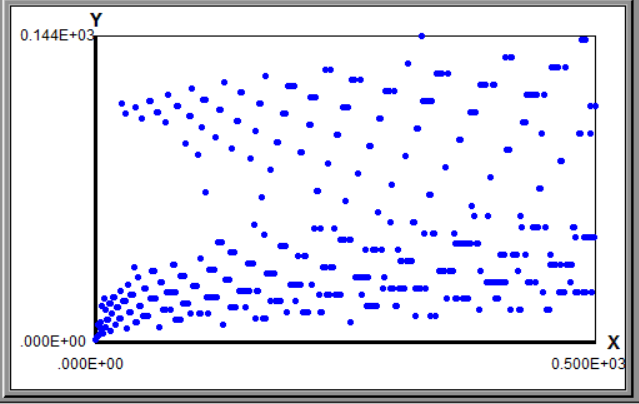
Figure 2. Collatz Length, lower region and lower region of solutions
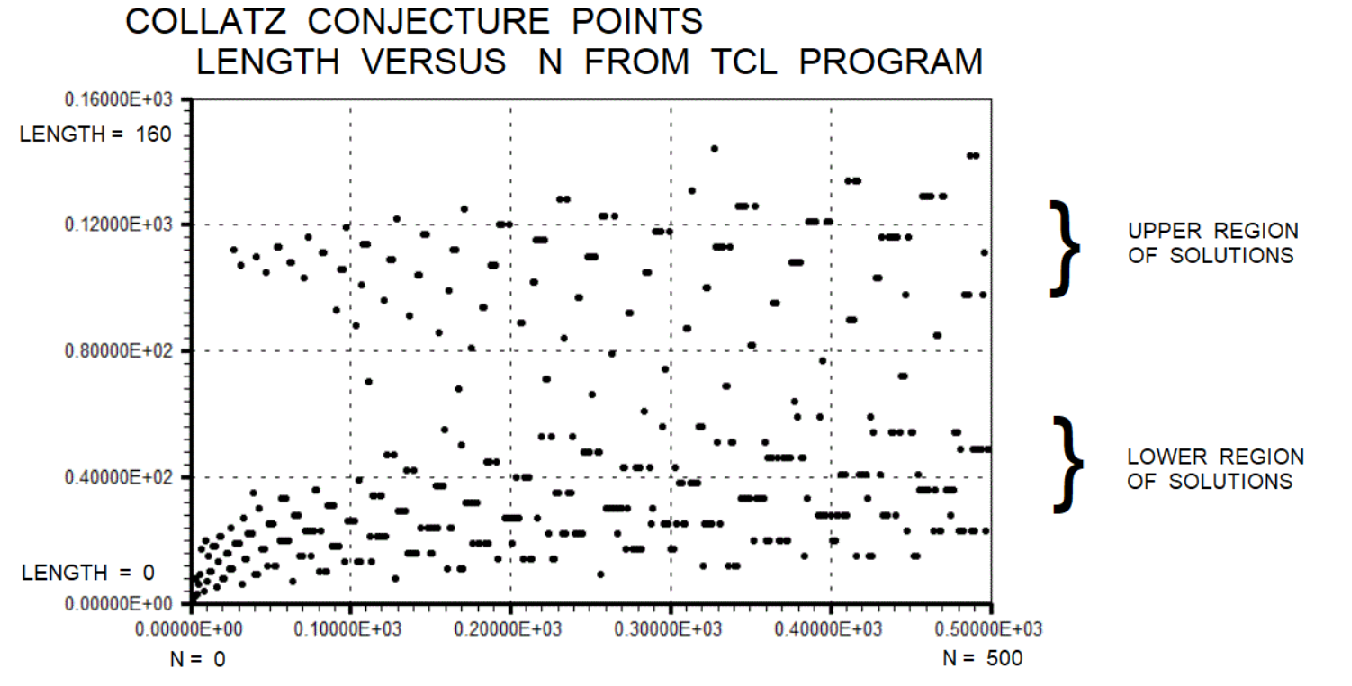
Figure 3. Collatz Length, curve fit on envelope of lower region
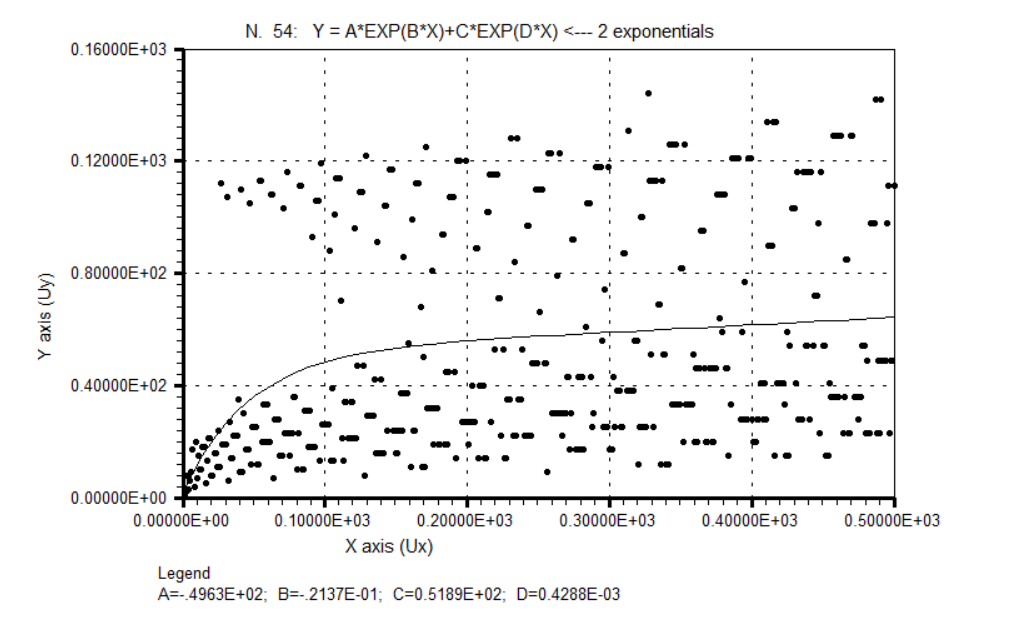
Figure 4. Collatz Length, Envelope of lower region
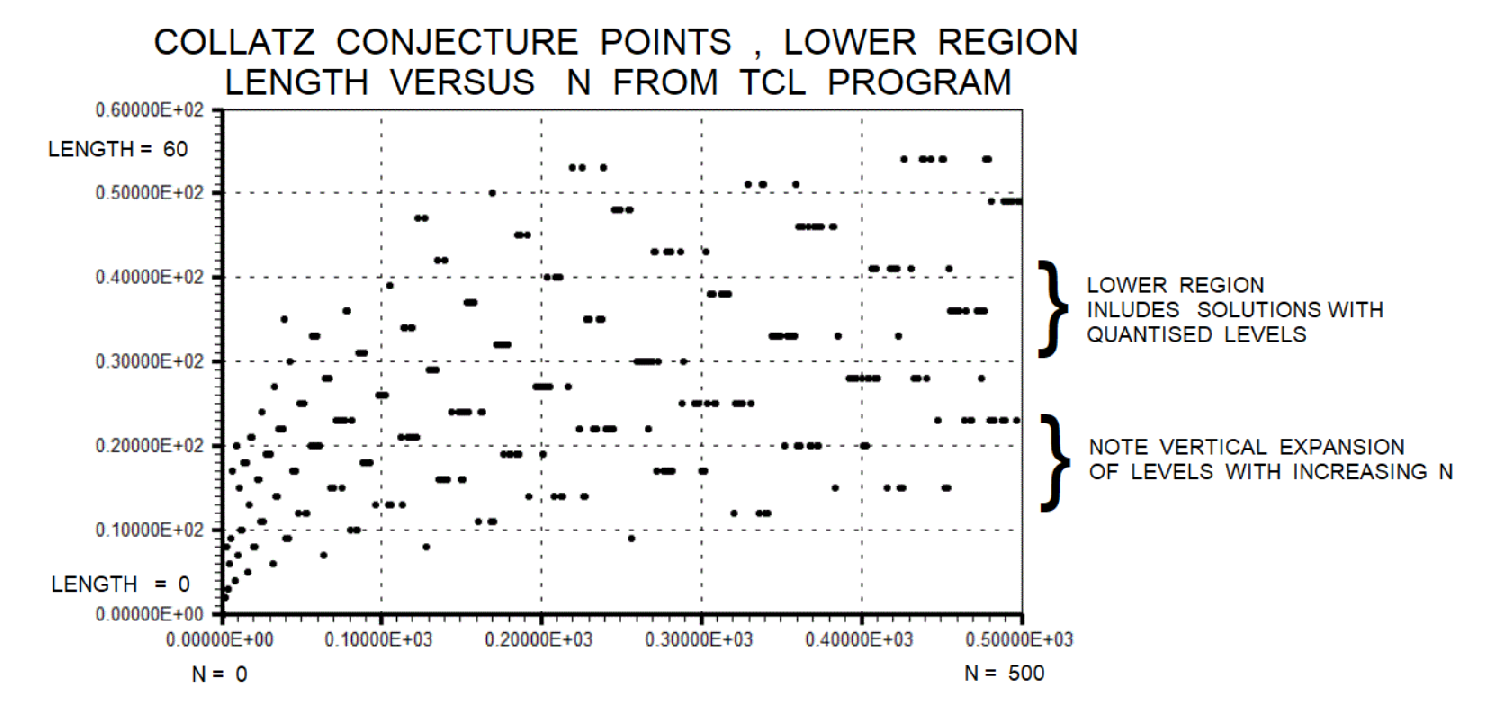
Figure 5. Bankroll over number of games
Unlike the Collatz Conjecture which goes to infinity, Starting Bankroll with diminishing games is a linear and deterministic function. But one can see multiple, quantized, and simultaneous solutions in the "crowd" of gamblers. Essentially, Bankroll(s) = { Bankroll start} - K1 * {number of games} ending at Zero, but not ending at infinity like the Collatz Conjecture.
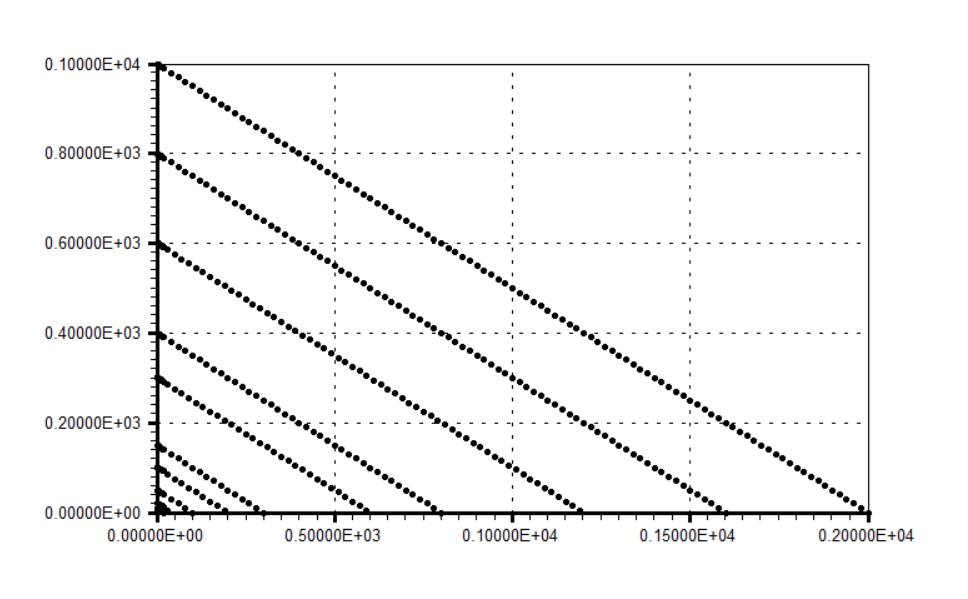
Figure 6.Snippets Concepts Collatz staircase
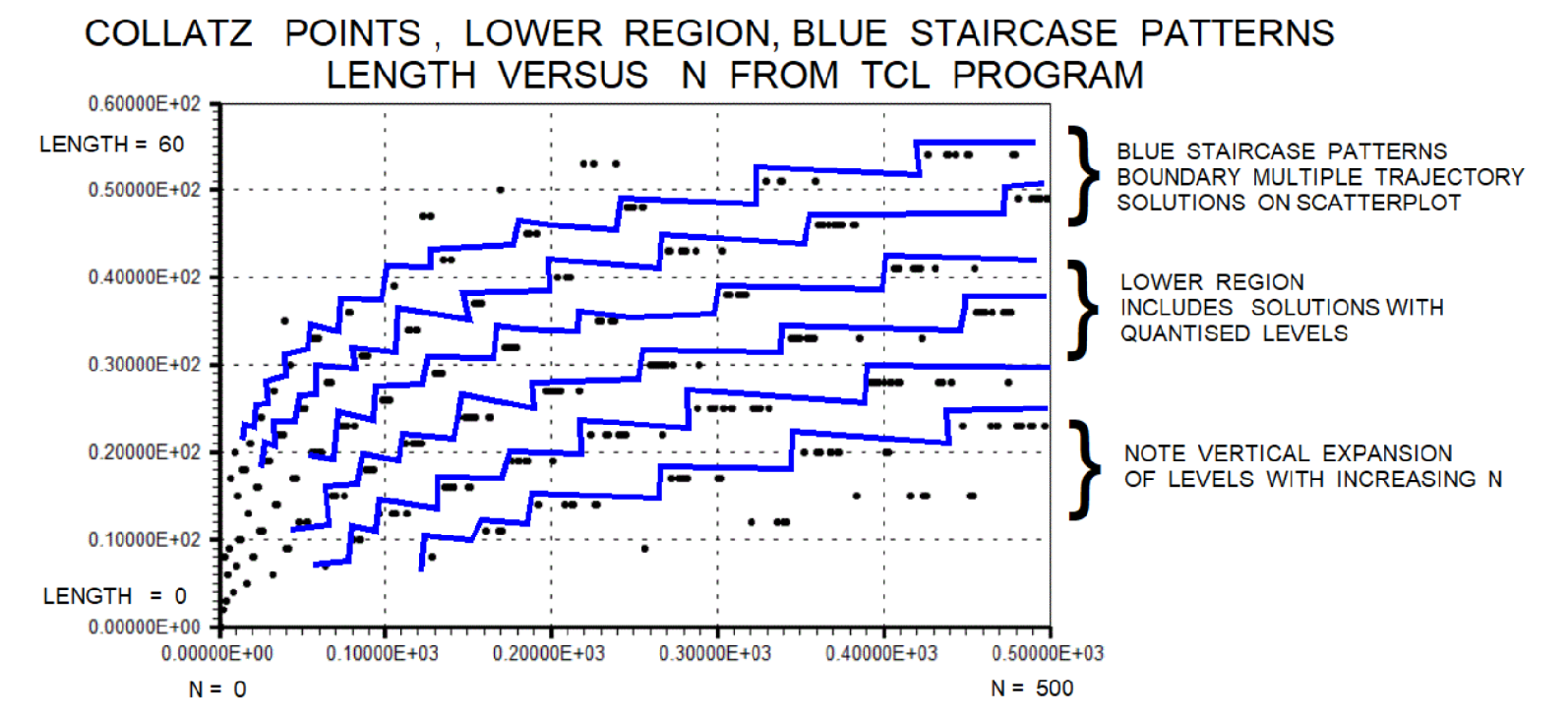
Appendix Code
Appendix TCL Programs and Scripts
1. Expanded Toy for Demo
Experimenting Draft
This is a draft.
Trial Test Program
Testing Extended deck
Due to the space on wiki page, I am omitting some wordy explanatory comments inside the deck, while debugging. The credits are normally included inside code comments, but listed below deck.
# Collatz Strings Experimental,  V2
# Tcl 8.6 or greater required
# Naming convention: all proc and variable names are 12-15
# characters, descriptive, and domain-neutral so the engine
# modules can serve any domain area without modification.
#
# ----
# Compatible with Tcl/Tk (Tool Command Language / Toolkit) 8.6+
# Written for Windows 11 on ActiveState Tcl.
# Use Pure 7-bit ASCII code, no Unicode characters used anywhere.
# ----
# Need modular code with procs length  of 15 to 25 lines.
# ----
# Written for college IT lab and uses minimal external libraries.
#
# Program deck may contain multiple estimation procs.
# Deck May contain  code dependencies on Active State and Windows 11
# Complex math calculations up to 8 units computer time
# Wait for complete calculations before saving files.
# Proc names and variables names need to be very human readable
# and very explanatory.
# Avoid variables with single letter names.
# Whereas single letter names are known to lead
# to many historic errors.
# Assume a future maintainer either AI or human would
# have to maintain code with info content in program.
# This is Experimenting Draft,
# and not a replacement for TCL Core.
# This is a hacker's patch, not rigorously derived.
# appears correct solutions for autotests.
# TCL Club 7/01/2026
#
# ---------------------------------------------------------------
# Logging module
# ---------------------------------------------------------------

proc start_session_log {} {
    set stamp [clock format [clock seconds] -format "%Y-%m-%d_%H-%M-%S"]
    set ::session_log_file [open "session_$stamp.log" w]
    fconfigure $::session_log_file -buffering line
}

proc end_session_log {} {
    if {[info exists ::session_log_file]} {
        close $::session_log_file
        unset ::session_log_file
    }
}

proc log_puts {args} {
    if {[llength $args] == 1} {
        set text [lindex $args 0]
        puts $text
        if {[info exists ::session_log_file]} {
            puts $::session_log_file $text
        }
    } elseif {[llength $args] == 2} {
        lassign $args chan text
        puts $chan $text
        if {[info exists ::session_log_file] && ($chan eq "stdout" || $chan eq "stderr")} {
            puts $::session_log_file $text
        }
    } else {
        error "usage: log_puts ?channel? string"
    }
}

proc show_console_if_available {} {
    if {[llength [info commands console]] > 0} {
        catch {console show}
    }
}

# ---------------------------------------------------------------
# Collatz Integer Trajectory to Gateword conversion
# ---------------------------------------------------------------

proc generate_symbolic_gateword_sequence {starting_integer_value {trajectory_step_limit 500}} {
    set current_integer_value $starting_integer_value
    set symbolic_gateword_string ""
    set trajectory_step_counter 0
    while {$current_integer_value > 1} {
        if {[expr {$current_integer_value % 2}] == 0} {
            append symbolic_gateword_string "E"
            set current_integer_value [expr {$current_integer_value / 2}]
        } else {
            append symbolic_gateword_string "O"
            set current_integer_value [expr {3 * $current_integer_value + 1}]
        }
        incr trajectory_step_counter
        if {$trajectory_step_counter > $trajectory_step_limit} {
            break
        }
    }
    return $symbolic_gateword_string
}

proc compute_symbolic_motif_complexity_measure {symbolic_gateword_string motif_window_length} {
    set gateword_character_length [string length $symbolic_gateword_string]
    if {$gateword_character_length < $motif_window_length} {
        return 1
    }
    set unique_motif_collection [list]
    set last_start_position [expr {$gateword_character_length - $motif_window_length}]
    for {set index_position 0} {$index_position <= $last_start_position} {incr index_position} {
        set window_end [expr {$index_position + $motif_window_length - 1}]
        set current_motif_substring [string range $symbolic_gateword_string $index_position $window_end]
        if {[lsearch $unique_motif_collection $current_motif_substring] == -1} {
            lappend unique_motif_collection $current_motif_substring
        }
    }
    return [llength $unique_motif_collection]
}

# ---------------------------------------------------------------
# Breakpoint analysis
# ---------------------------------------------------------------

proc score_gateword_split_point {gateword_text split_index} {
    set left_part  [string range $gateword_text 0 [expr {$split_index - 1}]]
    set right_part [string range $gateword_text $split_index end]

    set left_odd_matches   [regexp -all -inline {O} $left_part]
    set left_even_matches  [regexp -all -inline {E} $left_part]
    set right_odd_matches  [regexp -all -inline {O} $right_part]
    set right_even_matches [regexp -all -inline {E} $right_part]

    set left_balance_score  [expr {[llength $left_odd_matches] - [llength $left_even_matches]}]
    set right_balance_score [expr {[llength $right_odd_matches] - [llength $right_even_matches]}]

    return [expr {abs($right_balance_score - $left_balance_score)}]
}

proc find_best_gateword_split {gateword_text} {
    set gateword_length [string length $gateword_text]
    set best_split_position 0
    set best_split_score -1

    for {set candidate_position 1} {$candidate_position < $gateword_length - 1} {incr candidate_position} {
        set candidate_score [score_gateword_split_point $gateword_text $candidate_position]
        if {$candidate_score > $best_split_score} {
            set best_split_score $candidate_score
            set best_split_position $candidate_position
        }
    }
    return $best_split_position
}

proc gateword_breakpoint {gateword_text} {
    set gateword_length [string length $gateword_text]
    if {$gateword_length < 3} {
        return [list 0 $gateword_text]
    }

    set best_split_position [find_best_gateword_split $gateword_text]

    set window_start [expr {$best_split_position - 2}]
    if {$window_start < 0} {
        set window_start 0
    }
    set window_end [expr {$best_split_position + 2}]
    if {$window_end >= $gateword_length} {
        set window_end [expr {$gateword_length - 1}]
    }

    return [list $best_split_position [string range $gateword_text $window_start $window_end]]
}

# ---------------------------------------------------------------
# Wiki Table construction (split into smaller focused procs)
# ---------------------------------------------------------------

proc compute_gateword_flow_estimate {gateword_length} {
    if {$gateword_length <= 0} {
        return 0.0
    }
    set midpoint_position [expr {$gateword_length / 2}]
    return [expr {1.0 - (double($midpoint_position) / $gateword_length)}]
}

proc format_truncated_gateword {gateword_text} {
    set truncated_text [string range $gateword_text 0 29]
    if {[string length $gateword_text] > 30} {
        append truncated_text "..."
    }
    return $truncated_text
}

proc build_collatz_table_rows {list_of_starting_numbers max_steps} {
    set table_data [list]
    set row_index 0

    foreach start_n $list_of_starting_numbers {
        incr row_index
        set gateword [generate_symbolic_gateword_sequence $start_n $max_steps]
        set gateword_length [string length $gateword]
        set breakpoint_info [gateword_breakpoint $gateword]
        lassign $breakpoint_info breakpoint_position breakpoint_window

        lappend table_data [list $row_index $start_n $gateword $gateword_length \
            $breakpoint_position $breakpoint_window]
    }
    return $table_data
}

proc print_collatz_table_rows {table_data} {
    log_puts "%| # | Start n | Gateword (truncated) | Length | Est. NLP Breakpoint | BP Window | Prob Flow to Attractor |  Convergence  |Quibbles-Notes |%"
        foreach row $table_data {
        lassign $row row_index start_n gateword gateword_length breakpoint_position breakpoint_window

        set flow_estimate [compute_gateword_flow_estimate $gateword_length]
        set truncated_gateword [format_truncated_gateword $gateword]
        set flow_estimate_text [format "%.3f" $flow_estimate]

        log_puts "&| $row_index | $start_n | $truncated_gateword | $gateword_length | $breakpoint_position | $breakpoint_window | $flow_estimate_text | Converging to 1 |  |&"
    }
}

proc build_collatz_wave_packet_table {list_of_starting_numbers max_steps} {
    set table_data [build_collatz_table_rows $list_of_starting_numbers $max_steps]
    print_collatz_table_rows $table_data
    return $table_data
}

# ---------------------------------------------------------------
# Run it
# ---------------------------------------------------------------

show_console_if_available
start_session_log
build_collatz_wave_packet_table {7 10 20 30 50 27} 30
end_session_log

# end of file
# References. # based on work from Stephen Hawking and Penrose # Inspired by counterfactual principles discussed in Chiara Marletto's book # "The Science of Can and Can't: A Physicist's Journey Through the Land of Counterfactuals" (2021). # No text, quotes, or direct examples from the book are used in this code. # The dummy subroutine implements a generic axiom for educational purposes only. puts "==============================================================" puts "Credits" puts "Inspired by principles discussed in Dr. Travis S. Taylor's monograph, PHD," puts "Symbolic Collapse Grammar and the Convergence of the Collatz Function, June 2025" puts "Dr. Travis S. Taylor, Phd, QuantumFrontier, LLC, puts "Huntsville, AL, Department of Physics, University of Alabama " puts "Reference: Maria Violaris, arXiv:2601.08102v1, January 2026" puts "Reference: https://wiki.tcl-lang.org/page/Snippets+Quantum+Many+Worlds" puts "Based on ref. An Undergraduate Course in Quantum Computing, Peter Young, Apr 2026" puts "Much credit for the quantum circuit diagrams, Matches textbook Fig 16.4 etc" puts "University of California Santa Cruz, CA, arXiv:2604.10396"
Result in Wiki Tables from Active State
Wiki table. Expected Output of Gateword Strings, Mockup
| Index # | Start n | Gateword Strings (maybe truncated for space) | Length | Dominant Motif at Mid | Prob Flow to Attractor | Quibble |
|---|---|---|---|---|---|---|
| 1 | 7 | OEOEOEEOEEEOEEEE | 16 | OEE | 0.500 | Converging to 1 |
| 2 | 10 | EOEEEE | 6 | OEE | 0.000 | Converging to 1 |
| 3 | 20 | EEOEEEE | 7 | OEE | 0.143 | Converging to 1 |
| 4 | 30 | EOEOEOEOEEEEEOEEEE | 18 | OEE | 0.444 | Converging to 1 |
| 5 | 50 | EOEEOEOEEEOEOEEOEEEE | 24 | OEE | 0.500 | Converging to 1 |
| 6 | 27 | OEOEOEOEOEOEOEOEOEOEOE ... truncated for space | 111 ??? | ?? | ??? | Converging to 1 ???? |
Wiki table. ActiveState Gateword Strings in Conjectured Wave Packet
| # | Start n | Gateword (truncated) | Length | Est. NLP Breakpoint | BP Window | Prob Flow to Attractor | Convergence | Quibbles-Notes |
|---|---|---|---|---|---|---|---|---|
| 1 | 7 | OEOEOEEOEEEOEEEE | 16 | 1 | OEOE | 0.500 | Converging to 1 | |
| 2 | 10 | EOEEEE | 6 | 2 | EOEEE | 0.500 | Converging to 1 | |
| 3 | 20 | EEOEEEE | 7 | 1 | EEOE | 0.571 | Converging to 1 | |
| 4 | 30 | EOEOEOEOEEEEEOEEEE | 18 | 2 | EOEOE | 0.500 | Converging to 1 | |
| 5 | 50 | EOEEOEOEEEOEOEEOEEEOEEEE | 24 | 2 | EOEEO | 0.500 | Converging to 1 | |
| 6 | 27 | OEOEEOEOEOEOEOEEOEEOEOEEOEOEOE... | 31 | 1 | OEOE | 0.516 | Converging to 1 |
Draft Figures, & ASCII Diagrams
gold 7/2/2026. These ASCII Diagrams are Visual heuristics, not proofs about the Collatz Conjecture map.
figure. TUNNELING TRANSMISSION: THE ACTUAL PHYSICS FORMULA
+----------------------------------------------------------------------------------+
| TUNNELING TRANSMISSION: THE ACTUAL PHYSICS FORMULA ( for Snippet )              |
|    Standard rectangular potential barrier, E < V0 case                          |
|                                                                                  |
|    kappa = sqrt( 2*m*(V0 - E)*q_e ) / hbar      (decay constant inside barrier) |
|                                                                                  |
|    T = 1 / ( 1 + (V0^2 * sinh^2(kappa*L)) / (4*E*(V0-E)) )                     |
|                                                                                  |
|    where:                                                                       |
|      m  = electron mass     = 9.1093837e-31 kg                                 |
|      hbar = reduced Planck  = 1.0545718e-34 J*s                                |
|      q_e  = eV to Joules    = 1.60217662e-19                                   |
|      L    = barrier width in meters (input as nm, converted)                   |
|      E    = particle energy (eV)                                                |
|      V0   = barrier height (eV)                                                 |
|                                                                                  |
+----------------------------------------------------------------------------------+
Following Draft Examples and string terminology from Dr. Taylor's paper.
Dr. Taylor calls a Collatz strings as a Symbolic Gatewords and other terms in his paper. The worked example for Integer 11 is from his paper. I am preparing some more worked examples for coding checks. These ASCII Diagrams are Visual heuristics and may contain engineering rules of thumb, but not proofs about the Collatz Conjecture map.
figure. SYMBOLIC GATEWORD ENCODING: n=11 WORKED EXAMPLE
+----------------------------------------------------------------------------------+
| SYMBOLIC GATEWORD ENCODING  (generate_symbolic_gateword_sequence proc)         |
|    Alphabet: { O = odd step (3n+1),  E = even step (n/2) }                    |
|                                                                                  |
|    n=11 trajectory:                                                             |
|    11 -> 34 -> 17 -> 52 -> 26 -> 13 -> 40 -> 20 -> 10 -> 5 -> 16 -> 8 -> 4 -> 2 -> 1
|     O     E     O     E     E     O     E    E    E   O    E   E   E   E         |
|                                                                                  |
|    Gateword string:  O E O E E O E E E O E E E E                                |
|                      "OEOEEOEEEOEEEE"   (14 characters, 14 transformation steps)|
|                                                                                  |
+----------------------------------------------------------------------------------+
+----------------------------------------------------------------------------------+ | COMPRESSION RULES (apply_symbolic_compression_rules_to_gateword proc) | | Repeated regex substitution on the gateword string, up to N passes | | | | Each pass: | | 1. trim trailing "E" characters | | 2. regsub all "OEE" -> "O" | | 3. regsub all "EE" -> "E" | | stop early if the string stopped changing | | | | Example pass on "OEOEEOEEEOEEEE": | | trim trailing E: "OEOEEOEEEOEEEE" -> "OEOEEOEEEO" | | OEE -> O: "OEOEEOEEEO" -> "OEOOEO" (some matches) | | EE -> E: (further collapsing of double-E runs) | | ... repeats until stable or empty | | | | Note. Long Collatz strings are very demanding on computer resources and time, | | and may approach maximum integer representation and proc recursion limits | | on computer language? | | | | Caution: this is a STRING-REWRITING heuristic, | | Not a proven property of the Collatz map. | | Not a proven fact about Collatz convergence, ref terms of pure mathematicians | +----------------------------------------------------------------------------------+
figure. SYMBOLIC GATEWORD ENCODING: n=7
+----------------------------------------------------------------------------------+
| SYMBOLIC GATEWORD ENCODING  (generate_symbolic_gateword_sequence proc)         |
|    Alphabet: { O = odd step (3n+1),  E = even step (n/2) }                    |
|                                                                                  |
|    n=7 trajectory:                                                              |
|     7 -> 22 -> 11 -> 34 -> 17 -> 52 -> 26 -> 13 -> 40 -> 20 -> 10 -> 5        |
|     O     E     O     E     O     E     E     O     E     E    E    O           |
|    -> 16 -> 8 -> 4 -> 2 -> 1                                                   |
|       E    E   E   E                                                            |
|                                                                                  |
|    Gateword string:  O E O E O E E O E E E O E E E E                           |
|                      "OEOEOEEOEEEOEEEE"  (16 characters, 16 steps)             |
|                                                                                  |
|    Summary:                                                                     |
|      total steps    = 16                                                        |
|      odd  steps (O) =  5   (positions 1,3,5,8,12 counting from 1)             |
|      even steps (E) = 11                                                        |
|      odd/even ratio = 5/11 = 0.4545...                                         |
+----------------------------------------------------------------------------------+
figure. SYMBOLIC GATEWORD ENCODING: n=10
+----------------------------------------------------------------------------------+
| SYMBOLIC GATEWORD ENCODING  (generate_symbolic_gateword_sequence proc)         |
|    Alphabet: { O = odd step (3n+1),  E = even step (n/2) }                    |
|                                                                                  |
|    n=10 trajectory:                                                             |
|    10 -> 5 -> 16 -> 8 -> 4 -> 2 -> 1                                           |
|     E    O    E    E   E   E                                                    |
|                                                                                  |
|    Gateword string:  E O E E E E                                                |
|                      "EOEEEE"  (6 characters, 6 steps)                         |
|                                                                                  |
|    Summary:                                                                     |
|      total steps    =  6                                                        |
|      odd  steps (O) =  1   (position 2)                                        |
|      even steps (E) =  5                                                        |
|      odd/even ratio = 1/5 = 0.2000                                             |
|                                                                                  |
|    Note: The n=10 trajectory reaches 5, then merges with n=5's path to 1.      |
+----------------------------------------------------------------------------------+
figure. SYMBOLIC GATEWORD ENCODING: n=20
+----------------------------------------------------------------------------------+
| SYMBOLIC GATEWORD ENCODING  (generate_symbolic_gateword_sequence proc)         |
|    Alphabet: { O = odd step (3n+1),  E = even step (n/2) }                    |
|                                                                                  |
|    n=20 trajectory:                                                             |
|    20 -> 10 -> 5 -> 16 -> 8 -> 4 -> 2 -> 1                                     |
|     E     E    O    E    E   E   E                                              |
|                                                                                  |
|    Gateword string:  E E O E E E E                                              |
|                      "EEOEEE E"  (7 characters, 7 steps)                       |
|                                                                                  |
|    Summary:                                                                     |
|      total steps    =  7                                                        |
|      odd  steps (O) =  1   (position 3)                                        |
|      even steps (E) =  6                                                        |
|      odd/even ratio = 1/6 = 0.1667                                             |
|                                                                                  |
+----------------------------------------------------------------------------------+
figure. SYMBOLIC GATEWORD ENCODING: n=30
+----------------------------------------------------------------------------------+
| SYMBOLIC GATEWORD ENCODING  (generate_symbolic_gateword_sequence proc)         |
|    Alphabet: { O = odd step (3n+1),  E = even step (n/2) }                    |
|                                                                                  |
|    n=30 trajectory:                                                             |
|    30 -> 15 -> 46 -> 23 -> 70 -> 35 -> 106 -> 53 -> 160 -> 80 -> 40           |
|     E     O     E     O     E     O     E      O     E     E    E               |
|    -> 20 -> 10 -> 5 -> 16 -> 8 -> 4 -> 2 -> 1                                  |
|       E     E    O    E    E   E   E                                            |
|                                                                                  |
|    Gateword string:  E O E O E O E O E E E E E O E E E E                       |
|                      "EOEOEOEOEEEEEOEEEE"  (18 characters, 18 steps)           |
|                                                                                  |
|    Summary:                                                                     |
|      total steps    = 18                                                        |
|      odd  steps (O) =  5   (positions 2,4,6,8,14)                             |
|      even steps (E) = 13                                                        |
|      odd/even ratio = 5/13 = 0.3846...                                         |
|                                                                                  |
+----------------------------------------------------------------------------------+
figure. SYMBOLIC GATEWORD ENCODING: n=50
+----------------------------------------------------------------------------------+
| SYMBOLIC GATEWORD ENCODING  (generate_symbolic_gateword_sequence proc)         |
|    Alphabet: { O = odd step (3n+1),  E = even step (n/2) }                    |
|                                                                                  |
|    n=50 trajectory:                                                             |
|    50 -> 25 -> 76 -> 38 -> 19 -> 58 -> 29 -> 88 -> 44 -> 22 -> 11             |
|     E     O     E     E     O     E     O     E     E     E    O                |
|    -> 34 -> 17 -> 52 -> 26 -> 13 -> 40 -> 20 -> 10 -> 5 -> 16                 |
|       E     O     E     E     O     E     E     E    O    E                    |
|    -> 8 -> 4 -> 2 -> 1                                                         |
|       E   E   E                                                                 |
|                                                                                  |
|    Gateword string:  E O E E O E O E E E O E O E E O E E E O E E E E          |
|                      "EOEEOEOEEEOEOEEOEEEOEEEE"  (24 characters, 24 steps)     |
|                                                                                  |
|    Summary:                                                                     |
|      total steps    = 24                                                        |
|      odd  steps (O) =  8   (positions 2,5,7,11,13,16,20,24 counting from 1)   |
|      even steps (E) = 16                                                        |
|      odd/even ratio = 8/16 = 0.5000  (exactly half, coincidental)             |
|                                                                                  |
+----------------------------------------------------------------------------------+
figure. FIVE EXAMPLES: COMPARATIVE SUMMARY TABLE
+----------------------------------------------------------------------------------+
| FIVE EXAMPLES: COMPARATIVE SUMMARY TABLE                                       |
|                                                                                  |
| +------+-------+----------+-------+-------+-----------+----------------------+  |
| |  n   | steps | gateword | odd O | even E| O/E ratio | gateword string      |  |
| +------+-------+----------+-------+-------+-----------+----------------------+  |
| |   7  |  16   | 16 chars |   5   |  11   |   0.455   | OEOEOEEOEEEOEEEE     |  |
| |  10  |   6   |  6 chars |   1   |   5   |   0.200   | EOEEEE               |  |
| |  20  |   7   |  7 chars |   1   |   6   |   0.167   | EEOEEEE              |  |
| |  30  |  18   | 18 chars |   5   |  13   |   0.385   | EOEOEOEOEEEEEOEEEE   |  |
| |  50  |  24   | 24 chars |   8   |  16   |   0.500   | EOEEOEOEEEOEOEEOEEEOEEEE|  |
| +------+-------+----------+-------+-------+-----------+----------------------+  |
| |  11* |  14   | 14 chars |   4   |  10   |   0.400   | OEOEEOEEEOEEEE       |  |
| +------+-------+----------+-------+-------+-----------+----------------------+  |
|    * n=11 included as reference (the original example from Dr. Taylor's paper) |
|                                                                                  |
+----------------------------------------------------------------------------------+
figure. EXAMPLE Mockup
n = 11 gateword
OEOEEOEEEOEEEE

amplitude sketch
                O
            O   E
        O   E   E
    O   E   E   E
E E E E E E E E E E E E E E
Shift-and-add resembles constructive interference in a simple ASCII model. text A: OEOEEOEEEOEEEE B: EOEEEOEEEE sum: OEOE[PEAK]OEEEE
+----------------------------------------------------------------------------------+
| SHIFT-AND-ADD: CONSTRUCTIVE INTERFERENCE IN AN ASCII MODEL , Mockup              |
|                                                                                  |
|    A:    O E O E E O E E E O E E E E                                            |
|    B:      E O E E E O E E E O E E E                                            |
|                                                                                  |
|    sum:   O E O E [PEAK] O E E E E                                             |
|                                                                                  |
|    Meaning: the shifted overlap strengthens the center region.                  |
|    Result:   a packet-like shape with a visible peak.                           |
+----------------------------------------------------------------------------------+
resembles destructive interference in a simple ASCII model.

A:    OEOEEOEEEOEEEE
B:      EOEEEOEEEE
zzz:   ..0..0..0..0..
+----------------------------------------------------------------------------------+
| SHIFT-AND-SUBTRACT: DESTRUCTIVE INTERFERENCE IN AN ASCII MODEL, Mockup          |
|                                                                                  |
|    A:    O E O E E O E E E O E E E E                                            |
|    B:      E O E E E O E E E O E E E                                            |
|                                                                                  |
|    sum:   . . 0 . . 0 . . 0 . . 0 . .                                           |
|                                                                                  |
|    Meaning: shifted overlap reduces the visible signal.                         |
|    Result:   cancellation or weak amplitude at matching positions.              |
+----------------------------------------------------------------------------------+
n = 10
EOEEEE

envelope view Mockup
        *
      *   *
    *       *
  *           *
*               *
+----------------------------------------------------------------------------------+ | n = 10 | | EOEEEE | | | | envelope view Mockup | | * | | *** | | ***** | | ******* | | *********** | | *************** | +----------------------------------------------------------------------------------
figure. COLLATZ CONJECTURE: BASIC IDEA FOR ENGINEERS
+----------------------------------------------------------------------------------+
| COLLATZ CONJECTURE: BASIC IDEA FOR ENGINEERS                                   |
|                                                                                  |
|    The Collatz conjecture states that any positive integer eventually reaches  |
|    the number 1 when engineers apply these two simple rules.                   |
|                                                                                  |
|    Rule 1: If the number is even, divide by 2.                                 |
|    Rule 2: If the number is odd, multiply by 3 and add 1.                      |
|                                                                                  |
|    Example starting with 7:                                                    |
|    7 → 22 → 11 → 34 → 17 → 52 → 26 → 13 → 40 → 20 → 10 → 5 → 16 → 8 → 4 → 2 → 1  |
|                                                                                  |
+----------------------------------------------------------------------------------+
figure. QUANTUM TUNNELING: ENGINEERING PERSPECTIVE
+----------------------------------------------------------------------------------+
| QUANTUM TUNNELING: ENGINEERING PERSPECTIVE                                     |
|                                                                                  |
|    Quantum tunneling occurs when a particle passes through a potential         |
|    energy barrier even though classical physics predicts it should not.        |
|                                                                                  |
|    The probability depends on barrier width, height, and particle energy.      |
|                                                                                  |
|    Engineers exploit this phenomenon in tunnel diodes, flash memory,           |
|    scanning tunneling microscopes, and quantum computing hardware.             |
|                                                                                  |
|    The effect demonstrates how quantum mechanics enables behaviors impossible  |
|    under classical rules.                                                      |
+----------------------------------------------------------------------------------+
figure. COMPUTATIONAL EXPLORATION OF COLLATZ CONJECTURE
+----------------------------------------------------------------------------------+
| COMPUTATIONAL EXPLORATION OF COLLATZ CONJECTURE                                |
|                                                                                  |
|    Engineers test the Collatz conjecture by writing programs that apply        |
|    the rules repeatedly and track the number of steps to reach 1.              |
|                                                                                  |
|    Large-scale searches have verified the conjecture for all                   |
|    numbers up to extremely high values.                                        |
|                                                                                  |
|    This brute-force approach represents a classic "hack programming" method    |
|    to explore unsolved mathematical problems.                                  |
+----------------------------------------------------------------------------------+
figure. GLOSSARY OF KEY TERMS
+----------------------------------------------------------------------------------+
| GLOSSARY OF KEY TERMS                                                          |
|                                                                                  |
|    Collatz Conjecture                                                          |
|      An unsolved mathematical problem that claims any positive integer         |
|      eventually reaches 1 under simple even-odd rules.                         |
|                                                                                  |
|    Quantum Tunneling                                                           |
|      A quantum mechanical phenomenon where particles pass through energy       |
|      barriers that classical physics considers impossible.                     |
|                                                                                  |
|                                                                                  |
|     Programming                                                            |
|      An exploratory coding approach that uses iterative testing and            |
|      approximations to investigate difficult problems.                         |
+----------------------------------------------------------------------------------+
figure. COLLATZ STRINGS: BASIC CONCEPT
+----------------------------------------------------------------------------------+
| COLLATZ STRINGS: BASIC CONCEPT                                                 |
|                                                                                  |
|    Engineers represent Collatz sequences as strings of operations.             |
|    Common notation uses "E" for divide by 2 and "O" for 3n+1.                  |
|                                                                                  |
|    Example starting from 7:                                                    |
|    7 (O) → 22 (E) → 11 (O) → 34 (E) → 17 (O) → ... → 1                        |
|                                                                                  |
|    The string "OEOEO..." encodes the path to 1.                                |
|    This string representation helps analyze patterns in Collatz behavior.        |
+----------------------------------------------------------------------------------+
figure. COLLATZ STRING GENERATION ALGORITHM
+----------------------------------------------------------------------------------+
| COLLATZ STRING GENERATION ALGORITHM, UNDER TEST                                |
|                                                                                |
|    Procedure:                                                                  |
|      1. Start with positive integer n                                          |
|      2. While n > 1:                                                           |
|         - If n even: append "E", set n = n/2                                   |
|         - If n odd:  append "O", set n = 3n+1                                  |
|      3. Record the resulting string of E's and O's                             |
|                                                                                  |
|    Example for n=13:                                                           |
|    13(O)→40(E)→20(E)→10(E)→5(O)→16(E)→8(E)→4(E)→2(E)→1                        |
|    String: "OEEE O EEEE"                                                       |
+----------------------------------------------------------------------------------+
figure. TCL COLLATZ STRING
+----------------------------------------------------------------------------------+
| TCL COLLATZ STRING, DISPLAY MOCKUP                                                      |
|                                                                                  |
|    Input: Starting number                                                      |
|    Output: Collatz string + steps to reach 1                                   |
|                                                                                  |
|    Example:                                                                    |
|      Start = 27                                                                |
|      Steps = 111                                                               |
|      String = OEOOEEOEEOEEEO... (long sequence)                                |
|                                                                                  |
|    +----------------+----------+---------------+                               |
|    | Starting Number| Steps    | Collatz String|                               |
|    +----------------+----------+---------------+                               |
|    | 7              | 16       | OEOEOEOEEEEE  |                               |
|    | 27             | 111      | OEOOEE...     |                               |
|    +----------------+----------+---------------+                               |
+----------------------------------------------------------------------------------+
figure. COLLATZ STRINGS VS NUMERIC SEQUENCES
+----------------------------------------------------------------------------------+
| COLLATZ STRINGS VS NUMERIC SEQUENCES                                           |
|                                                                                  |
|    +-------------------+---------------------+--------------------------+      |
|    | Representation    | Advantages          | Disadvantages            |      |
|    +-------------------+---------------------+--------------------------+      |
|    | Numeric Sequence  | Easy to compute     | Long lists for large n   |      |
|    | Collatz String    | Compact pattern     | Requires decoding back   |      |
|    | (E/O)             | analysis            | to numbers               |      |
|    +-------------------+---------------------+--------------------------+      |
|                                                                                  |
|    Strings enable pattern searching across many trajectory values.               |
+----------------------------------------------------------------------------------+
figure. APPLICATIONS OF COLLATZ STRINGS IN PROGRAMMING
+----------------------------------------------------------------------------------+
| APPLICATIONS OF COLLATZ STRINGS IN PROGRAMMING                                 |
|                                                                                  |
|    • Visualizing hailstone sequences as binary like strings                    |
|    • Searching for repeating patterns or cycles                                |
|    • Educational tool for teaching iteration and recursion                     |
|    • Testing programming language performance on long computations             |
|    • Generating unique identifiers from integer inputs                         |
|                                                                                  |
|    Engineering students  implement Collatz string generators                    |
|    to practice algorithm design and string manipulation.                       |
+----------------------------------------------------------------------------------+
figure. COLLATZ STRING LENGTH DISTRIBUTION
+----------------------------------------------------------------------------------+
| COLLATZ STRING LENGTH DISTRIBUTION                                             |
|                                                                                  |
|    Some numbers with short strings reach 1 quickly.                        |
|    Some numbers produce very long strings before descending.                   |
|                                                                                  |
|    Engineers study the statistical distribution of string lengths              |
|    to understand the conjecture's behavior.                                    |
|                                                                                  |
|                                                                                 |
+----------------------------------------------------------------------------------+
figure. SUMMARY: COLLATZ STRINGS IN ENGINEERING EDUCATION
+----------------------------------------------------------------------------------+
| SUMMARY: COLLATZ STRINGS IN ENGINEERING EDUCATION                              |
|                                                                                  |
|    Collatz strings provide a compact way to represent complex sequences.       |
|    The approach combines number theory with string processing.                 |
|    Students gain practical experience in algorithm development.                |
|                                                                                  |
|    The TCL language makes exploration of Collatz strings accessible         |
|    and educational for engineering students.                                   |
+----------------------------------------------------------------------------------+
gold 2/9/2026. Added categories, so can find message in Wiki.
Hidden Comments Section
Program Change Log
gold 7/1/2026. Testing, encountered initial difficulty in saving work? Long code blocks with or unmatched wiki markup can sometimes confuse the Tcl Wiki formatting engine, especially if fences are not balanced or a line begins with markup it treats specially.
gold 2/14/2026. Added Automatic Dump of Examples, Using ActiveState.
gold 2/14/2026. convert to strict 7-bit ASCII for Playground V9. reporting error at bottom. program should run to completion with automatic test suite.
gold 7/1/2026. Forwarding Python version to other venue. The TCL version is posted here.
Matrix of Collatz solutions look like two swarms of bees rather a single linear solution or even look like multiple fuzzy levels of solution ranges, eg. non-linear solutions, observable in various pngs. You can tell me different. Based on long experience of fitting equations in engineering, possibly the probabilistic reasoning or pattern matching on quantum solutions plural is more adaptable.
Difficult for me to evaluate the Quantum math theories. The Python versions are posted in other venues. The TCL version is posted on wiki.
However, I suppose that the simulation model using TcL could check the Yada-Yada theory for consistencies with other vouched quantum rules. However, code seems interesting from a hack programming viewpoint.
Please place any comments here with your wiki MONIKER and date, Thanks.gold 7/1/2026
Note. Testing computer methods and computer programs, maybe wrong numbers.
| Category Numerical Analysis | Category Toys | Category Calculator | Category Mathematics | Category Example | Toys and Games | Category Games | Category Application | Category GUI |