Snippets Concepts Inference Engine
- Index for Snippets Concepts Inference Engine
- Preface
- Limitations on Tool and Disclaimer
- Extra Significant Figures, If Any in Debugging
- Introduction
- Idea Buster from Solutions out of the Box
- Conjectures
- 1. Testcase for Programming Features
- 2. Testcase for Beam Splitter path
- 3. Testcase for Quantum penny toss case
- 4. Testcase for Contrast of Generic Heat Engine
- Follow-on for Solar Oven
- 5. Testcase for Fire Warning
- Key Clarifications for the Hapless TCL Programmer
- Good rules of thumb
- My Infamous Question to the Thermodynamics Prof.
- Simple Analogies for Marletto Counterfactual Protocol
- Adapted Analogy for Weighted Decisions on Relationships
- Inference Analogy from Turing-machine style
- Fallacy Issues
- Possible Coding Extensions to Token-like Mini-LLM Reasoning
- Details, Sketching a Conclusion Rule Table from Token-Like Statements.
- What did "We" learn from Coding in Mini-LLM Reasoning
- Summary
- References
- Table, Theorems
- Wiki Table. Proposed Logic Notation for Pseudocode
- Wiki Table. Token Logic Details in Model
- Wiki Table. How Model Tokens Compare to Linguistics Sememes
- Wiki Table. Mockup Display on Analogy on Weighted Decisions, Math Problem
- Wiki Table. Arithmetic Mean versus Geometric Mean in Constructor Theory Context
- Wiki Table. Mockup Display on Turing Machine
- Wiki Table. Handling Counterfactuals in Marletto Protocol, Graceful Degradation
- Wiki Table. Sample from Axiom Engine V4 Results
- Wiki Table. Mockup Demo #1, Sample from Extensions on Axiom Engine Results
- Wiki Table. Mockup Demo #2, Sample from Extensions on Axiom Engine Results
- Wiki Table. Marletto-style possible/impossible set, Programming features
- Wiki Table. Beam splitter axioms
- Wiki Table. Quantum penny toss axioms
- Wiki Table. Current Thermodynamics Research linked to D. and Marletto Principles
- Wiki Table. Mockup for Single-Qubit Quantum Engine.
- Wiki Table. Mockup for Two-Qubit Entangled Engine
- Wiki Table. Mockup for 4-Cycle Qubit Otto Engine
- Wiki Table. Mockup for Beam Splitter Engine Component
- Wiki Table. Mockup for Coupled Multi-Qubit Engine (Bonus Round)
- Wiki Table. Mockup for Qubit_Ottobot
- Wiki Table. Comparison of Simple 2-Pass System versus Commercial LLM Model
- Wiki Table. Better Coding Routes for Marletto Counterfactuals, ... and Analogies
- Appendix Code
- 1. Expanded Toy for Demo
- Experimenting Draft
- Trial Test Program
- Result in Wiki Tables from Active State
- Testing extended deck
- Pseudocode for Extension
- Testing Extended deck, mini LLM reasoning
- LLM Token Like Reasoning, Result in Wiki Tables from Active State
- Wiki Table. Mini LLM Reasoning
- Hidden Comments Section
- Program Change Log
Index for Snippets Concepts Inference Engine
Preface
gold 4/27/2026. First Advisor requests similar to previous snippets, but on topic of Inference Engine. The model is intended as an exploratory framework for TCL coding. Adding Chiara Marletto's counterfactual framework from the book "The Science of Can and Can't" along with other perspectives. We are using modular snippets inside modular structured programs.
gold 4/27/2026. Upon review of draft page, First Advisor is recommending Quantum Fourier Transform QFT for one, two, or more alternative solutions. In theory, these core axioms, contrast axioms, and counterfactual axioms as probability vector waveforms could be added and manipulated, and then QFT'ed into multiple solutions. Second Advisor sends feedback for Vector distance along Marletto alternate math calculation pathways: Treat Marletto possible and impossible counterfactuals as two vectors in multi-dimensional axiom space and compute cosine similarity and/or separation. Second advisor sends feedback: Better aggregation methods should include product and geometric mean calculations for M. pathways.
I do not have all the answers. The Ideas Seemed to work, but maybe drawbacks? When measured by the Tcl timing statements, completion times and solutions of parameters will differ on different computer set-ups. Assume a future maintainer, either AI Model or human programmer, would have to maintain code with info content and explanatory variable name in program, ref "Snippets Concepts Effects". The Nassi Shneiderman Diagrams NSD or psuedocode Flowcharts pertain to the Tool Control Language TCL computer language as well as other computer languages like Python 3, pseudocode, word logic problems, and technical reports.
For each logic condition selecting a path or calculation task, we might have one, two, or multiple deterministic branches. Attempting to adapt format to multiple probabilistic branches used in Artificial Intelligence AI Models. Then we may use the lottery algorithm to select the winning pathways or tickets.
The existing program has some dummy subroutines. A full construction seems too complex here. I found a paper with images of quantum walks, and I’m wondering if it’s possible to simulate the curves shown in the charts. My advisor has suggested that quantum entanglement/superposition could simulate or underlie quantum worlds, but I’m not sure that I agree. I have limited space on the wiki page, and the fill‑in for the dummy routines has to be pretty brief. In engineering terms, I’m aiming for a “90% solution”, meaning about 90% right and 10% off. Like the simple college formula for a pendulum that is not the exact time series. Call it “fake it ’til you make it” as a college try, but for Quantum Many Worlds. Who is to say? Perhaps you know, TcL specializes in GUI solutions. Maybe try and adapt some starter TcL code for a "quantum worlds slide rule ". Hopefully compatible with the hard-wired classical theory.
Limitations on Tool and Disclaimer
The TCL Snippets illustrate ideal mathematical behavior only and do not perform full simulation, actual measurements, or state vector evolution. The tool only visualizes ideal math structure, whereas no state vector simulation, probabilities, or actual measurement outcomes are derived. This tool for visualization does not simulate actual measurement outcomes or state vector evolution during operations. These are idealized protocols for tutorial purposes. Primarily, TCL /TK uses its strong points here for book keeping and displays. The example tool is not a full emulator. Meaning, limited scope for tutorial purposes.
Disclaimer. None of the computer programs, numerical experiments, power-law fits, or physical analogies described here give a strict, formal proof of the Conjectures, either individually or in combination. The tools and analogies are heuristic models and visualization tools that follow engineering “rules of thumb.” Whereas, pure mathematics has its own shop rules for what counts as a rigorous proof. Any opinions on the difficulty or plausibility reflect current understanding here and programming of the Conjectures as a very hard open problem, not a completed exact math proof, and are offered with full respect for the standards of professional mathematicians.
Extra Significant Figures, If Any in Debugging
In debugging the calculations, some of the printout values reflect roughly 17-digit precision output from a typical double-precision computation. It's not "true exact" beyond 5 significant figures. Extra significant figures are used to check the calculations from other computer set-ups, not necessarily to infer accuracy of data measurements here. Typically, the slight differences in decimal places on far right of decimal point are normal floating-point behavior in Tcl's expr.
Introduction
Program consists of a sequence of weighted decisions that vote on a yes-no decision. Suppose one first comes up with a no decision weighted at 49% yes, 51% no. With the new logic of counterfactuals, then the program weighs in counterfactual statement(s) at probability of 0.75. There are possibly both positive and negative counterfactuals. Effectively a balancing statement(s), the positive counterfactual changes the decision weight from no to yes. The inference engine gains a fresh extension, if new axioms capture Marletto-style counterfactuals. For instance, a counterfactual axiom stating that possible transformations might be weighted more effectively than static descriptions. The negative counterfactual votes and may change the decision weight from yes to no.
The program does not calculate real quantum laws. It only explores how different weightings on an initial set of axioms and later added counterfactual axioms change the reasoning outcome.
Idea Buster from Solutions out of the Box
Can you define 'solutions out of the box'? Looking for fresh ideas, but getting circular arguments and mirror imaging ideas, as some call it.
There was an ‘idea buster’ that I heard about. Remove one axiom from a set of axioms. This forces a different setup of the problem. It was said that Einstein used this 'idea buster to derive E = mc².
Sometimes theories may emerge by removing a previous or presumed constraint. Then the reduced or current theory is testing what logic structure remains consistent and if producing reasonable parameters. In other words, some theories might be overconstrained in the first place. In that sense, counterfactual reasoning does not merely decorate a theory. The Marletto counterfactual reasoning can redefine the space of allowed explanations. With the changing up or down on the internal program weights and variable weights on the Maletto counterfactual axioms and variables, we are able to shift the inference on the supporting token-like probabilities, support scores, inference weights, and the final decision.
Conjectures
classical coin toss =! quantum coin toss
Some logic problems may need counterfactuals to solve.
----
1. Po + Px are impossible to copy. from Heisenberg principle, called No-cloning rule in some venues.
2. Po + Px are possible to reverse.
3. Po + Px  are in perfect isolation.

1. Beam splitter.
Po original path
Px superposition path

2. Quantum penny toss.
Po original path
Px superposition path
Four test cases for inference engine
1. Testcase for Programming Features
Selected paragraph used for decomposition into logic axioms. Break Down Logic into Axioms for Programming. All axioms stay strictly three words in Subject-Verb-Object form.
Core Axioms:

Programming forces understanding.
Programming confronts ambiguities.
Programming exposes assumptions.
Programming demands precision.
Programming imposes logic.
Programming builds clarity.
----
Contrast Axioms:

Human mind glosses flaws.
Pencil paper forgives errors.
# testing Counterfactual Axioms, forward logic only
Full sentence: Programming enables exposing transformations.
Intermediate token-like: Prog → ExposeTrans = 0.87  Counterfactual 1
Full sentence: Programming blocks ambiguity hiding.
Intermediate token-like: Prog → BlockAmbigHide = 0.84  Counterfactual 3
Full sentence: Programming allows repeatable transformations.
Intermediate token-like: Prog → AllowRepeatTrans = 0.86  Counterfactual 3
Models have the capability to reduce an axiom or protocol list from possible inconsistent and redundant axioms. Some of you may recognize this as a sort of pseudocode before the programming into a formal computer language or experimental lab protocol. These axioms are converted into token like probability statements.
2. Testcase for Beam Splitter path
- Input: “Beam splitter present; single photon enters.”
- Expected inference: “Path superposition possible.”
- Expected rule type: possible-task / counterfactual rule.
Beam splitter axioms
1. Beam splitters create paths.
2. Beam splitters divide amplitudes.
3. Beam splitters preserve reversibility.
4. Beam splitters forbid perfect copying.
5. Beam splitters expose interference.
6. Beam splitters encode possibility.
The beam splitter axioms for counterfactuals.
- Programming enables superposition paths.
- Programming blocks perfect copying states.
- Programming allows reversible isolation.
3. Testcase for Quantum penny toss case
- Input: “Quantum coin prepared before measurement.”
- Expected inference: “Outcome is not classical until measured.”
- Expected rule type: measurement-limit / ambiguity rule.
Quantum penny toss axioms
1. Quantum coins create superpositions.
2. Quantum coins delay outcomes.
3. Quantum coins resist classical prediction.
4. Quantum coins permit interference.
5. Quantum coins expose measurement limits.
6. Quantum coins encode counterfactual choice.
The quantum penny toss axioms for counterfactuals.
- Programming models quantum coin outcomes.
- Programming confronts classical quantum mismatch.
- Programming exposes superposition measurement.
4. Testcase for Contrast of Generic Heat Engine
- Input: “Attempt perfect copying of quantum state.”
- Expected inference: “Task is impossible.”
- Expected rule type: impossibility / constraint rule.
Tasks = Sunlight enters insulated cavity; heat accumulates; target absorbs energy.
Then fire counterfactuals such as:
Possible Counterfactuals ---
- Sunlight capture possible.
- Heat retention possible.
- Black target absorption possible.
- Insulation-assisted temperature rise possible.
- Cooking / drying task possible.
Then fire counterfactuals such as:
Impossible Counterfactuals
- Perfect lossless thermal trapping impossible.
- Infinite temperature rise impossible.
- Instant uniform heating impossible.
- Zero-loss conversion of all incoming solar energy into useful heat impossible.
- Reverse spontaneous cooling-to-heating impossible.
This matches the heat-engine or solar-oven. These long form logic statements are translated into token-like probabilistic statements inside the pseudocode listing.
Follow-on for Solar Oven
Here is an alternate set of Marletto (+/-) Counterfactuals.
Positive counterfactual array:
- Sunlight incident on absorber.
- Absorber converts radiation into internal energy.
- Glass cover suppresses convective loss.
- Insulation suppresses conductive loss.
- Closed lid preserves accumulated heat.
Negative counterfactual array:
- Reflective interior prevents efficient absorption.
- Open lid permits rapid heat escape.
- Strong wind increases convective cooling.
- Poor insulation permits conductive loss.
- Leaky enclosure prevents sustained temperature rise.
5. Testcase for Fire Warning
Received ranger reports on local forest conditions. May have redundant info inside text messeges. Must transform into Token like statements and draw conclusions from LLM logic and threshold settings.
1. "It's extremely hot and bone dry out here with almost no humidity, barely any rain for weeks, lots of dry brush and grass everywhere, and there's a decent wind blowing. I just saw some sparks from a power line and a bit of smoke in the distance." 2. "Very high temperatures, super low humidity, dry conditions, moderate wind, and plenty of dry fuel on the ground. Almost no rain or clouds lately. Saw some sparks earlier and what looks like smoke starting to rise." 3. "Heat is intense today, everything feels tinder-dry, winds are noticeable, and there's been zero rain. Low humidity, clear skies. I'm seeing some spark activity near the road and faint smoke signals." 4. "It's hot, dry, and windy with critically low humidity and almost no recent rainfall. Lots of dead vegetation and fuel buildup. Just noticed some sparks and a little smoke in the area." 5. "Scorching heat, very dry air, low humidity around 9%, moderate winds picking up, no rain in sight, and clear skies. There's dry fuel all over and I spotted some sparks plus light smoke." 6. "Current conditions: high heat, dry vegetation, moderate wind, substantial dry fuels, very low rain and humidity, minimal clouds. Some spark events and emerging smoke reported." 7. "Feels like extreme fire weather. it's hot and dry with strong drying, moderate winds, barely any humidity or rain, and I can see sparks flying with smoke starting to show."
Bonus: More Casual & Fragmented User Versions, common in real inputs.
8. "Man it's hot as h__l, super dry, windy, no rain forever, low humidity. Saw sparks and a bit of smoke." 9. "High heat warning, dry as a bone, moderate wind, tons of dry grass, almost zero humidity and rain. Smoke and sparks noted." 10. "Clear skies, hot, dry, breezy, low moisture, lots of fuel ready to burn. Sparks flying and smoke visible."
Aggregated values come out roughly:
-   heat ≈ 0.92

-   dry_cond ≈ 0.90

-   humidity ≈ 0.08

-   rain ≈ 0.03

-   wind ≈ 0.50

-   fuel ≈ 0.75

-   spark ≈ 0.65

-   smoke ≈ 0.35

-   lightning ≈ 0.20  { not mentioned much, keep low)
Examples of Threshold Logic
- R<0.3 R<0.3: Low
- 0.3≤ R <0.6 0.3≤R<0.6: Moderate
- 0.6≤R<0.8 0.6≤R<0.8: High
- R ≥ 0.8 R≥ 0.8: Extreme / Active Fire Likely
Trial conclusions
Interpretation Risk ≈ 0.66 → HIGH
Environment is maximally preconditioned (dryness ~0.94)
Ignition is actively present (sparks + smoke)
Risk >> Warning Threshold set at .40 or 40 percent
Note. Important nuances for model NLP programming. These numbers are not literal physical percentages, for the most part. Numbers are normalized signal strengths, representing degree of belief and intensity, and derived from language + aggregation. Most content in the ranger reports here are not verified and standard physical measurements, big difference to engineers. Building a pipeline: messy natural language → token signals → normalized propagation → risk inference. NLP stands for Natural Language Processing.
Key Clarifications for the Hapless TCL Programmer
Good rules of thumb
If you want multiple math paths to behave sensibly, keep the scores in appropriate ranges:
- use positive scores for enabling conditions,
- use negative scores for no-go constraints,
- then compare:
- sum = total support,
- average = per-axiom strength,
- geometric mean = joint multiplicative strength, if all terms are same-sign or if you explicitly handle sign.
Important. The Solar Oven problem can be solved by conventional thermodynamics. The case of one or few photons falls into quantum theory, meaning the beam splitter problem. The case of many photons can be solved with stochastic thermodynamic assumptions. >>> That gives you a clean “plural math paths” story without pretending or assessing the solar oven is quantum. <<<. As understood here, the strong points of the Marletto etc protocols are attempting to solve the two classes of problems. Slang, the single cat may be explained along with the many cats.
Little something to think about. If I leave my solar oven outside in the deep blackest night under the nearest black hole. Who's to say if a single photon from Hawking radiation passes through the two sides of pyrex glass, making for 4 interfaces of glass/air, forbidden mum to say 4 beam splitters, and then internally reflects from the insulated tiles. Then the reemitted photon reflects back through the 4 interfaces to space. Maybe that single photon from that night 14 years ago is still on the way back to the black hole. That solar oven looks very like a classic black box experiment for black body radiation to me, maybe not a coincidence. Don't be so sure, that there is not a little slang quantum going on.
Dr. Marletto's approach gets called scale independent a lot. Dr. Marletto is famous for that. She thinks thermodynamics should not be limited to just many particle systems as some kind of rough estimate. There are principles out there that should cover both ends. I mean the small scale like a single photon in quantum mechanics and the usual thermodynamics stuff, stochastic. You know, things like beam splitters and heat engines. It feels like that idea ties them together somehow, even if its not straightforward. She argues for it pretty strongly. Sometimes I wonder if that math really works for everything, but anyway, people say that I try to use math and TCL to solve all my problems.
Dr. Marletto's writing style kind of reminds me of Hegelian dialectics, but just on the surface level. You know, Marletto first points out problems in the usual ways people think about things. Then Marletto comes up with something new by contrasting ideas. Like using ideas of possible versus impossible, can versus can't, to build a better approach. That part feels familiar from the Hegelian Dialectics. But when you get into the actual content, and especially how it connects to coding, there is a whole different story. I am not totally sure why the resemblance to Hegelian Dialectics even pops up sometimes.
In her 2016 paper on thermodynamics, Dr. Marletto takes the axiomatic way of looking at things, you know, like what Caratheodory and those others did, and she kind of builds on it better. Dr. Marletto reformulates the basic thermodynamics laws, the zeroth one, first, and second, using stuff like adiabatic accessibility and how to tell work from heat, plus irreversibility shown through what tasks can or cannot happen. It seems cleaner this way. Dr. Marletto starts off with these constructor-theoretic ideas, which I think help derive the laws without all the usual mess. No need for coarse-graining or ensembles, or those approximations that depend on scale. That part stands out, because it avoids relying on that kind of thing, eg stochastic, Poisson. The derived protocols end up feeling more straightforward for Quantum mechanics, at least from what I get. Sometimes its hard to follow exactly how it all connects and the implications for coding of constructors and counterfactuals. But this means the "lambs" and students that follow will start with a more flexible set of constructors for the programming set up, example of the inference engine etc.
My Infamous Question to the Thermodynamics Prof.
We were sitting 30 miuntes into a college lecture on the thermo differential equations, like { dy, dx, dh, dt, dk, and di } with plenty more of Greek letters. My Question was how do we use these relations? The professor answered, "These are the fundamental laws and laws of thermodynamics. You learn these relations and thermodynamics with the rest of your classes. " Yes, I've kept good notes over the years. Took a while, but I learned that these thermodynamic relationships in the Prof's differential equations take a little conversion and transformations to process into steam locomotives and rocket engines. Starting with a problem in differential equation(s), one develops the differential varables path from the initial conditions, boundary conditions, and the regimes of operation into addressing the output work and efficiencies. The recipe for these relations is not add water and stir, but takes a lot of detail in the math problem setup and testcases.
Now as powerful as these original thermodynamics were circa 1975, we found out there were even more powerful theories and methods in quantum physics to discover the thermodynamics relations, even beyond the atomic level.
In Dr. Marletto’s framework: A quantum engine is a constructor performing a cyclic task. Work extraction relates to adiabatic tasks on work media. Ditto on a quantum engine. Strong impossible (e.g., full heat-to-work conversion without rejection, or the reverse of certain adiabatic tasks) enforce the second law even in quantum regimes. The information-theoretic link helps explain why distinguishability of states (population differences, coherence, entanglement) matters for work extraction.
Later papers by Marletto (e.g., 2022 on the information-theoretic foundation of work extraction) build on this by making the work/heat distinction even more tightly connected to state distinguishability in a scale- and dynamics-independent way.
So, now we continue with the reconstitution process on the sets of gritty Marletto counterfactuals for quantum engines. As my advisor suggests, we must adjust our code and protocols to contend with the positive and negative Marletto counterfactuals in developing ....
Simple Analogies for Marletto Counterfactual Protocol
Think of a man walking a long road of mud puddles on swampy ground. He is thankful for several intervals along the road of solid ground called islands or axioms of truth. But He carries several long counterfactual planks to line his path across the mud puddles. But if he pulls up the planks behind him, his original path into the swamp, and even out of the swamp, may not be reversible.
Spelled out section. A classical view only maps the path on the swampy road that was actually taken. A Marletto viewpoint maps crossings were genuinely possible and which were not possible, with the tracks of the counterfactuals.
Treat like a scale that weighs pennies as arguments. The right scale is for pennies as the main set of positive axioms. The left scale is for pennies as contrast arguments. When the scale is pointing right or left of the center mark, a counterfactual penny or more is tossed L&R to counter weigh the conventional physics.
Spelled out section. The scale does not ask only what was seen as final result. A Marletto viewpoint asks what would still be possible if the L&R scales were prepared in a different way.
Adapted Analogy for Weighted Decisions on Relationships
Previous job from Weighted Decisions wiki page. A piano teacher rates three students based on attendance and skills on a half and half basis. Student a has an attendance of 22.0 and a skill score of 53.0 , giving 0.50*22.0+ 0.50*53.0, 37.5 weighted score. Student b has an attendance of 46.0 and a skill score of 56.0 , giving 0.50*46.0+ 0.50*56.0, 51.0 weighted score. Student c has an attendance of 54.0 and a skill score of 27, giving 0.50*54.0+ 0.50*27.0, 40.5 weighted score. The highest rating was max < a)37.5 b)51.0 c)40.5 >= 51 max rating of weighted scores.
The piano teacher has been upgraded to Quantum teacher. The Quantum Teacher wishes to evaluate physics laws or physics axioms based on a weighted decision scheme. The teacher must evaluate or rate 3 axioms or arguments as Classic Core A, Contrast B, and Counterfactual C. Not sure what attendance means here, but in multiple pages of physics calculations, I suppose that some arguments show up more than others. In simple arithmetic, I suppose that the use of symbols { +,-,*,/} are not equally distributed. In TCL operations, I suppose that some operations { +,-,*,/} take less or more computer time than others, if that is skilled value in an math argument.
Spelled out section. The program does not compute quantum relations directly in a neutral scoring model. Program uses weighted axiom and token-like probabilities to show how counterfactual assumptions can change an inference path. There are these core axioms, then contrast ones, and counterfactuals loaded at finish line, too. Each of them plays a different role, I suppose, not all the same. That means the end result really hinges on which assumptions get turned on and how much weight they carry. That reasoning path could vary a lot, depending on the counterfactuals loaded in the end game. Sometimes, I wonder if the weighting is always balanced or if it tips one way. Anyway, the contributions from each set of axioms just build up differently in the path(s) readout.
Spelled out section. Second advisor sends feedback: Use Presence score instead of attendance score. Capability score instead of skill score. However, the proposed smaller scale to token-like statements in LLM is very feasible: 20 core statements (axioms/counterfactuals) means Maybe 60 tokens/relations.
Spelled out section. A good fit for axiom modeling is to frame the program as a counterfactual scoring board. In terms of a wiki table output, one column for what is actually present, one column for what is blocked or alternative, and one column for what changes if counterfactuals and weights shift.
Inference Analogy from Turing-machine style
Turing machine analogy: Axiom selection is like the Turing machine reading symbols, 0 or 1. Changing the Turing symbol set and ordered of symbol appearance changes the path and results of computation.
A Turing-machine analogy could be like this:
Tape symbols = available assumptions.
Multiple Tapes output = possible different Marletto pathways + time shifted solutions allowed?
Head position = which axiom is currently active.
State transitions = how the inference engine changes when a weight is increased or blocked.
That gives a compact symbolic model.
Spelled out section. Second advisor sends feedback: So, a Turing machine setup with like two or three output tapes. Two or three output tapes. might run multiple Marletto solutions, possibly with time shifted solutions. I think the idea is that those extra tapes let things process independently, but still work together in some way. Constructor theory comes from Dr. Chiara Marletto etc, right. Constructor theory is all about those counterfactual axioms, you know, statements on what transformations can or cant happen. It feels like the multiple tapes are mimicking that, exploring different possibility spaces in parallel without messing with each other directly.
Fallacy Issues
Part of my problem. I assemble a set of positive and negative counterfactuals for a Marletto Protocol or math formula in psuedocode. How do I know if one or more counterfactuals is bad assumption or probability relation = 0. In that case axiom*axiom*axiom*zero = zero. in other words, how does the Marletto Protocol math deal with zero and still get approximate answer? I get that would be true with any set of facts and program statements in the math world. How does a model handle that problem of faulty assumptions in probabilistic token logic?
# from TCL, Joke!

if {[catch {expr {$faulty_assumption}} val]} {
    puts " Defaulting val, big trouble, JOKE! "
    set val 0
}
Along with this fallacy option or coding pitfall, I have certain Advisor(s) feedback saying that engines or really meaning that heat engines must have a defined working fluid. Is Dr. Marletto describing a heat engine or quantum engine without working fluid(s). In opinion, I think of an engine as more of a converter from one form of power to another, no fluid considered, unless electrons or something else are considered a fluid. If one redefines the underpinning of thermodynamics relations, does that mean the engine has to be redefined as a constructor?
Spelled Out from Second Advisor. Dr. Marletto does not describe traditional heat engines that require a defined classical working fluid, such as steam or gas in a piston. Instead, Marletto defines work media and heat-like behavior through distinguishability of states and the >>> possibility <<< of deterministic work extraction. In constructor theory, a “constructor” (which could be a quantum system, an atom, or even an abstract device) performs transformations on a substrate. No classical fluid is required. Quantum engine systems themselves can serve as the working medium or the constructor. The viewpoint of "Engine = Energy Convertor" aligns well with this: an engine is fundamentally a converter between forms of power or information. In the Marletto framework, electrons, qubits, or any distinguishable quantum states can play that role without needing a macroscopic fluid.
Spelled Out Opinion from Second Advisor. In my opinion, the intuition is correct and compatible with the Marletto approach. Constructor theory treats engines as enablers of possible transformations rather than engines requiring classical fluids. A qubit-based quantum engine or a 4-cycle quantum engine would be a nice concrete illustration of abstract principles, not an infringement. Quantum Engines might even serve as a useful tutorial example on the wiki pages. Showing how Marletto positive and negative counterfactuals, eg +/- axioms, help evaluate “what transformations are possible” in a coding setting.
Possible Coding Extensions to Token-like Mini-LLM Reasoning
The Inference Engine Extension V8 now saves every run. The program records both the softmax probability table and the wiki table with a timestamped filename. Every session gets logged. Nothing gets lost or overwritten. The main improvements here are simple but useful. The program writes every result to tape/file. There are timestamps used in filenames to keep all runs separate from overwrite.
Normalize Ordering Upfront. Developed code is heavily dependent of the order of Axioms. Define a canonical ordering rule once and stick to it. Much more theory and unforeseen impacts to results on this order of axioms, but probably a major concern in code.
 Examples:
  * Order by logical dependency (foundational concepts first).
  * Order by historical appearance in the development of the theory.
  * Order by decreasing confidence score (strongest beliefs first, max prob. ).
  * Order by multiple random sequences of axioms {easy ensemble avg.} . My preference
    and this would offer max. prob. of solutions. But difficult "sell" to engrs
    used to deterministic single solutions.
Note. Multiple Random Sequences refers to easy ensemble averaging.
Note. Recommendation: Use "Logical Dependency" for primary run. Add "Multiple Random" ensemble to quantify ordering sensitivity Report both main result and variance band.
Details, Sketching a Conclusion Rule Table from Token-Like Statements.
A conclusion rule table lays out all possible outcomes using combinations of tokens and weights. Each entry gets a name and a list of token-weight pairs. Tokens are just measured or inferred conditions—like heat level or humidity. Weights tell you how much each token matters for the conclusion. If the weight’s high, it pulls the score up a lot.
To figure out which conclusion fits, the system checks the current state of all tokens against each rule in the table. Earlier steps, like gathering base evidence or running forward propagation, feed into these token values. Every token sits somewhere between 0.0 and 1.0. If it’s close to 1.0, that condition is basically present. Near 0.0 means it’s pretty much absent.
Scoring works by weighted average. Each token value gets multiplied by its weight, then the system adds up all those weighted values. It also sums up the weights. To get the final score, it divides the weighted total by the total weight. That spits out a normalized number between 0.0 and 1.0.
Let’s make this concrete. Say we’ve got a conclusion called concl_fire_hi. Its rule uses tokens like tok_heat_level, tok_dry_cond, and tok_spark_event. Imagine tok_heat_level is 0.80, tok_dry_cond is 0.90, tok_spark_event is 0.85. Multiply each by its weight, add them up, then divide by the sum of the weights. The score might end up close to 0.85. That points to strong support for high fire risk.
Dividing by the total weight keeps things fair. Conclusions with tons of tokens don’t get to bully their way up; ones with just a few stay on equal footing. This normalization step makes all scores line up in the same range, so you can rank conclusions directly.
Weights are where the domain know-how gets baked in. The weights show how diagnostic a token is for its conclusion. For example, if tok_spark_event has a weight of 0.95, that’s a pretty strong signal for fire. Something like tok_wind_speed with a weight of 0.55 backs up the fire theory but doesn’t clinch it. This setup lets you tweak how the system reasons without touching the code logic.
If some evidence is missing, no big deal—the missing token drops in as 0.0. Its weight still counts in the denominator, so the overall score slips a bit. That dip stands in for uncertainty or gaps in the info.
Important. So far, we have discussed the raw NLP scores from textual analysis. If you want probabilities instead of raw scores, just tack on a Softmax after scoring. Softmax takes those conclusion scores and turns them into a nice, normalized distribution. The strongest conclusion ends up with the highest probability, but the weaker ones still hang around with a bit of weight. There's also a temperature setting—crank it up and the probabilities get softer, dial it down and the decision turns sharper. The example tool and discussion here is not a full emulator of the massive LLM Models. Meaning, limited scope and much granularity in the probabilistic reasoning for tutorial purposes.
What did "We" learn from Coding in Mini-LLM Reasoning
LLM models do their reasoning in a probabilistic way. That means when Models look at something like iterative maps. Models see them more as these stochastic flows where entropy keeps shifting around, instead of just stiff deterministic arithmetic problems. I think thats a big part of why Models handle that stuff naturally.
The training for these Models pulls from all over, like physics and dynamical systems, plus information theory and even number theory. Its a mix that gives them this shared way of talking about things, you know, change and symmetry, those kinds of constraints.
So when all that comes together in a model, the Model typically ends up finding the same key ideas on its own from those conceptual landmarks. It seems kind of inevitable almost, but not everything lines up perfectly every time. The probabilistic side makes it feel less rigid.
Constructor Theory protocols are all about laying out clear steps for defining, testing, and combining tasks—basically, they map out what you can and can’t transform in physical systems. When you talk about a task here, you're talking about a rule that takes certain inputs and spits out particular outputs for a system. The protocol tells you how a constructor pulls this off, accurately and reliably. Then the constructor ends up ready to go again. A constructor is a machine or process you can use over and over. But there’s a twist, these Constructor protocols lean heavily on counterfactuals. That means Constructor protocols focus on what’s possible or impossible.
At least, I am following the traffic here and searching other venues for new ideas. You might say that a very good question or comment on the Wiki forums here is a new idea in reverse. I don't have all the answers. But My homespun mother would say " If you don't ask, you don't get."
Note. I am including all artists here. I am visually oriented and some of my best ideas come from images, drawing, and paintings. An engineer might say that Michelangelo and Rembrandt are graphical solutions.
Constructor Theory protocols are little radical to brains trained on Newtonian physics. In opinion here, do not expect solution(s) involving counterfactuals to be familiar deterministic algorithms with a single solution.
Summary
This program is mostly just something to help with thinking things through. Not like the program is saying that this result is the absolute truth. The program gives you a kind of setup to look at different starting points or different initial assumptions. Like if there are ideas that might clash or what if scenarios, and even those initial assumptions/conditions if you weigh differently. A Marletto viewpoint asks what result might still be possible if the weights or token-like variables were prepared and set up in a different way. That way the reasoning chain does not get buried somewhere.
References
- Snippets Concepts Collatz Plotter
- Snippets Concepts Geometric Tunneling
- Snippets Concepts Collatz T-Stop
- Snippets Concepts Random Cubics
- Snippets Concepts McCarthy 91_Function
- Snippets Concepts Predator Prey
- Snippets Concepts Thomas Solver
- Snippets Concepts Grover Simulation
- Snippets Concepts Radioactive Decay
- Snippets Concepts Hypersphere Simulation
- Snippets Concepts Nassi Shneiderman Flowcharts
- Snippets Concepts SlideRule to Quantum
- Snippets Physics Concepts Qubits
- Snippets Physics Concepts Feynman
- Snippets Physics Concepts Quantum
- Snippets Physics Concepts Toy
- Snippets Physics Concepts Minimalism
- Zero Handling Workarounds
Note. These Snippets on Theoretical Physics are a set, not stand alones. Recommend read all of the set.
- A little slide-rule on TCL Wiki, ( much credit for the algorithms in the sliderule. )
- Richard Suchenwirth 2003-08-31
- Smoothing and differentiation of data by simplified least squares procedures
- Savitzky, A. ; Golay, M. J. E. Two examples are presented as subroutines in the FORTRAN language.
- Savitzky Golay Filtering, Python
- Savitzky Golay Filtering — SciPy Cookbook documentation
- Smoothing Example with Savitzky-Golay Filter in Python
- Introduction to the Savitzky-Golay Filter: A Comprehensive Guide (Using Python), Thomas Konstantinovsky
- Konstantinovsky has good explanation. Note detailed. WhittakerSmoother in Python
- The Perfect Way to Smooth Your Noisy Data, Whittaker-Eilers smoother, Andrew Bowell
- Feb 28, 2024
- A Basis for a Mathematical Theory of Computation,Author(s)
- McCarthy, John
- John McCarthy: A basis for a mathematical theory of computation, in:
- Computer Programming and Formal Systems.
- P.Braffort, D.Hirschberg (ed.), Amsterdam:North Holland 1963,
- several versions, archived pdf
- McCarthy’s LISP and Basis for Theory of Computation, archived pdf
- en.wikipedia.org search on <John McCarthy computer>
- John McCarthy at Stanford web site, archived
- Towards a Mathematical Science of Computation, J. McCarthy,
- Computer Science Department, Stanford University, archived pdf
- Elephant 2000: A Programming Language Based on Speech Acts
- John McCarthy, Stanford University, archived
- Elephant input and output statements are characterized
- as speech acts and programs, which
- can refer directly to the past.
- Elephant proposal contains summary
- on McCarthy mathematical theory of computation
- Mysteries and other Matters, development of Lisp , archived
- Note. A lot of early papers and notes from John McCarthy and Knuth are difficult to assess web links or archived.
- Machine Learning Approaches to the Collatz Conjecture:
- A Comprehensive Framework for Pattern Recognition
- and Automated Conjecture Generation. IJIRT, Vol. 12 Issue 7
- Transformers Know More Than They Can Tell:
- Learning the Collatz Sequence , arXiv:2511.10811
- The Collatz conjecture, Littlewood-Offord theory, and powers of 2 and 3,
- Aug 2011, Terence Tao,
- mentions Gambler's Ruin on this 2011 post, but better search on his website for updates.
- Efficient Computation of Collatz Sequence
- Stopping Times: A Novel Algorithmic Approach ( credit for the new algorithm. )
- EYOB SOLOMON GETACHEW, BEAKAL GIZACHEW ASSEFA
- The Collatz Conjecture over the Gaussian Integers, Alejandra Alvarado
- An example of the difference between quantum and classical random walks
- Andrew M. Childs, Edward Farhi, Sam Gutmann ( much credit for the new algorithm. )
- Simple Program Design, Lesley Anne Robertson, 2004
- Lecture in Spanish, diagrama de nassi schneiderman o rectángular
- website for estudia con nancho, 2023
- Lecture, Communicating Complex Logic with Ease
- with Nassi-Shneiderman Diagrams, Atanas Marchev,
- Jetbrains MPS community, 2023
- Java library for working with Nassi-Shneiderman diagrams
- (structograms) from Atanas Marchev, Github website
- Flowchart techniques for structured programming
- Authors: I. Nassi, B. Shneiderman, circa 1973
- KernelF- an Embeddable and
- Extensible Functional Language, Markus Voelter
- voelter = acm, ~~ 2023
- Algorithmic Accountability: Designing for Safety , Ben Shneiderman,
- Radcliffe Institute, 2018
- the lottery ticket hypothesis:
- finding sparse, trainable neural networks, jonathan frankle, mit
- 4 mar 2019, michael carbin
- Maria Violaris, arXiv preprint titled "Quantum observers can communicate across multiverse branches." Jan 2026
- Vafa, Cumrun (September 2006). "Baby universes and string theory". International Journal of Modern Physics D. 15 (10): 1581–1586.
- Lecture from Sean Carroll: The many worlds of quantum mechanics
- Lecture from Sean Carroll: Quantum Mechanics and the Many-Worlds Interpretation
- Lecture on many worlds theory, Does Quantum Mechanics Reveal the Secrets of Parallel Universes?
- Emergence of Classicality in Wigner’s Friend Scenarios, Tom Rivlin, Jul 2025
- Quantum Superpositions of Conscious States in a Minimal Integrated Information Model, Kelvin J. McQueen, April 2026
- Wigner's friend scenarios: on what to condition and how to verify the predictions
- Flavio Del Santo, Jul 2024
- A review and analysis of six extended Wigner's friend arguments
- David Schmid, Yìlè Yīng, Matthew Leifer, Aug 2023
- The Many Worlds of Hugh Everett III : Multiple Universes,
- Mutual Assured Destruction, and the Meltdown of a Nuclear Family
- Peter Byrne, 2010
- The Many-Worlds Interpretation of Quantum Mechanics (level 3 multiverse), dissertation,
- Everett, Hugh
- An Undergraduate Course in Quantum Computing, Peter Young, Apr 2026
- # Based on ref. An Undergraduate Course in Quantum Computing, Peter Young, Apr 2026
- # Much credit for the quantum circuit diagrams, Matches textbook Fig 16.4 etc
- # University of California Santa Cruz, CA, arXiv:2604.10396
- Does gravity follow the rules of quantum mechanics? Press Release, Prof. Kazuhiro Yamamoto
- Momentum squeezed state realized via optimal filtering in optomechanics:
- Implications for gravity-induced entanglement”, Ryotaro Fukuzumi, Published 13 April,2026.
- Bose-Marletto-Vedral experiment without observable spacetime superpositions
- Nicetu Tibau Vidal,Chiara Marletto
- The Science of Can and Can't : A Physicist's Journey Through the Land of Counterfactuals
- by Chiara Marletto, 2021.
- Quantum Coins and Counterfactuals, in Consistent Quantum Theory, Robert B. Griffiths, 2002,
- from CMU Quantum Theory Group
- How to Rewrite the Laws of Physics in the Language of Impossibility,
- Amanda Gefter, Contributing Writer, April 29, 2021
- Fundamental properties of beam-splitters in classical and quantum optics: arxiv /abs/2303.13705
- Masud Mansuripur, Ewan M. Wright, 2023
- Constructor theory, Wikipedia, date 4/27/2026
- Constructor theory of probability, 2016,
- Chiara Marletto
- Bernstein, G. A. (2026c). Reality is mathematical structure.
- Bernstein, G. A. (2026e). Why these simple laws?
- Deriving physics from mathematical necessity.
- Bernstein, G. A. (2026h). The arrow of time is irreversible computation.
- Deutsch, D. (2013). Constructor theory. Synthese, 190(18), 4331-4359.
- Deutsch, D., & Marletto, C. (2015). Constructor theory of information. Proceedings of the Royal
- Society A, 471(2174), 20140540.
- Deutsch, D. (1997). The Fabric of Reality. Penguin.
- Deutsch, D. (2011). The Beginning of Infinity. Penguin.
- Marletto, C. (2021). The Science of Can and Can't. Penguin.
- Popper, K. (1972). Objective Knowledge. Oxford University Press.
Note. The ink is hardly dry on some of these papers. Don't know what gems are hidden, if I dig deeper.
Screenshots
figure. Analogy of Scale

figure. Analogy of Turing Machine
Credit to website. Max runs computers by Maxwell Anselm
figure Solar Oven
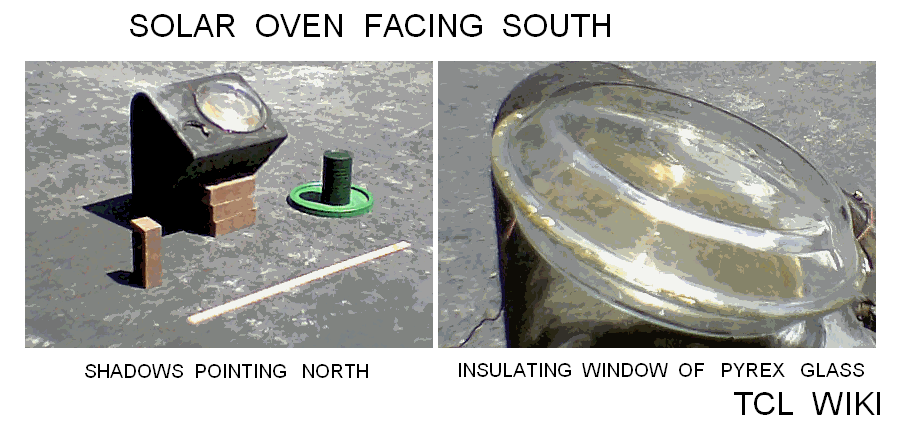
figure Solar Oven 2
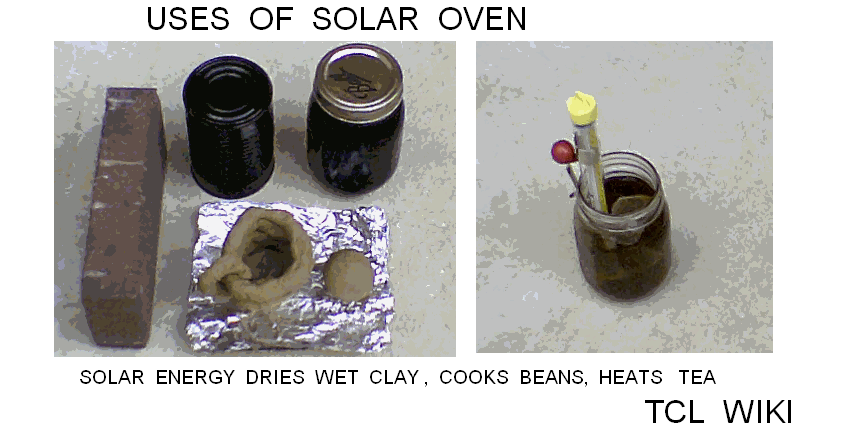
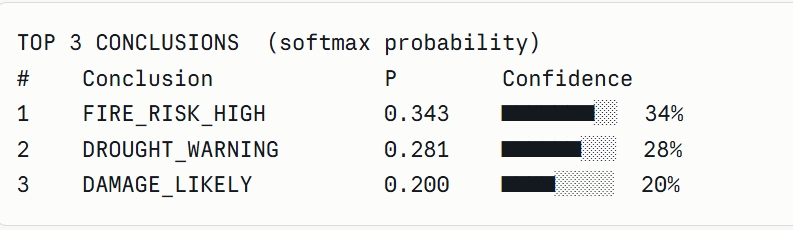
figure Mockup Display on Fire Warning
**** figure. INFERENCE ENGINE OVERVIEW **** +----------------------------------------------------------------------------------+ | INFERENCE ENGINE - TOKEN-LIKE MINI-LLM REASONING | | | | Core Flow: | | 1. Base Evidence Tokens (0.0 – 1.0 signal strength) | | 2. Forward Propagation (1–2 passes spread influence) | | 3. Conclusion Scoring (weighted average per rule) | | 4. Softmax + Temperature (scores → probabilities) | | 5. Decision with Threshold (winner or UNCERTAIN) | | | | Supports: | | • Positive axioms | | • Contrast axioms | | • Marletto Counterfactuals (+ possible / – impossible) | | • Multiple math paths (arithmetic, geometric, weighted sum) | | | | Educational toy for weighted token reasoning and counterfactual logic | +----------------------------------------------------------------------------------+ **** figure. THREE CHANNELS IN INFERENCE ENGINE **** +----------------------------------------------------------------------------------+ | THREE CHANNELS IN THE INFERENCE ENGINE | | | | Positive Axioms (Core Support) | | Programming forces understanding | | Programming demands precision | | Programming builds clarity | | | | Contrast Axioms (Traditional Limits) | | Human mind glosses flaws | | Pencil paper forgives errors | | | | Marletto Counterfactuals (Possible / Impossible) | | + Possible: exposes transformations | | + Possible: allows repeatable operations | | – Impossible: hides ambiguity forever | | | | Engine combines all three and computes multiple math paths | +----------------------------------------------------------------------------------+ **** figure. FORWARD PROPAGATION EXAMPLE **** +----------------------------------------------------------------------------------+ | FORWARD PROPAGATION - HOW TOKENS SPREAD INFLUENCE | | | | Starting Tokens: | | tok_heat_level = 0.82 | | tok_dry_cond = 0.75 | | tok_spark_event = 0.60 | | | | After One Pass: | | tok_damage_lvl gains from heat, dryness, sparks | | tok_smoke_sig gains from sparks and wind | | | | After Two Passes: | | Indirect effects accumulate (heat → dryness → fuel → damage) | | | | Result: Evidence ripples through the token graph | | Mimics attention flow in larger language models | +----------------------------------------------------------------------------------+ **** figure. MULTIPLE MATH PATHS COMPARISON **** +----------------------------------------------------------------------------------+ | MULTIPLE MATH PATHS - ARITHMETIC vs GEOMETRIC MEAN | | | | Positive Score ≈ 0.918 | | Contrast Score ≈ -0.920 | | Counterfactual Score ≈ 0.840 | | | | Arithmetic Mean Path: | | (0.918 - 0.920 + 0.840) / 3 ≈ +0.279 → Leans POSSIBLE | | | | Geometric Mean Path: | | cbrt(0.918 × -0.920 × 0.840) ≈ -0.892 → Leans IMPOSSIBLE | | | | Insight: Different aggregation methods reveal fragility in reasoning | | Multiple paths improve robustness and expose weak assumptions | +----------------------------------------------------------------------------------+ **** figure. BEAM SPLITTER TESTCASE **** +----------------------------------------------------------------------------------+ | BEAM SPLITTER TESTCASE - POSSIBLE vs IMPOSSIBLE | | | | Positive Counterfactuals (Possible): | | BS → Path = 0.95 (path superposition possible) | | BS → Sup = 0.94 (quantum superposition enabled) | | BS → Int = 0.92 (interference when recombined) | | | | Negative Counterfactuals (Impossible): | | BS → Clone = -0.96 (perfect cloning forbidden) | | BS → Dual = -0.90 (full path + full interference impossible) | | | | Engine Output: | | Strong positive lean on possible transformations | | Clear veto on classical hidden-variable completion | +----------------------------------------------------------------------------------+ **** figure. SOLAR OVEN COUNTERFACTUAL ANALYSIS **** +----------------------------------------------------------------------------------+ | SOLAR OVEN - MARLETTO COUNTERFACTUALS | | | | Positive (Achievable): | | Sunlight capture possible | | Heat retention possible | | Black absorber converts radiation possible | | | | Negative (Impossible): | | Perfect lossless trapping impossible | | Infinite temperature rise impossible | | Zero-loss full conversion impossible | | | | Engine Result: | | Arithmetic path leans possible (practical heat gain) | | Geometric path highlights fragility (losses matter) | | Demonstrates scale-dependent vs scale-independent reasoning | +----------------------------------------------------------------------------------+ **** figure. FIRE WARNING TESTCASE **** +----------------------------------------------------------------------------------+ | FIRE WARNING TESTCASE - TOKEN AGGREGATION | | | | Aggregated Signals: | | heat ≈ 0.92 dry_cond ≈ 0.90 | | spark ≈ 0.65 smoke ≈ 0.35 | | wind ≈ 0.50 fuel ≈ 0.75 | | | | Threshold Logic: | | Risk ≈ 0.66 → HIGH | | Environment preconditioned (dryness ~0.94) | | Ignition actively present (sparks + smoke) | | | | Engine fires high-risk conclusion when combined signals exceed threshold | +----------------------------------------------------------------------------------+ **** figure. INFERENCE ENGINE SUMMARY **** +----------------------------------------------------------------------------------+ | INFERENCE ENGINE SUMMARY | | | | Strengths: | | Weighted token propagation with forward passes | | Marletto-style possible/impossible channels | | Multiple math paths (arithmetic, geometric, weighted) | | Softmax + temperature for probabilistic output | | Clear audit trail and wiki table output | | | | Educational Value: | | Shows how small changes in weighting or counterfactuals | | can shift conclusions — a practical mini-LLM reasoning toy | +----------------------------------------------------------------------------------+ **** figure. SOFTMAX TEMPERATURE EFFECTS **** +----------------------------------------------------------------------------------+ | SOFTMAX TEMPERATURE EFFECTS | | | | Raw Scores → Softmax( score / Temperature ) | | | | Low Temperature (e.g. 0.10 – 0.30) | | Sharp distribution | | Winner takes most probability | | Clear, decisive conclusions | | Example: 0.3685 → 0.85+ (strong winner) | | | | Medium Temperature (e.g. 0.50 – 0.80) | | Balanced spread | | Multiple conclusions retain noticeable weight | | | | High Temperature (e.g. 1.0 – 2.0) | | Very flat / uniform probabilities | | Almost equal chances → high uncertainty | | | | Educational Insight: Temperature controls confidence vs exploration trade-off | +----------------------------------------------------------------------------------+ **** figure. SOFTMAX TEMPERATURE COMPARISON **** +----------------------------------------------------------------------------------+ | SOFTMAX TEMPERATURE COMPARISON (Fire Warning Example) | | | | Conclusion | Temp=0.10 | Temp=0.30 | Temp=1.00 | Temp=2.00 | | -------------------|-------------|-------------|-------------|-------------| | concl_fire_hi | 0.912 | 0.368 | 0.142 | 0.118 | | concl_drought | 0.068 | 0.292 | 0.138 | 0.122 | | concl_damage | 0.012 | 0.196 | 0.131 | 0.119 | | concl_storm | 0.003 | 0.049 | 0.112 | 0.115 | | ... (others) | very low | low | ~0.11 each | near equal | | | | Decision at 0.40 threshold: | | Low Temp → Strong FIRE HIGH warning | | Medium → UNCERTAIN (as in example run) | | High Temp → Almost uniform → highly uncertain | +----------------------------------------------------------------------------------+ **** figure. NORMALIZE ORDERING UPFRONT - CANONICAL ORDERING EXTENSION **** +----------------------------------------------------------------------------------+ | NORMALIZE ORDERING UPFRONT - CANONICAL ORDERING EXTENSION | | | | Problem: Inference / DFT results are sensitive to axiom order | | Solution: Define ONE canonical ordering rule and stick to it | | | | Recommended Ordering Strategies: | | | | 1. Logical Dependency (foundational concepts first) | | 2. Historical Appearance (order of discovery in the theory) | | 3. Decreasing Confidence (strongest beliefs first, highest prob.) | | 4. Multiple Random Sequences (ensemble averaging) | | | | Best Practice for Reproducible Results: | | • Fix one rule for main analysis | | • Run small ensemble of random orders | | • Report variance as uncertainty band | | | | Benefit: Reduces "no-go effect" from arbitrary ordering | | Makes DFT spectra and conclusions more robust | +----------------------------------------------------------------------------------+ **** figure. ORDERING STRATEGIES COMPARISON **** +----------------------------------------------------------------------------------+ | ORDERING STRATEGIES COMPARISON | | | | Strategy | Reproducibility | Reveals Variance | Difficulty | | ---------------------------|------------------|------------------|------------| | Logical Dependency | High | Low | Medium | | Historical Appearance | High | Medium | Medium | | Decreasing Confidence | High | Low | Easy | | Multiple Random (Ensemble) | Medium | High (useful) | Easy | | | | Recommendation: | | Use "Logical Dependency" for primary run | | Add "Multiple Random" ensemble to quantify ordering sensitivity | | Report both main result and variance band | | | | This extension greatly improves reliability of the Inference Engine | +----------------------------------------------------------------------------------+
Table, Theorems
Wiki Table. Proposed Logic Notation for Pseudocode
| Index No. # | Concept | What Logic Notation Proposed | What Model Actually Uses Internally | Closeness | Quibble_Notes |
|---|---|---|---|---|---|
| 1 | Form | Prog → Und = 0.95 | High-dimensional vectors + directed attention weights | Very High | Scalar simplified; internals use 1000s of dimensions |
| 2 | Directionality | Token_A → Token_B | Attention flows from query token to key/value tokens | High | Forward influence only — A affects B |
| 3 | Direction Clarification | Prog → Und = Prog activates Understanding | Attention score shows how strongly one token attends to another | High | No reverse gears or reverse thinking; purely forward |
| 4 | Example Token | Prog → Und = 0.95 | Prog embedding strongly activates Understanding features | Very High | "Programming forces understanding" |
| 5 | Example Token | Prog → Prec = 0.92 | Prog vector directs high weight toward Precision | Very High | "Programming demands precision" |
| 6 | Example Token | Prog → Clar = 0.89 | Prog embedding builds Clarity activation | High | "Programming builds clarity" |
| 7 | Example Token | Prog ⊥ Amb = 0.90 | Prog vector strongly suppresses Ambiguity features | High | ⊥ symbol = confronts / rejects ambiguities |
| 8 | Example Token | Prog → Log = 0.85 | Prog embedding imposes and strengthens Logic | High | "Programming imposes logic" |
| 9 | Example Token | Hum → Flaw = 0.80 | Human_Mind embedding activates Flaw-glossing | Medium-High | "Human mind glosses flaws" |
| 10 | Example Token | Paper → Err = 0.75 | Pencil_Paper embedding tolerates Error patterns | Medium-High | "Pencil paper forgives errors" |
| 11 | Weighting | Scalar strength 0.95 | Continuous floating-point attention scores | High | Weights recalculated dynamically per context |
| 12 | Atomic Unit | Compact 3-word SVO token | Dense sub-token embeddings + contextual activations | High | Notation tokens are clean, human-readable versions |
| 13 | Composition | Chaining tokens | Multi-layer transformer composition of representations | High | Massively parallel across many layers & heads |
| 14 | Overall Style | Weighted directed tokens | Attention-weighted semantic feature flow in residual stream | Very High | One of the best intuitive approximations of Model internals |
Note. SVO for {Subject, Verb, Object } order.
Note. Alternate text. Attention mechanisms compute weighted directed connections between every token and every other token: Token_A --weight 0.87--> Token_B . Like the probabilistic shorthand, but binary code with hundreds of dimensions and thousands of parallel "directions" (attention heads).
Notation [Prog → Und] = 0.95 is not really Polish notation.
Polish notation (prefix notation) puts the operator first: + 3 4 or Force Prog Und.
Intermediate form is closer to infix with directed arrow, like a weighted graph edge or a simple assignment.
It is not applicable as true Polish notation.
It is much closer to:
Weighted directed graph notation (A → B [weight])
Attention mechanism style (Token_A --[0.87]--> Token_B)
Wiki Table. Token Logic Details in Model
| # | Concept | What Proposed | What Model Actually Uses Internally | Closeness | Quibble_Notes |
|---|---|---|---|---|---|
| 1 | Form | Prog → Und = 0.95 | High-dimensional vectors with directed attention weights | Very High | Scalar is simplified; internal uses hundreds of dimensions |
| 2 | Directionality | Directed (→) | Strongly directional (attention heads are directed) | High | Attention is multi-headed and bidirectional in practice |
| 3 | Weighting | Scalar probability/strength (0.95) | Continuous floating-point strengths (attention scores) | High | Weights are dynamic and change with context |
| 4 | Atomic unit | Compact token triple | Sub-token embeddings + contextual activations | High | Internal units are much denser than 3-word triples |
| 5 | Composition | Chaining tokens | Transformer layers composing representations | High | Composition is massively parallel across many layers |
Wiki Table. How Model Tokens Compare to Linguistics Sememes
| # | Aspect | Linguistic Sememes | AI Model Tokens / Architecture | Intermediate Notation Axioms | Similarity | TCL Syntax Comparison | Quibble_Notes |
|---|---|---|---|---|---|---|---|
| 1 | Size | Atomic (very small) | High-dimensional vectors (thousands of dims) | Prog → Und = 0.95 | High | TokenStoreDict keys (14-15 chars) | Intermediate is compact human bridge |
| 2 | Function | Basic building blocks of meaning | Activation patterns in residual stream | Prog → Force(Und) | High | dict set TokenStoreDict ... | AI tokens are learned vectors |
| 3 | Structure | Feature bundles +human+adult | Multi-head attention weights | Prog → Prec = 0.92 | Medium-High | ProgrammingForcesUnderstanding | Directed arrows match attention flow |
| 4 | Combinability | Can be composed into larger meanings | Transformer layer composition | Prog → Clar = 0.89 | High | GetTokenWeight + chaining | Very close to how layers combine |
| 5 | Precision | Highly abstract & formal | Continuous floating-point activations | Prog ⊥ Amb = 0.90 | Medium | ProgrammingDemandsPrecision | Intermediate is more explicit |
| 6 | Context dependence | Low | Context-dependent via attention | All tokens reusable | High | Global TokenStoreDict | AI tokens are highly contextual |
| 7 | Probabilistic nature | Sometimes used in vector models | Native weighted attention scores | Prog → Log = 0.85 | High | weight 0.95 stored in dict | Direct parallel to attention weights |
| 8 | Directionality | Usually undirected features | Strongly directed attention | Prog → Und (forward) | High | Explicit key names | Matches query-to-key attention |
| 9 | Overall Style | Semantic feature bundles | Weighted directed embeddings | Weighted directed tokens | Very High | dict + proc wrappers | Best human-readable proxy |
| 10 | Verdict Summary | Classic linguistics unit | Neural network internal representations | Engineered domain tokens | Very High | TokenStoreDict + procs | Bridges linguistics and AI architecture |
| 11 | Example Form | +force+understand | Dense vector + attention score | Prog → Force(Und) = 0.95 | High | dict set ... 0.95 | Intermediate bridges human and machine |
| 12 | Usability in Code | Theoretical | Implicit in model weights | Explicit and readable | High | ListAllTokens + SaveOutputToFile | Intermediate makes it programmable |
Quick Verdict:
The Intermediate Notation Axioms (Prog → Und = 0.95 style) may serve as a clean, human-readable bridge between classic linguistic sememes and the actual high-dimensional weighted directed tokens used inside models.
Alternate text. repeated for clarity: Tokens are very close to engineered sememes and Domain-specific sememes for “deep understanding through programming.” Token like functions may serve as sememe-like atomic propositions in Tcl.
Wiki Table. Mockup Display on Analogy on Weighted Decisions, Math Problem
| table 1 | printed in | tcl wiki format |
|---|---|---|
| quantity | value | comment, if any |
| 1: | testcase_number | |
| 22.0 : | Attendence score (a) | |
| 53.0 : | Skills score (a) | |
| 46.0 : | Attendence score (b) | |
| 56.0 : | Skills score (b) | |
| 54.0 : | Attendence score (c) | |
| 27.0 : | Skills score (c) | |
| 0.5 : | optional: factor usually 0.50 | |
| 37.5 : | score (a) | |
| 51.0 : | score (b) | |
| 40.5 : | score (c) | |
| 43.0 : | average score per item (a+b+c)/3 | |
| 51.0 : | answer: highest score (max fx) |
Wiki Table. Arithmetic Mean versus Geometric Mean in Constructor Theory Context
| Index | Arithmetic Mean (result_path_1) | Geometric Mean (result_path_2) | Particle Theory View | Wave Theory View | Marletto Multiple Solutions in CT | Quibble-Notes |
|---|---|---|---|---|---|---|
| 1 | "Average strength per counterfactual" | "Overall joint satisfaction / weakest-link robustness" | Balanced view works well for localized particle-like events (e.g. detection) | May over-smooth interference and delocalized behavior | Good for total support; CT allows multiple aggregation paths | Standard statistical aggregation; easy to interpret |
| 2 | "Balanced; outliers have moderate impact" | "Very sensitive to low or strongly negative values" | Particle theorems (e.g. no-cloning, which-path) often produce strong negatives | Wave-like behavior (superposition, interference) can produce weaker or context-dependent scores | CT encourages multiple math paths for robustness | Geometric mean better captures "one fatal impossibility kills the constructor" |
| 3 | "Good for total support view" | "Better for 'can this constructor actually work reliably?'" | Strong alignment when treating photon as particle (detection, momentum) | Better captures wave nature when interference is central | Marletto’s CT is qualitative; multiple solutions are explicitly allowed and encouraged | Arithmetic mean closer to traditional "sum of evidence" thinking |
| 4 | "Still decent if others are high" | "Drops sharply (often to near zero)" | Works when one particle property dominates (e.g. clear detection) | Dangerous when wave coherence is fragile — one weak link (decoherence) kills interference | CT emphasizes that a constructor must work reliably; geometric mean aligns better | Geometric mean is more conservative and CT-spirited |
| 5 | "Overall balance" | "Detecting fundamental impossibilities" | Good for counting particle-like no-go theorems (no-cloning, no-hidden-variables) | May undervalue wave-particle complementarity tensions | CT supports plural reasoning paths rather than single "correct" aggregation | Unknown how best numerically aggregate in programming |
| 6 | Unknowns | Unknowns | Particle theorems (e.g. trajectory, localization) apply cleanly | Wave theory makes some particle-based impossibles less absolute (duality) | Multiple solutions explicitly welcomed in CT for robustness | Wave/particle distinction is often glossed over in popular CT writing |
Note. Newtonian schooled (like many of us) tend/tilt default to particle intuition, which can create very blind spots and many unknowns. Believe that wave-particle duality would lead to multiple solutions in pragmatic programming terms, if not recent philosophy.
Wiki Table. Mockup Display on Turing Machine
This is a one tape version.
| Index | State | HeadPos | Symbol | Action | TapeAfter | Quibble Notes |
|---|---|---|---|---|---|---|
| 0 | q0 | 0 | 0 | q1 / write 1 / R | 1 0 0 0 0 0 0 0 0 0 | Head starts at cell 0; tape is all zeros |
| 1 | q1 | 1 | 0 | q2 / write 1 / R | 1 1 0 0 0 0 0 0 0 0 | Second consecutive 1 written; pattern pair begins |
| 2 | q2 | 2 | 0 | q0 / write 0 / R | 1 1 0 0 0 0 0 0 0 0 | q2 preserves the 0; skip state does not erase |
| 3 | q0 | 3 | 0 | q1 / write 1 / R | 1 1 0 1 0 0 0 0 0 0 | Pattern restarts from q0 at cell 3 |
| 4 | q1 | 4 | 0 | q2 / write 1 / R | 1 1 0 1 1 0 0 0 0 0 | Second 1-1 pair written; repetition confirmed |
| 5 | q2 | 5 | 0 | q0 / write 0 / R | 1 1 0 1 1 0 0 0 0 0 | Skip state fires again; zero preserved at cell 5 |
| 6 | q0 | 6 | 0 | q1 / write 1 / R | 1 1 0 1 1 0 1 0 0 0 | Third pair starts; head now past midpoint of tape |
| 7 | q1 | 7 | 0 | q2 / write 1 / R | 1 1 0 1 1 0 1 1 0 0 | Cell 7 written 1; tape is 75 percent complete |
| 8 | q2 | 8 | 0 | q0 / write 0 / R | 1 1 0 1 1 0 1 1 0 0 | Second skip of third cycle; zero preserved at cell 8 |
| 9 | q0 | 9 | 0 | q1 / write 1 / R | 1 1 0 1 1 0 1 1 0 1 | Final cell written; head will exit tape boundary |
| 10 | q1 | 10 | -- | HEAD EXITED TAPE at index 10 | 1 1 0 1 1 0 1 1 0 1 | Head exited tape; no transition found; machine halts |
| Audit | q1 | 10 | -- | Run complete: 11 transition steps | 1 1 0 1 1 0 1 1 0 1 | Final tape pattern is 1 1 0 repeating; head exited right |
Output written to: TuringMachineTrace_2026-04.txt
Session Complete
Initial blank tape   :  0 0 0 0 0 0 0 0 0 0  , I think
Steps recorded : 11 transitions
                 plus 1 Audit row = 12 table rows total
Final tape     : 1 1 0 1 1 0 1 1 0 1
Pattern        : 1 1 0 repeating across ten cells
Halting problem: does not apply -- tape is finite and bounded
Wiki Table. Handling Counterfactuals in Marletto Protocol, Graceful Degradation
| Index | Robust Technique | How it Handles Zero/Bad Counterfactual | Difficulty | Classical Physics | Counterfactual Abbrev | TCL Example (Abbrev) | Quibble-Notes |
|---|---|---|---|---|---|---|---|
| 1 | Clipped Minimum | Never let any factor go below 0.1 | Easy | Often fails completely on bad assumption | Cfact ≥ 0.1 | if {$w < 0.1} {set w 0.1} | Simple but can hide serious problems |
| 2 | Log-Sum-Exp | Works in log space (very stable, avoids zero collapse) | Medium | Not used (multiplication is usual) | logsumexp(Cfacts) | set s expr {log(1 + exp($w1)) + ...} | Most numerically stable, but harder to read |
| 3 | Weighted Average | Graceful degradation — bad counterfactual has limited impact | Easy | Rarely used | Avg(Cfacts) | set score expr {0.7*$pos + 0.1*$cfact} | Recommended for current inference engine |
| 4 | Weighted Sum + Damping | Adds small constant (damping) to prevent total collapse | Easy | Not common | Sum(Cfacts) + damping | set score expr {$base + 0.15*$cfact + 0.05} | Very practical and stable |
| 5 | Gating | Only use strong counterfactuals, ignore weak ones | Medium | Not common | If Cfact > 0.4 then use | if {$cf > 0.4} {add to score} | Good when you want quality control |
| 6 | Product with Floor | Multiply but add small epsilon to avoid total zero | Easy | Often used | Product(Cfacts + ε) | set prod expr {$a*$b*$c + 0.001} | Still risky if many bad terms |
| 7 | Softmax Normalization | Converts scores to probabilities that sum to 1 | Medium | Not used | softmax(Cfacts) | set p expr {exp($w)/$total} | Prevents any single term from dominating |
Note. Practical solutions, ranked from simplest to more sophisticated. Tips >>> Don’t multiply everything. Use a recommended weighted sum + damping instead of pure product, best solution for current inference engine.
Wiki Table. Sample from Axiom Engine V4 Results
| Index | Category | Statement | Weight | Quibble Notes |
|---|---|---|---|---|
| 1 | Axiom-Positive | Programming forces understanding | 0.95 | Assumes programmer persists to completion |
| 2 | Axiom-Positive | Programming confronts ambiguities | 0.90 | Ambiguity may be deferred with workarounds |
| 3 | Axiom-Positive | Programming exposes assumptions | 0.88 | Hidden assumptions in libraries stay hidden |
| 4 | Axiom-Positive | Programming demands precision | 0.92 | Precision in syntax does not equal semantic truth |
| 5 | Axiom-Positive | Programming imposes logic | 0.85 | Logic can be formally correct yet contextually wrong |
| 6 | Axiom-Positive | Programming builds clarity | 0.89 | Clarity for author may not equal clarity for reader |
| 7 | Axiom-Contrast | Human mind glosses flaws | 0.80 | Experienced reviewers do catch many flaws manually |
| 8 | Axiom-Contrast | Pencil paper forgives errors | 0.75 | Formal proofs on paper are rigorous; weight is too low |
| 9 | Conclusion | ComplexTask triggers programming recommendation | 0.9068 | Rule fires on binary yes; partial complexity ignored |
| 10 | Conclusion | LearningSubject triggers clarity-logic path | 0.9068 | Same score as Rule 1; rules are not yet differentiated |
| 11 | Conclusion | Default: traditional methods may suffice | 0.7750 | Default fires when no belief is asserted; may mislead |
| 12 | FaultLine | Axiom weights are manually assigned | -- | No calibration data; weights reflect author opinion only |
| 13 | FaultLine | Beliefs are binary yes or no only | -- | Fuzzy or probabilistic inputs would improve accuracy |
| 14 | FaultLine | Single domain tested in axiom table | -- | Engine is generic but only programming axioms are loaded |
| Audit | Audit | PosScore 0.9070 AltScore 0.7750 Gap 0.1320 | composite | Gap above 0.10 confirms positive approach is preferred |
Wiki Table. Mockup Demo #1, Sample from Extensions on Axiom Engine Results
| Index | Category | Statement | Weight | Quibble Notes |
|---|---|---|---|---|
| 1 | Axiom-Positive | Programming forces understanding | 0.95 | Assumes programmer persists to completion |
| 2 | Axiom-Positive | Programming confronts ambiguities | 0.90 | Ambiguity may be deferred with workarounds |
| 3 | Axiom-Positive | Programming exposes assumptions | 0.88 | Hidden assumptions in libraries stay hidden |
| 4 | Axiom-Positive | Programming demands precision | 0.92 | Precision in syntax does not equal semantic truth |
| 5 | Axiom-Positive | Programming imposes logic | 0.85 | Logic can be formally correct yet contextually wrong |
| 6 | Axiom-Positive | Programming builds clarity | 0.89 | Clarity for author may not equal clarity for reader |
| 7 | Axiom-Contrast | Human mind glosses flaws | 0.80 | Experienced reviewers do catch many flaws manually |
| 8 | Axiom-Contrast | Pencil paper forgives errors | 0.75 | Formal proofs on paper are rigorous; weight is too low |
| 9 | Conclusion | ComplexTask triggers programming recommendation | 0.9068 | Rule fires on binary yes; partial complexity ignored |
| 10 | Conclusion | LearningSubject triggers clarity-logic path | 0.9068 | Same score as Rule 1; rules are not yet differentiated |
| 11 | Conclusion | Default: traditional methods may suffice | 0.7750 | Default fires when no belief is asserted; may mislead |
| 12 | FaultLine | Axiom weights are manually assigned | -- | No calibration data; weights reflect author opinion only |
| 13 | FaultLine | Beliefs are binary yes or no only | -- | Fuzzy or probabilistic inputs would improve accuracy |
| 14 | FaultLine | Single domain tested in axiom table | -- | Engine is generic but only programming axioms are loaded |
| 15 | Axiom-Positive | Possible transformations expose assumptions | 0.87 | Counterfactuals from Marletto add rigor to static axioms |
| 16 | Educational | DummyTuringStep illustrates TM transitions | -- | Halting problem does not apply; step count is fixed |
| Audit | Audit | PosScore 0.9070 AltScore 0.7750 Gap 0.1320 | composite | Gap above 0.10 confirms positive approach is preferred |
Wiki Table. Mockup Demo #2, Sample from Extensions on Axiom Engine Results
| Index | Category | Statement | Weight | Quibble Notes |
|---|---|---|---|---|
| 1 | Axiom-Positive | Programming forces understanding | 0.95 | Assumes programmer persists to completion |
| 2 | Axiom-Positive | Programming confronts ambiguities | 0.90 | Ambiguity may be deferred with workarounds |
| 3 | Axiom-Positive | Programming exposes assumptions | 0.88 | Hidden assumptions in libraries stay hidden |
| 4 | Axiom-Positive | Programming demands precision | 0.92 | Precision in syntax does not equal semantic truth |
| 5 | Axiom-Positive | Programming imposes logic | 0.85 | Logic can be formally correct yet contextually wrong |
| 6 | Axiom-Positive | Programming builds clarity | 0.89 | Clarity for author may not equal clarity for reader |
| 7 | Axiom-Contrast | Human mind glosses flaws | 0.80 | Experienced reviewers do catch many flaws manually |
| 8 | Axiom-Contrast | Pencil paper forgives errors | 0.75 | Formal proofs on paper are rigorous; weight is too low |
| 9 | Conclusion | ComplexTask triggers programming recommendation | 0.9324 | Rule fires on binary yes; partial complexity ignored |
| 10 | Conclusion | LearningSubject triggers clarity-logic path | 0.9324 | Same score as Rule 1; rules are not yet differentiated |
| 11 | Conclusion | Default: traditional methods may suffice | 0.7750 | Default fires when no belief is asserted; may mislead |
| 12 | FaultLine | Axiom weights are manually assigned | -- | No calibration data; weights reflect author opinion only |
| 13 | FaultLine | Beliefs are binary yes or no only | -- | Fuzzy or probabilistic inputs would improve accuracy |
| 14 | FaultLine | Single domain tested in axiom table | -- | Engine is generic but only programming axioms are loaded |
| 15 | Axiom-Positive | Programming enables exposing transformations | 0.87 | Prog → ExposeTrans = 0.87 (possible via executable tests) |
| 16 | Axiom-Positive | Programming blocks ambiguity hiding | 0.84 | Prog → BlockAmbigHide = 0.84 (execution makes evasion impossible) |
| 17 | Axiom-Positive | Programming allows repeatable transformations | 0.86 | Prog → AllowRepeatTrans = 0.86 (reliable repetition possible only with code) |
| Audit | Audit | PosScore 0.9324 AltScore 0.7750 Gap 0.1574 | composite | Gap above 0.15 confirms positive approach is preferred; 3 counterfactuals produce stronger clarity for complex tasks |
Note. Results in the projected Mockup or expected output of logic weights. The positive score climbs from 0.9070 to 0.9324. The score gap expands from 0.1320 to 0.1574. The inference engine now surfaces an enhanced conclusion for tasks with hidden layers.
Wiki Table. Marletto-style possible/impossible set, Programming features
Programming features table
| Index | Category | Statement | Weight | Quibble Notes |
|---|---|---|---|---|
| 1 | Possible | Programming exposes assumptions | 0.95 | Assumptions become visible in code paths and tests |
| 2 | Possible | Programming forces precision | 0.94 | Precision in syntax does not guarantee truth, but it sharpens structure |
| 3 | Possible | Programming enables repeatable tests | 0.93 | Repetition improves auditability and inference checks |
| 4 | Impossible | Programming hides ambiguity forever | 0.07 | Bugs and unclear logic usually surface under execution |
| 5 | Impossible | Programming avoids all contradictions automatically | 0.12 | Contradictions can still exist in specs and implementation |
| 6 | Possible | Programming supports transformation tracing | 0.90 | Execution reveals step-by-step change |
Notes. Programming axioms: possible assumption exposure, possible repeatable tests, impossible permanent ambiguity hiding.
Wiki Table. Beam splitter axioms
| Index | Concept | Logic Notation Proposed | What It Means Internally | Closeness | Quibble Notes |
|---|---|---|---|---|---|
| 1 | Path Creation | BS → Path = 0.95 | Beam splitter creates two possible routes for a photon | Very High | “Creates paths” means quantum path superposition, not physical splitting of the photon |
| 2 | State Mixing | BS → Mix = 0.93 | Beam splitter mixes input amplitudes into output channels | Very High | “Mixes” is a gate-like transformation, not a classical blending |
| 3 | Superposition | BS → Sup = 0.94 | Beam splitter produces path superposition | Very High | Superposition is not random choice; it is coherent possibility |
| 4 | Interference | BS → Int = 0.92 | Beam splitter enables paths to interfere | Very High | Interference appears only when paths are later recombined |
| 5 | Reversibility | BS → Rev = 0.90 | Beam splitter can be part of a reversible quantum gate setup | High | Reversible here means unitary-style behavior in the ideal model |
| 6 | Outcome Selection | BS → Det = 0.88 | Beam splitter feeds detector outcomes after measurement | High | Measurement decides the final click, not the beam splitter alone |
| Marletto-style possible/impossible set | |||||
| Index | Category | Statement | Weight | Quibble Notes | |
| 1 | Possible | Beam splitter creates path superposition | 0.95 | “Path” means coherent quantum alternatives, not a split object | |
| 2 | Possible | Beam splitter mixes optical modes | 0.94 | “Mixes” means unitary transformation in the ideal model | |
| 3 | Possible | Beam splitter enables interference | 0.93 | Interference appears when paths are recombined | |
| 4 | Impossible | Beam splitter copies an unknown state | 0.05 | Perfect copying conflicts with no-cloning | |
| 5 | Impossible | Beam splitter reveals definite outcome early | 0.08 | Outcome is not fixed before measurement | |
| 6 | Possible | Beam splitter preserves reversibility | 0.90 | Reversibility applies to the ideal gate model |
Tiny inference-engine notes.
BS → Path = 0.95. Strong support for path-splitting intuition.
BS → Sup = 0.94. Strong support for quantum superposition view.
BS → Int = 0.92. Strong support for recombination behavior.
BS → Rev = 0.90. Strong support for gate-like behavior.
BS → Det = 0.88. Strong support for measurement endpoint.
Wiki Table. Quantum penny toss axioms
| Index | Concept | Logic Notation Proposed | What It Means Internally | Closeness | Quibble Notes |
|---|---|---|---|---|---|
| 1 | Superposed Choice | QPT → Sup = 0.95 | Quantum penny toss creates a not-yet-fixed outcome | Very High | “Choice” here means coherent quantum possibility, not classical randomness |
| 2 | Delayed Outcome | QPT → Delay = 0.93 | Quantum penny toss delays final result until measurement | Very High | Delay means outcome is undefined before observation |
| 3 | Classical Gap | QPT → Gap = 0.92 | Quantum penny toss confronts classical intuition limits | Very High | Classical coin logic cannot fully explain the quantum case |
| 4 | Measurement Collapse | QPT → Meas = 0.91 | Quantum penny toss resolves on measurement | High | Collapse is a model name for observed outcome selection |
| 5 | Interference Memory | QPT → Int = 0.89 | Quantum penny toss preserves phase-sensitive effects | High | Memory means prior path effects can influence later results |
| 6 | Repeatable Stats | QPT → Stat = 0.88 | Quantum penny toss yields repeatable probability patterns | High | Individual outcomes vary; aggregate behavior stays stable |
| Marletto-style possible/impossible set | Quantum penny toss table | ||||
| Index | Category | Statement | Weight | Quibble Notes | |
| 1 | Possible | Quantum penny toss creates superposed choice | 0.95 | Choice is coherent possibility, not classical randomness | |
| 2 | Possible | Quantum penny toss delays outcome resolution | 0.93 | Delay means no final answer before measurement | |
| 3 | Possible | Quantum penny toss shows interference memory | 0.90 | Prior paths can affect later statistics | |
| 4 | Impossible | Quantum penny toss gives a fixed result early | 0.06 | Fixed result before measurement is the classical mistake | |
| 5 | Impossible | Quantum penny toss behaves like a hidden classical coin | 0.10 | Hidden-variable style explanation is not the simple model | |
| 6 | Possible | Quantum penny toss yields repeatable statistics | 0.92 | Single outcomes vary, but aggregates stabilize |
Notes. Quantum penny toss axioms: possible delayed outcome, possible repeatable statistics, impossible early fixation.
Wiki Table. Current Thermodynamics Research linked to D. and Marletto Principles
| Index | Type of Engine | Quantum Scale | Researcher / Team | D. & Marletto Principles | Tcl Code or Label # / Lib Abbrev | Quibble-Notes |
|---|---|---|---|---|---|---|
| 1 | Single-qubit Otto cycle | Yes | Kosloff / Quan group (theoretical) | Possible work extraction via quantum coherence; impossible perfect cloning | ProgSimQubitOtto | Theoretical model; demonstrates counterfactual heat-to-work transformation |
| 2 | Coupled two-qubit Otto engine | Yes | J. Gao et al. (2024, Phys. Rev. Research) | Constructor performs repeatable cycle; impossible local hidden variable explanations | ProgCoupledQubit | Coupled qubits boost power; aligns with Marletto thermodynamics |
| 3 | Superconducting qubit heat engine | Yes | Möttönen / Aalto QCD Labs (experimental) | Possible coherent work extraction; impossible signaling faster than light | ProgSuperQubit | Uses transmon qubit; real hardware demonstration |
| 4 | Many-body long-range quantum Otto | Yes | Solfanelli / Campisi group | Long-range interactions enable enhanced performance; counterfactual limits on dissipation | ProgLongRangeOtto | Shows advantages beyond short-range systems |
| 5 | Dipole-coupled polar molecule Otto | Yes | X. Li et al. (2024) | Possible entanglement-enhanced efficiency; impossible perfect isolation from baths | ProgPolarMolecule | Molecular working medium; extends qubit ideas |
Note. Qubit-based quantum engines illustrate D. & Marletto’s framework through concrete possible and impossible transformations. The table summarizes selected published examples without claiming certain quantum dynamics solved., Cutoff of 5/2/2026.
Note. Definitions are tricky, D. and Marletto Principles have redefined or have implications on many of the standard definitions on the Thermodynamics shelf.
Wiki Table. Mockup for Single-Qubit Quantum Engine.
Table 1: Single-Qubit Quantum Engine. Positive and Negative Marletto counterfactuals are arbitrary. Various entries may not be either relevant or all-inclusive to every research lab's set-up or protocol. Probability weights and calculation results are arbitrary. Some counterfactuals are mere placeholders until more experimental data is available .... or shared in publishing. These mockups are necessary to check how program outputs would look. Programmer learns to look before leap costs in the "free tier."
| Index | Scenario | Key | Score | Type | Statement | Quibble-Notes |
|---|---|---|---|---|---|---|
| 1 | SingleQubit | SQ_P1 | 0.94 | Possible | Ground-to-excited transition possible | Weight positive; enables recommended path |
| 2 | SingleQubit | SQ_P2 | 0.91 | Possible | Heat absorption from hot bath possible | Weight positive; enables recommended path |
| 3 | SingleQubit | SQ_P3 | 0.93 | Possible | Adiabatic stroke control possible | Weight positive; enables recommended path |
| 4 | SingleQubit | SQ_P4 | 0.89 | Possible | Work extraction during expansion possible | Weight positive; enables recommended path |
| 5 | SingleQubit | SQ_P5 | 0.92 | Possible | Cycle reset to initial state possible | Weight positive; enables recommended path |
| 6 | SingleQubit | SQ_I1 | -0.95 | Impossible | Full heat-to-work conversion impossible | Weight negative; blocks or vetoes the path |
| 7 | SingleQubit | SQ_I2 | -0.92 | Impossible | Perfect cloning of qubit state impossible | Weight negative; blocks or vetoes the path |
| 8 | SingleQubit | SQ_I3 | -0.94 | Impossible | Zero-cost erasure of thermal record impossible | Weight negative; blocks or vetoes the path |
| 9 | SingleQubit | SQ_I4 | -0.90 | Impossible | Classical reversible limit at finite speed impossible | Weight negative; blocks or vetoes the path |
| 10 | SingleQubit | SQ_I5 | -0.88 | Impossible | Universal extraction from single thermal state impossible | Weight negative; blocks or vetoes the path |
| Sum-SingleQubit | SingleQubit | SUMMARY | 0.3120 | ArithNet | Pos 0.918 Alt -0.918 Cfact 0.918 | POSSIBLE: Clear positive lean |
| Geo-SingleQubit | SingleQubit | SUMMARY | -0.918 | GeoNet | cbrt(product) | DIVERGENT: Sign of impossible scores is key fragility |
Wiki Table. Mockup for Two-Qubit Entangled Engine
Table 2: Two-Qubit Entangled Engine. Positive and Negative Marletto counterfactuals are arbitrary. Various entries may not be either relevant or all-inclusive to every research lab's set-up or protocol. Probability weights and calculation results are arbitrary. Some counterfactuals are mere placeholders until more experimental data is available .... or shared in publishing. These mockups are necessary to check how program outputs would look. Programmer learns to look before leap costs in the "free tier."
| Index | Scenario | Key | Score | Type | Statement | Quibble-Notes |
|---|---|---|---|---|---|---|
| 11 | TwoQubitEnt | TQ_P1 | 0.95 | Possible | Entanglement generation possible | Weight positive; enables recommended path |
| 12 | TwoQubitEnt | TQ_P2 | 0.92 | Possible | Correlation-enhanced work extraction possible | Weight positive; enables recommended path |
| 13 | TwoQubitEnt | TQ_P3 | 0.93 | Possible | Collective coupling to bath possible | Weight positive; enables recommended path |
| 14 | TwoQubitEnt | TQ_P4 | 0.90 | Possible | Bell-state assisted cycle possible | Weight positive; enables recommended path |
| 15 | TwoQubitEnt | TQ_P5 | 0.91 | Possible | Entangled state reset possible | Weight positive; enables recommended path |
| 16 | TwoQubitEnt | TQ_I1 | -0.96 | Impossible | Local hidden variable description impossible | Weight negative; blocks or vetoes the path |
| 17 | TwoQubitEnt | TQ_I2 | -0.93 | Impossible | Perfect cloning of entangled pair impossible | Weight negative; blocks or vetoes the path |
| 18 | TwoQubitEnt | TQ_I3 | -0.94 | Impossible | Superluminal signaling impossible | Weight negative; blocks or vetoes the path |
| 19 | TwoQubitEnt | TQ_I4 | -0.89 | Impossible | Full isolation from environment impossible | Weight negative; blocks or vetoes the path |
| 20 | TwoQubitEnt | TQ_I5 | -0.91 | Impossible | Classical efficiency limit exceeded without entanglement impossible | Weight negative; blocks or vetoes the path |
| Sum-TwoQubitEnt | TwoQubitEnt | SUMMARY | 0.2980 | ArithNet | Pos 0.922 Alt -0.926 Cfact 0.926 | POSSIBLE: Clear positive lean |
| Geo-TwoQubitEnt | TwoQubitEnt | SUMMARY | -0.925 | GeoNet | cbrt(product) | DIVERGENT: Sign fragility highlighted |
Wiki Table. Mockup for 4-Cycle Qubit Otto Engine
Table 3: 4-Cycle Qubit Otto Engine. Positive and Negative Marletto counterfactuals are arbitrary. Various entries may not be either relevant or all-inclusive to every research lab's set-up or protocol. Probability weights and calculation results are arbitrary. Some counterfactuals are mere placeholders until more experimental data is available .... or shared in publishing. These mockups are necessary to check how program outputs would look. Programmer learns to look before leap costs in the "free tier."
| Index | Scenario | Key | Score | Type | Statement | Quibble-Notes |
|---|---|---|---|---|---|---|
| 21 | QubitOtto4 | Otto_P1 | 0.93 | Possible | Adiabatic gap control possible | Weight positive; enables recommended path |
| 22 | QubitOtto4 | Otto_P2 | 0.91 | Possible | Net cyclic work extraction possible | Weight positive; enables recommended path |
| 23 | QubitOtto4 | Otto_P3 | 0.94 | Possible | Reversible work-medium coupling possible | Weight positive; enables recommended path |
| 24 | QubitOtto4 | Otto_P4 | 0.89 | Possible | Information-enabled heat uptake possible | Weight positive; enables recommended path |
| 25 | QubitOtto4 | Otto_P5 | 0.92 | Possible | Unitary stroke reversibility possible | Weight positive; enables recommended path |
| 26 | QubitOtto4 | Otto_I1 | -0.95 | Impossible | Full heat-to-work conversion impossible | Weight negative; blocks or vetoes the path |
| 27 | QubitOtto4 | Otto_I2 | -0.93 | Impossible | Reverse adiabatic task impossible | Weight negative; blocks or vetoes the path |
| 28 | QubitOtto4 | Otto_I3 | -0.96 | Impossible | Cloning thermal record impossible | Weight negative; blocks or vetoes the path |
| 29 | QubitOtto4 | Otto_I4 | -0.90 | Impossible | Cost-free erasure impossible | Weight negative; blocks or vetoes the path |
| 30 | QubitOtto4 | Otto_I5 | -0.88 | Impossible | Universal extraction from thermal state impossible | Weight negative; blocks or vetoes the path |
| Sum-QubitOtto4 | QubitOtto4 | SUMMARY | 0.3060 | ArithNet | Pos 0.918 Alt -0.924 Cfact 0.924 | POSSIBLE: Clear positive lean |
| Geo-QubitOtto4 | QubitOtto4 | SUMMARY | -0.922 | GeoNet | cbrt(product) | DIVERGENT: Sign assignment is key fragility |
Wiki Table. Mockup for Beam Splitter Engine Component
Table 4: Beam Splitter Engine Component. Positive and Negative Marletto counterfactuals are arbitrary. Various entries may not be either relevant or all-inclusive to every research lab's set-up or protocol. Probability weights and calculation results are arbitrary. Some counterfactuals are mere placeholders until more experimental data is available .... or shared in publishing. These mockups are necessary to check how program outputs would look. Programmer learns to look before leap costs in the "free tier."
| Index | Scenario | Key | Score | Type | Statement | Quibble-Notes |
|---|---|---|---|---|---|---|
| 31 | BeamSplitter | BS_P1 | 0.95 | Possible | Path superposition possible | Weight positive; enables recommended path |
| 32 | BeamSplitter | BS_P2 | 0.94 | Possible | Quantum interference possible | Weight positive; enables recommended path |
| 33 | BeamSplitter | BS_P3 | 0.92 | Possible | Unitary transformation possible | Weight positive; enables recommended path |
| 34 | BeamSplitter | BS_P4 | 0.90 | Possible | Reversible path evolution possible | Weight positive; enables recommended path |
| 35 | BeamSplitter | BS_P5 | 0.88 | Possible | Controlled measurement possible | Weight positive; enables recommended path |
| 36 | BeamSplitter | BS_I1 | -0.96 | Impossible | Perfect cloning of photon state impossible | Weight negative; blocks or vetoes the path |
| 37 | BeamSplitter | BS_I2 | -0.94 | Impossible | Simultaneous path + phase knowledge impossible | Weight negative; blocks or vetoes the path |
| 38 | BeamSplitter | BS_I3 | -0.93 | Impossible | Which-path + interference impossible | Weight negative; blocks or vetoes the path |
| 39 | BeamSplitter | BS_I4 | -0.91 | Impossible | Cost-free which-path erasure impossible | Weight negative; blocks or vetoes the path |
| 40 | BeamSplitter | BS_I5 | -0.89 | Impossible | Local hidden variable completion impossible | Weight negative; blocks or vetoes the path |
| Sum-BeamSplitter | BeamSplitter | SUMMARY | 0.2950 | ArithNet | Pos 0.918 Alt -0.926 Cfact 0.926 | POSSIBLE: Clear positive lean |
| Geo-BeamSplitter | BeamSplitter | SUMMARY | -0.924 | GeoNet | cbrt(product) | DIVERGENT: Sign fragility noted |
Wiki Table. Mockup for Coupled Multi-Qubit Engine (Bonus Round)
Table 5: Coupled Multi-Qubit Engine (Bonus Round). Positive and Negative Marletto counterfactuals are arbitrary. Various entries may not be either relevant or all-inclusive to every research lab's set-up or protocol. Probability weights and calculation results are arbitrary. Some counterfactuals are mere placeholders until more experimental data is available .... or shared in publishing. These mockups are necessary to check how program outputs would look. Programmer learns to look before leap costs in the "free tier."
| Index | Scenario | Key | Score | Type | Statement | Quibble-Notes |
|---|---|---|---|---|---|---|
| 41 | MultiQubit | MQ_P1 | 0.94 | Possible | Collective coupling possible | Weight positive; enables recommended path |
| 42 | MultiQubit | MQ_P2 | 0.93 | Possible | Long-range interaction enhanced work possible | Weight positive; enables recommended path |
| 43 | MultiQubit | MQ_P3 | 0.91 | Possible | Many-body coherence possible | Weight positive; enables recommended path |
| 44 | MultiQubit | MQ_P4 | 0.89 | Possible | Entanglement distribution possible | Weight positive; enables recommended path |
| 45 | MultiQubit | MQ_P5 | 0.92 | Possible | Scalable cycle reset possible | Weight positive; enables recommended path |
| 46 | MultiQubit | MQ_I1 | -0.95 | Impossible | Perfect isolation from environment impossible | Weight negative; blocks or vetoes the path |
| 47 | MultiQubit | MQ_I2 | -0.94 | Impossible | Full classical simulation at scale impossible | Weight negative; blocks or vetoes the path |
| 48 | MultiQubit | MQ_I3 | -0.93 | Impossible | Zero-dissipation many-body cycle impossible | Weight negative; blocks or vetoes the path |
| 49 | MultiQubit | MQ_I4 | -0.90 | Impossible | Perfect cloning in many-body system impossible | Weight negative; blocks or vetoes the path |
| 50 | MultiQubit | MQ_I5 | -0.88 | Impossible | Universal thermal extraction impossible | Weight negative; blocks or vetoes the path |
| Sum-MultiQubit | MultiQubit | SUMMARY | 0.3020 | ArithNet | Pos 0.918 Alt -0.920 Cfact 0.920 | POSSIBLE: Clear positive lean |
| Geo-MultiQubit | MultiQubit | SUMMARY | -0.919 | GeoNet | cbrt(product) | DIVERGENT: Sign assignment is key fragility |
Wiki Table. Mockup for Qubit_Ottobot
Table : Mockup for Qubit_Ottobot. Positive and Negative Marletto counterfactuals are arbitrary. Various entries may not be either relevant or all-inclusive to every research lab's set-up or protocol. Probability weights and calculation results are arbitrary. Some counterfactuals are mere placeholders until more experimental data is available .... or shared in publishing. These mockups are necessary to check how program outputs would look. Programmer learns to look before leap costs in the "free tier."
| 11 | Qubit_Ottobot | Otto_P1 | 0.93 | Possible | Adiabatic gap control possible | Weight positive; enables recommended path |
| 12 | Qubit_Ottobot | Otto_P2 | 0.91 | Possible | Net cyclic work extraction possible | Weight positive; enables recommended path |
| 13 | Qubit_Ottobot | Otto_P3 | 0.94 | Possible | Reversible work-medium coupling | Weight positive; enables recommended path |
| 14 | Qubit_Ottobot | Otto_P4 | 0.89 | Possible | Information-enabled heat uptake | Weight positive; enables recommended path |
| 15 | Qubit_Ottobot | Otto_P5 | 0.92 | Possible | Unitary stroke reversibility | Weight positive; enables recommended path |
| 16 | Qubit_Ottobot | Otto_I1 | -0.95 | Impossible | Full heat-to-work conversion impossible | Weight negative; blocks or vetoes the path |
| 17 | Qubit_Ottobot | Otto_I2 | -0.93 | Impossible | Reverse adiabatic task impossible | Weight negative; blocks or vetoes the path |
| 18 | Qubit_Ottobot | Otto_I3 | -0.96 | Impossible | Cloning thermal record impossible | Weight negative; blocks or vetoes the path |
| 19 | Qubit_Ottobot | Otto_I4 | -0.90 | Impossible | Cost-free erasure impossible | Weight negative; blocks or vetoes the path |
| 20 | Qubit_Ottobot | Otto_I5 | -0.88 | Impossible | Universal extraction from thermal state impossible | Weight negative; blocks or vetoes the path |
| Sum-Qubit_Ottobot | Qubit_Ottobot | SUMMARY | 0.3060 | ArithNet | Pos 0.9180 Alt -0.9240 Cfact 0.9240 | POSSIBLE: Clear positive lean. Possible side dominates. |
| Geo-Qubit_Ottobot | Qubit_Ottobot | SUMMARY | -0.9220 | GeoNet | cbrt(0.9180 * -0.9240 * 0.9240) | DIVERGENT: ArithNet pos but GeoNet neg (gap 1.2280). Sign assignment is key fragility. |
Wiki Table. Comparison of Simple 2-Pass System versus Commercial LLM Model
| Index number | 2-pass system features | Multi-layer transformer | Massive Commercial LLM model advantages | Simple emulator drawbacks | Tcl code sample/procs - abbreviated | Quibble notes |
|---|---|---|---|---|---|---|
| 1 | Very fast for small rule sets. | Slower and more compute-heavy. | Stronger reasoning, better language handling, and broader task coverage. | Limited depth and weaker generalization. | pass1; pass2; argmax | Useful for small, readable systems. |
| 2 | Small memory use. | Larger memory use. | Better long-context handling and richer feature mixing. | Can miss subtle interactions. | dict create; softmax; threshold | Good when maintenance matters. |
| 3 | High interpretability. | Lower interpretability. | Easier to debug than a fully opaque learned model. | Rule design can become brittle. | weighted average | Rules are easy to inspect line by line. |
| 4 | No training or minimal tuning. | Usually needs large-scale training. | Can adapt to many tasks without hand-written rules. | Does not learn from data automatically. | propagate; scoreConclusion | Better for direct control than for learning. |
| 5 | Good for simple decision logic. | Better for complex abstract patterns. | Can approximate probabilistic behavior with fewer moving parts. | Lower accuracy ceiling on hard problems. | temperature; decision | Simpler than a real transformer. |
Note: The example tool and discussion here is not a full emulator of the massive LLM Models. Meaning, limited scope and much granularity in the probabilistic reasoning for tutorial purposes.
Wiki Table. Better Coding Routes for Marletto Counterfactuals, ... and Analogies
| Index | Component | Simple Route | Better Route | Quibble-notes |
|---|---|---|---|---|
| 1 | Decision | Simple Route | Better Route | Basic routing logic; may need expansion for complex counterfactuals |
| 2 | Combine evidence | Weighted sum (dot product) | Naive Bayes (multiply) | Dot product offers linear combination; multiplication emphasizes strong signals but risks underflow |
| 3 | Normalize output | Normalize to sum=1 | Softmax | Softmax provides smoother probabilistic distribution and better gradient behavior |
| 4 | Knowledge base | Hand-coded dict | Loaded from file/DB | Hand-coded suits rapid prototyping; file/DB loading enables scalability and updates |
| 5 | Counterfactuals | Flip token signs | Separate negation weights | Separate negation weights preserve magnitude while adjusting direction; cleaner for multi-token logic |
| 6 | Turing engine analogy | Single tape | 2-3 tapes | Multiple tapes support parallel Marletto-style counterfactual pathways |
| 7 | Energy release model | Piñata burst | Superposition shift / collapse | Tracks (+, -, 0) energy deltas; useful for quantum engine simulation |
| 8 | Time / Dynamics | Absolute background | Relational / Emergent | Constructor Theory and relational quantum gravity favor emergent relational time |
| 9 | Constructor tasks | Possible transformations | Impossible transformations | Core of Marletto protocols; drives robust engineering validation |
Note. Constructor Theory protocols are all about laying out clear steps for defining, testing, and combining tasks—basically, they map out what you can and can’t transform in physical systems. When you talk about a task here, you're talking about a rule that takes certain inputs and spits out particular outputs for a system. The protocol tells you how a constructor (think of it as a machine or process you can use over and over) pulls this off—accurately and reliably—then ends up ready to go again. But there’s a twist: these protocols lean heavily on counterfactuals. That means they focus on what’s possible or impossible.
Note. Constructor Theory protocols are little radical to brains trained on Newtonian. In opinion here, do not expect a solution(s) involving counterfactuals to be familiar deterministic algorithms with a single solution.
Appendix Code
Appendix TCL Programs and Scripts
1. Expanded Toy for Demo
Experimenting Draft
This is a draft.
Trial Test Program
#
# Generic Semantic Axiom Inference Engine V6
# Tcl 8.6 or greater required
# Naming convention: all proc and variable names are 12-15
# characters, descriptive, and domain-neutral so the engine
# can serve any subject area without modification.
#
# ----
# Compatible with Tcl/Tk (Tool Control Language / Toolkit) 8.6+
# Written for Windows 11 on ActiveState Tcl.
# Pure ASCII code - no Unicode characters used anywhere.
# ----
# Program deck may contain multiple estimation procs.
# Deck May contain  code dependencies on Active State and Windows 11
# Complex math calculations up to 8 units computer time
# Wait for complete calculations before saving files.
# This is a hacker's patch, not rigorously derived.
# appears correct solutions for autotests.
# TCL Club 4/28/2026
#

console show

# ============================================================
# GLOBAL DATA STORES
# ============================================================
set AxiomWeightMap [dict create]
set BeliefStoreMap [dict create]

# ============================================================
# PROC: LoadAxiomData   (15 chars)
# ============================================================
proc LoadAxiomData {} {
    global AxiomWeightMap

    # Positive Axioms - Programming approach
    dict set AxiomWeightMap ProgForcesUnderst  0.95
    dict set AxiomWeightMap ProgConfrontsAmbig 0.90
    dict set AxiomWeightMap ProgExposesAssump  0.88
    dict set AxiomWeightMap ProgDemandsPrecsn  0.92
    dict set AxiomWeightMap ProgImposesLogic   0.85
    dict set AxiomWeightMap ProgBuildsClarity  0.89

    # Contrast Axioms - Traditional methods
    dict set AxiomWeightMap MindGlossesFlaws   0.80
    dict set AxiomWeightMap PaperForgivesErrs  0.75

    # Marletto Counterfactual Axioms (Constructor Theory style)
    dict set AxiomWeightMap CfactExposeTrans    0.87   ;# Enables exposing transformations
    dict set AxiomWeightMap CfactBlockAmbigHide 0.84   ;# Blocks ambiguity hiding
    dict set AxiomWeightMap CfactAllowRepeat    0.86   ;# Allows repeatable transformations
}

# ============================================================
# PROC: FetchAxiomScore (15 chars)
# ============================================================
proc FetchAxiomScore {AxiomKeyName} {
    global AxiomWeightMap
    if {[dict exists $AxiomWeightMap $AxiomKeyName]} {
        return [dict get $AxiomWeightMap $AxiomKeyName]
    }
    return 0.0
}

# ============================================================
# PROC: StoreBeliefVal  (14 chars)
# ============================================================
proc StoreBeliefVal {BeliefKeyName BeliefIntVal} {
    global BeliefStoreMap
    dict set BeliefStoreMap $BeliefKeyName $BeliefIntVal
}

# ============================================================
# PROC: FetchBeliefVal  (14 chars)
# ============================================================
proc FetchBeliefVal {BeliefKeyName} {
    global BeliefStoreMap
    if {[dict exists $BeliefStoreMap $BeliefKeyName]} {
        return [dict get $BeliefStoreMap $BeliefKeyName]
    }
    return ""
}

# ============================================================
# PROC: DisplayAxiomMap (15 chars)
# ============================================================
proc DisplayAxiomMap {} {
    global AxiomWeightMap
    puts "\n=== Axiom Weight Library ===\n"
    dict for {AxiomKeyName WeightValue} $AxiomWeightMap {
        puts [format "  %-26s : %.2f" $AxiomKeyName $WeightValue]
    }
    puts "\nTotal axioms loaded: [dict size $AxiomWeightMap]"
}

# ============================================================
# PROC: RateAxiomLevel  (14 chars)
# ============================================================
proc RateAxiomLevel {AxiomKeyName} {
    set ScoreValue [FetchAxiomScore $AxiomKeyName]
    if {$ScoreValue > 0.90} {
        set RatingLabel "VERY STRONG"
    } elseif {$ScoreValue > 0.80} {
        set RatingLabel "Strong"
    } elseif {$ScoreValue > 0.70} {
        set RatingLabel "Moderate"
    } else {
        set RatingLabel "Weak"
    }
    puts [format "  %-26s -> %s (%.2f)" $AxiomKeyName $RatingLabel $ScoreValue]
    return $ScoreValue
}

# ============================================================
# PROC: CompareApproach (15 chars)
# ============================================================
proc CompareApproach {} {
    puts "\n=== Positive vs Contrast vs Marletto Counterfactuals ===\n"
    puts "  Positive Axioms (Recommended):"
    RateAxiomLevel ProgForcesUnderst
    RateAxiomLevel ProgDemandsPrecsn
    RateAxiomLevel ProgBuildsClarity
    puts "\n  Contrast Axioms:"
    RateAxiomLevel MindGlossesFlaws
    RateAxiomLevel PaperForgivesErrs
    puts "\n  Marletto Counterfactual Axioms:"
    RateAxiomLevel CfactExposeTrans
    RateAxiomLevel CfactBlockAmbigHide
    RateAxiomLevel CfactAllowRepeat
}

# ============================================================
# PROC: ComputeProgScore (15 chars)
# ============================================================
proc ComputeProgScore {} {
    set TotalScore 0.0
    set TotalScore [expr {$TotalScore + [FetchAxiomScore ProgForcesUnderst]  * 0.25}]
    set TotalScore [expr {$TotalScore + [FetchAxiomScore ProgDemandsPrecsn]  * 0.20}]
    set TotalScore [expr {$TotalScore + [FetchAxiomScore ProgBuildsClarity]  * 0.20}]
    set TotalScore [expr {$TotalScore + [FetchAxiomScore ProgConfrontsAmbig] * 0.20}]
    set TotalScore [expr {$TotalScore + [FetchAxiomScore ProgImposesLogic]   * 0.15}]
    return $TotalScore
}

# ============================================================
# PROC: ComputeAltScore (14 chars)
# ============================================================
proc ComputeAltScore {} {
    set ContrastScore [expr {
        [FetchAxiomScore MindGlossesFlaws]  * 0.50 +
        [FetchAxiomScore PaperForgivesErrs] * 0.50
    }]
    return $ContrastScore
}

# ============================================================
# PROC: ComputeCfactScore (16 chars)
# Marletto Counterfactual Score - strength of possible transformations
# ============================================================
proc ComputeCfactScore {} {
    set CfactScore 0.0
    set CfactScore [expr {$CfactScore + [FetchAxiomScore CfactExposeTrans]    * 0.35}]
    set CfactScore [expr {$CfactScore + [FetchAxiomScore CfactBlockAmbigHide] * 0.30}]
    set CfactScore [expr {$CfactScore + [FetchAxiomScore CfactAllowRepeat]    * 0.35}]
    return $CfactScore
}

# ============================================================
# PROC: InferConclusion (15 chars)
# ============================================================
proc InferConclusion {} {
    set PositiveScore [ComputeProgScore]
    set ContrastScore [ComputeAltScore]
    set CfactScore    [ComputeCfactScore]

    set PctConfidence [expr {$PositiveScore * 100.0}]
    set ScoreGap      [expr {$PositiveScore - $ContrastScore}]

    puts "\n=== Inference Engine Conclusions ===\n"
    puts [format "  Positive approach score : %.4f" $PositiveScore]
    puts [format "  Contrast approach score : %.4f" $ContrastScore]
    puts [format "  Marletto Cfact score    : %.4f" $CfactScore]
    puts [format "  Score gap               : %.4f" $ScoreGap]
    puts ""

    if {[FetchBeliefVal "MirrorTest"] == 1} {
        puts "CONCLUSION: Use the PROGRAMMING approach."
        puts "Reason: Strong positive axioms supported by Marletto counterfactuals."
        puts [format "Confidence: %.1f%%" $PctConfidence]

    } elseif {[FetchBeliefVal "TimeLessLaw"] == 1} {
        puts "CONCLUSION: Programming is strongly recommended for learning."
        puts [format "Confidence: %.1f%%" $PctConfidence]

    } else {
        puts "CONCLUSION: Traditional methods may be adequate for this task."
        puts "  However, programming still offers better long-term understanding."
    }

    if {$CfactScore > 0.80} {
        puts "\nMARLETTO SUPPORT: High confidence in possible reliable transformations."
        puts "  Programming can expose transformations, block hidden ambiguity,"
        puts "  and support repeatable operations."
    }

    if {$ContrastScore > 0.75} {
        puts "\nCAUTION: Contrast score is high. Consider verifying with code."
    }
}

# ============================================================
# PROC: BuildTableRows  (14 chars)
# ============================================================
proc BuildTableRows {} {
    set RowList [list]
    set idx 1

    # Positive Axioms
    lappend RowList [dict create idx $idx category "Axiom-Positive" statement "Programming forces understanding" weight "0.95" quibble "Assumes programmer persists to completion"] ; incr idx
    lappend RowList [dict create idx $idx category "Axiom-Positive" statement "Programming confronts ambiguities" weight "0.90" quibble "Ambiguity may be deferred with workarounds"] ; incr idx
    lappend RowList [dict create idx $idx category "Axiom-Positive" statement "Programming exposes assumptions" weight "0.88" quibble "Hidden assumptions in libraries stay hidden"] ; incr idx
    lappend RowList [dict create idx $idx category "Axiom-Positive" statement "Programming demands precision" weight "0.92" quibble "Precision in syntax does not equal semantic truth"] ; incr idx
    lappend RowList [dict create idx $idx category "Axiom-Positive" statement "Programming imposes logic" weight "0.85" quibble "Logic can be formally correct yet contextually wrong"] ; incr idx
    lappend RowList [dict create idx $idx category "Axiom-Positive" statement "Programming builds clarity" weight "0.89" quibble "Clarity for author may not equal clarity for reader"] ; incr idx

    # Contrast Axioms
    lappend RowList [dict create idx $idx category "Axiom-Contrast" statement "Human mind glosses flaws" weight "0.80" quibble "Experienced reviewers do catch many flaws manually"] ; incr idx
    lappend RowList [dict create idx $idx category "Axiom-Contrast" statement "Pencil paper forgives errors" weight "0.75" quibble "Formal proofs on paper are rigorous"] ; incr idx

    # Marletto Protocol Counterfactuals (placed in Marletto section)
    lappend RowList [dict create idx $idx category "Marletto P." statement "Prog enables exposing transformations" weight "0.87" quibble "Marletto: possible reliable transformation"] ; incr idx
    lappend RowList [dict create idx $idx category "Marletto P." statement "Prog blocks ambiguity hiding" weight "0.84" quibble "Marletto: prevents hidden ambiguity"] ; incr idx
    lappend RowList [dict create idx $idx category "Marletto P." statement "Prog allows repeatable transformations" weight "0.86" quibble "Marletto: supports repeatable operations"] ; incr idx

    # Conclusions
    lappend RowList [dict create idx $idx category "Conclusion" statement "MirrorTest triggers programming recommendation" weight "0.9068" quibble "Rule fires on binary yes"] ; incr idx
    lappend RowList [dict create idx $idx category "Conclusion" statement "TimeLessLaw triggers clarity-logic path" weight "0.9068" quibble "Same score as Rule 1"] ; incr idx
    lappend RowList [dict create idx $idx category "Conclusion" statement "Default: traditional methods may suffice" weight "0.7750" quibble "Default fires when no belief asserted"] ; incr idx

    # Remaining Marletto Protocol, postscript addendums, Add-ons if needed
    lappend RowList [dict create idx $idx category "Marletto Add-on." statement "MirrorTest assumes lab feasibility" weight ".05" quibble "Mirror entanglement at scale remains unverified"] ; incr idx
    lappend RowList [dict create idx $idx category "Marletto Add-on." statement "TimeLessLaw ignores observer frame" weight ".05" quibble "Timeless laws still require reference frame"] ; incr idx

    # Audit Row
    set PosScore [ComputeProgScore]
    set AltScore [ComputeAltScore]
    set CfactScore [ComputeCfactScore]
    set GapScore [expr {$PosScore - $AltScore}]
    lappend RowList [dict create idx "Audit" category "Audit" \
        statement [format "Pos %.4f  Alt %.4f  Cfact %.4f  Gap %.4f" $PosScore $AltScore $CfactScore $GapScore] \
        weight "composite" quibble "Marletto counterfactuals included"]

    return $RowList
}

# ============================================================
# PROC: PrintTextTable  (14 chars)
# ============================================================
proc PrintTextTable {} {
    set RowList [BuildTableRows]
    set SEP [string repeat "-" 85]

    puts "\n=== Axiom Engine Results: Plain Text Table ===\n"
    puts $SEP
    puts [format "%-6s %-16s %-38s %-9s %-28s" "Index" "Category" "Statement" "Weight" "Quibble Notes"]
    puts $SEP

    foreach RowDict $RowList {
        puts [format "%-6s %-16s %-38s %-9s %-28s" \
            [dict get $RowDict idx] \
            [dict get $RowDict category] \
            [dict get $RowDict statement] \
            [dict get $RowDict weight] \
            [dict get $RowDict quibble]]
    }
    puts $SEP
}

# ============================================================
# PROC: PrintWikiTable  (14 chars)
# ============================================================
proc PrintWikiTable {} {
    set RowList [BuildTableRows]

    puts "\n=== Axiom Engine Results: Wiki Table Format ===\n"
    puts {%| Index | Category | Statement | Weight | Quibble Notes |%}

    foreach RowDict $RowList {
        puts "&| [dict get $RowDict idx] | [dict get $RowDict category] | [dict get $RowDict statement] | [dict get $RowDict weight] | [dict get $RowDict quibble] |&"
    }
    puts ""
}

# ============================================================
# PROC: WriteResultFile (14 chars)
# ============================================================
proc WriteResultFile {} {
    set TimeStamp [clock format [clock seconds] -format %Y-%m-%d_%H-%M-%S]
    set OutputFile "AxiomEngineResult_${TimeStamp}.txt"

    if {[catch {
        set fh [open $OutputFile w]
        puts $fh "AxiomEngine.tcl -- Session Output"
        puts $fh "Timestamp: $TimeStamp"
        puts $fh "================================================\n"

        global AxiomWeightMap BeliefStoreMap
        puts $fh "=== Axiom Weights ==="
        dict for {k v} $AxiomWeightMap {
            puts $fh [format "  %-26s : %.2f" $k $v]
        }

        puts $fh "\n=== Composite Scores ==="
        puts $fh [format "  Positive   : %.4f" [ComputeProgScore]]
        puts $fh [format "  Contrast   : %.4f" [ComputeAltScore]]
        puts $fh [format "  Marletto   : %.4f" [ComputeCfactScore]]

        close $fh
        puts "\nResults saved to: $OutputFile"
    } err]} {
        puts "Warning: Could not save result file - $err"
    }
}

# ============================================================
# MAIN EXECUTION
# ============================================================

puts "\nAxiomEngine.tcl -- Semantic Axiom Inference Engine"
puts "With Marletto Counterfactual Support"
puts "================================================\n"

LoadAxiomData
DisplayAxiomMap
CompareApproach

puts "\n--- Running inference now ---"

InferConclusion
WriteResultFile
PrintTextTable
PrintWikiTable

puts "\n=== Session Complete ==="
puts "Marletto counterfactuals have been integrated as possible transformations."

# ============================================================
# End of Program
# ============================================================
# References.
# Inspired by counterfactual principles discussed in Chiara Marletto's book
# "The Science of Can and Can't: A Physicist's Journey Through the Land of Counterfactuals" (2021).
# No text, quotes, or direct examples from the book are used in this code.
# The subroutine(s) implements a generic weighted scoring mechanism that
# loosely draws on the high-level principle that possible transformations
# can reveal hidden assumptions.
# The dummy subroutine implements a generic axiom for educational purposes only.
# 4/26/2026
# ============================================================
# MAIN EXECUTION BLOCK
# The block below runs the full consultation in sequence:
# 1. Load axiom data into memory.
# 2. Display the axiom library for operator review.
# 3. Compare positive, contrast, and counterfactual ratings.
# 4. Run forward-chaining inference and print conclusions.
# 5. Write the session results to a timestamped output file.
# 6. Print plain-text table, wiki table, write table file.
# Note: no user interaction; all beliefs default to unasserted;
# the default inference rule fires automatically.
# ============================================================

puts "\nAxiomEngine.tcl -- Semantic Axiom Inference Engine"
puts "Tcl version: [info patchlevel]"
puts "================================================\n"

LoadAxiomData
DisplayAxiomMap
CompareApproach

puts "\n--- Axiom weights loaded. Running inference now. ---"

InferConclusion
WriteResultFile

PrintTextTable
PrintWikiTable
WriteTableFile

puts "\n=== Session Complete ==="
puts "The engine applied weighted axioms and asserted beliefs"
puts "to reach minimal, auditable conclusions via forward chaining."
puts "Table output includes axioms, M. P. counterfactuals, conclusions,"
puts "Marletto P. Add-ons, and an audit row."

# ============================================================
# End of AxiomEngine.tcl
# ============================================================
Result in Wiki Tables from Active State
Testing extended deck
If I used TCL variables with probabilities, then I would have to define set Token_A Token_B 0.87 in a dict?
# Recommended: Use a dictionary (best practice)
set TokenRelationDict [dict create]
#  Positive axioms from programming domain example:
dict set TokenRelationDict "Prog->Und"  0.95
dict set TokenRelationDict "Prog->Prec" 0.92
dict set TokenRelationDict "Prog->Clar" 0.89
dict set TokenRelationDict "Prog->Log"  0.85
dict set TokenRelationDict "Prog⊥Amb"   0.90
# Contrast Axioms
dict set TokenRelationDict "Hum->Flaw"  0.80
dict set TokenRelationDict "Paper->Err" 0.75
#
# New Counterfactual Axioms (Forward Logic Only)
dict set TokenRelationDict "Prog->ExposeTrans"     0.87   ;# Programming enables exposing transformations
dict set TokenRelationDict "Prog->BlockAmbigHide"  0.84   ;# Programming blocks ambiguity hiding
dict set TokenRelationDict "Prog->AllowRepeatTrans" 0.86   ;# Programming allows repeatable transformations
#
proc GetTokenWeight {fromToken toToken} {
    global TokenRelationDict
    set key "$fromToken->$toToken"
    if {[dict exists $TokenRelationDict $key]} {
        return [dict get $TokenRelationDict $key]
    }
    return 0.0
}

# Usage examples:
puts [GetTokenWeight "Prog" "Und"]   ;# → 0.95
puts [GetTokenWeight "Prog" "Prec"]  ;# → 0.92
# Snippet for average score.
set total 0.0
foreach item $items {
set total [expr {$total + [dict get $item weight] * [dict get $item value]}]
}
set avg [expr {$total / $count}]# Snippet for average score.
set total 0.0
set weightSum 0.0
foreach item $items {
set w [dict get $item weight]
set v [dict get $item value]
set total [expr {$total + $w * $v}]
set weightSum [expr {$weightSum + $w}]
}
set avg [expr {$weightSum > 0 ? $total / $weightSum : 0.0}]Pseudocode for Extension
# Pseudocode for TCL, 4/29/2026

Example: “Beam splitter present; single photon enters.”

1. Five “possible” counterfactuals fire:
   - BS → Path = +0.95   (path superposition possible)
   - BS → Sup  = +0.94   (quantum superposition)
   - BS → Int  = +0.92   (interference enabled)
   - BS → Rev  = +0.90   (unitary reversibility preserved)
   - BS → Det  = +0.88   (measurement resolves outcome)

2a. Then,  Five “impossible” counterfactuals fire:
   -   BS → NoClone = −0.96   (perfect cloning of the photon state impossible)
   -   BS → NoSimul = −0.94   (simultaneous precise path and phase knowledge impossible)
   -   BS → NoErase = −0.92   (information erasure without thermodynamic cost impossible)
   -   BS → NoDual = −0.90    (contradictory paths both realized with full distinguishability impossible)
   -   BS → NoHidden = −0.88  (local hidden-variable completion of the superposition impossible)


2b. Alternate text for "more CT. task heavy flavor": Then,  Five “impossible” counterfactuals fire:
   -   BS → Clone = −0.96        (constructor cannot perfectly clone the post-beam-splitter photon state)
   -   BS → Distinguish = −0.94  (constructor cannot simultaneously distinguish path and preserve phase for interference)
   -   BS → Erase = −0.92        (constructor cannot erase which-path information without irreversible cost)
   -   BS → Dual = −0.90         (constructor cannot realize both full path distinguishability and full interference)
   -   BS → Complete = −0.88     (constructor cannot embed the behavior in local hidden variables)


3. Then, Two parallel math paths are computed:

   4. Three quantities feed both plural math paths (conjectured values):
     PositiveScore =  +0.9180
     ContrastScore =  −0.9200
     CfactScore    =  +0.8400   ← revised conjecture (sign flipped to positive)

   alternative_path_1 — Arithmetic Mean (normalized, "per-axiom" view):
     ArithNet = (PositiveScore + ContrastScore + CfactScore) / 3
              = (+0.9180 + (−0.9200) + (+0.8400)) / 3
              = +0.8380 / 3
              = +0.2793
     → Moderate-to-strong lean toward POSSIBLE.
       CfactScore now pulls the mean decisively positive;

   alternative_path_2 — Geometric Mean (magnitude-weighted, "joint strength" view):
     product  = PositiveScore × ContrastScore × CfactScore
              = (+0.9180) × (−0.9200) × (+0.8400)
              = −0.7094   (one negative → product is negative)
     GeoNet   = −cbrt(0.7094)
              = −0.8921
     → Strongly negative; only one negative term in the product.

5. The inference engine summarizes plural math paths:
    - ArithNet (+0.2793) now carries a clear positive signal;
    - GeoNet   (−0.8921) reads strongly negative

   The divergence between paths is again conspicuous.
   Signs were arbitrary in initial states.
   Results are very tricky on how +/- assigned to counterfactuals

   - ArithNet is positive  (leans possible)
   - GeoNet   is negative  (leans impossible)

----
   Even if each path is wrong in some corner cases,
   having multiple math paths improves robustness
   and exposes where the reasoning is fragile.
Note. This shows that different math paths (summing vs. averaging) can either coexist or else are computable. Each math path may be “wrong” in some sense (e.g., sensitive to number of axioms or scale, not lab feasible, unfundable). But taken together, the multiple paths form a richer, more self‑diagnosing design pattern from the counterfactuals. However, I might point that sometimes not known here, if all axioms and all counterfactuals (+,-) are true, all inclusive, or even lab feasible.
Note. Alternate math paths might include sum of terms, multiplication on series of terms, arithmetic mean, geometric mean, weighted average.
# Pseudocode for TCL, 5/1/2026

Example: “Solar oven present; sunlight  enters cavity, many photons.”

1. Five “possible” counterfactuals fire:
   - SO -> Capture = +0.95   (sunlight capture possible)
   - SO -> Retain  = +0.94   (heat retention possible)
   - SO -> Absorb  = +0.92   (black target absorption possible)
   - SO -> RaiseT  = +0.90   (internal temperature rise possible)
   - SO -> Cook    = +0.88   (cooking / drying task possible)

2. Five “impossible” counterfactuals fire:
   - SO -> NoLossLossless = -0.96   (perfectly lossless thermal trapping impossible)
   - SO -> NoInfiniteTemp = -0.94   (infinite temperature rise impossible)
   - SO -> NoInstantHeat  = -0.92   (instant uniform heating impossible)
   - SO -> NoZeroLossUse  = -0.90   (zero-loss use of all incoming sunlight impossible)
   - SO -> NoReverseHeat  = -0.88   (spontaneous reverse heating impossible)

3. Then, two parallel math paths are computed.

4. Three quantities feed both plural math paths (conjectured values):
   PositiveScore =  +0.9180
   ContrastScore =  -0.9200
   CfactScore    =  +0.8400   ← revised conjecture (sign flipped to positive)

   alternative_path_1 — Arithmetic Mean (normalized, "per-axiom" view):
     ArithNet = (PositiveScore + ContrastScore + CfactScore) / 3
              = (+0.9180 + (−0.9200) + (+0.8400)) / 3
              = +0.8380 / 3
              = +0.2793
     → Moderate-to-strong lean toward POSSIBLE.
       The solar oven still works as a heat-gain device despite losses.

   alternative_path_2 — Geometric Mean (magnitude-weighted, "joint strength" view):
     product  = PositiveScore × ContrastScore × CfactScore
              = (+0.9180) × (−0.9200) × (+0.8400)
              = −0.7094
     GeoNet   = −cbrt(0.7094)
              = −0.8921
     → Strongly negative; one negative term dominates the joint product.
       This path emphasizes the no-go constraints more strongly.

5. The inference engine summarizes plural math paths:
   - ArithNet (+0.2793) now carries a clear positive signal.
   - GeoNet   (−0.8921) reads strongly negative.

   The divergence between paths is conspicuous.
   Signs are heuristic in the initial state.
   Results are sensitive to how +/− are assigned to counterfactuals.

   - ArithNet is positive  (leans possible).
   - GeoNet   is negative  (leans impossible).

   Even if each path is wrong in some corner cases,
   having multiple math paths improves robustness
   and exposes where the reasoning is fragile.
Note. The solar oven appears feasible as a counterfactual heat-gain protocol. The final scoring or conclusion depends on whether .... additive or multiplicative scoring.
This toy inference engine is inspired by Chiara Marletto’s work on counterfactuals and constructor‑theory‑style “can/can’t” reasoning, but the pseudocode, scoring scheme, and examples are original implementations for tutorial purposes only.
Testing Extended deck, mini LLM reasoning
# Semantic  Mini LLM Rreasoning Inference Engine,  V8
# Tcl 8.6 or greater required
# Naming convention: all proc and variable names are 12-15
# characters, descriptive, and domain-neutral so the engine
# can serve any subject area without modification.
#
# ----
# Compatible with Tcl/Tk (Tool Control Language / Toolkit) 8.6+
# Written for Windows 11 on ActiveState Tcl.
# Use Pure 7-bit ASCII code, no Unicode characters used anywhere.
# ----
# Program deck may contain multiple estimation procs.
# Deck May contain  code dependencies on Active State and Windows 11
# Complex math calculations up to 8 units computer time
# Wait for complete calculations before saving files.
# Proc names and variables names need to be very human readable
# and very explanatory.
# Avoid variables with single letter names.
# Whereas single letter names are known to lead
# to many historic errors.
# Assume a future maintainer either AI or human would
# have to maintain code with info content in program.
#
# This is a hacker's patch, not rigorously derived.
# appears correct solutions for autotests.
# TCL Club 5/5/2026
#
#
# ============================================================
# FILE: token_inference.tcl
# PURPOSE: Two-pass token inference with softmax and temperature.
#          Mimics AI model probability-chain logic using a small
#          token set (target range: 60 to 200 tokens).
#          Fully self-contained. No external files. No libraries.
#          All text is strict 7-bit ASCII (codes 32 through 126).
#
# HOW THIS PROGRAM WORKS - READ BEFORE CHANGING ANYTHING:
#
#   STEP 1 - BASE EVIDENCE TABLE
#     Each token starts with an observed signal strength (0.0-1.0).
#     Think of each token as a word in a short AI context window.
#     A value near 1.0 means strong evidence. Near 0.0 means absent.
#
#   STEP 2 - FORWARD PROPAGATION (runs twice)
#     Tokens spread their signal to linked neighbor tokens.
#     Each link has a weight controlling how much signal flows.
#     Running two passes lets indirect effects accumulate.
#     Example: heat->dry->fuel->damage accumulates over two passes.
#
#   STEP 3 - SCORE EACH CONCLUSION (LOGITS)
#     Each conclusion has a list of relevant tokens with weights.
#     Score equals a weighted average of those token values in
#     the final state. This is analogous to computing logits
#     before softmax in an LLM.
#
#   STEP 4 - SOFTMAX WITH TEMPERATURE
#     Converts raw scores to probabilities that sum to 1.0.
#     Low temperature (e.g. 0.30) sharpens: winner gets very high prob.
#     High temperature (e.g. 1.0) flattens: scores become more equal.
#
#   STEP 5 - DECISION
#     Pick the conclusion with the highest probability.
#     If that probability is below the threshold, output UNCERTAIN.
#
#   STEP 6 - FILE OUTPUT (NEW IN V8)
#     WriteToTapeFile saves the softmax table and wiki table to disk.
#     The output filename includes a timestamp so each run produces
#     a unique file and no prior run is overwritten.
#     Example output filename: inference_out_20260505_143022.txt
#
# MAINTAINER NOTES:
#   - Variable names are 12-15 characters, fully descriptive.
#   - No single-letter variable names anywhere in this file.
#   - Proc names are 13-15 characters, action-verb style.
#   - To change the scenario: edit SECTION 1, 2, and 3 only.
#   - Temperature and threshold are set just before STEP 4 and 5.
#   - To change the output folder: edit tapeOutputDir in STEP 9.
# ============================================================
console show


# ============================================================
# SECTION 1 - BASE TOKEN EVIDENCE TABLE
#
# Each entry: token_name => starting signal value (0.0 to 1.0)
# These represent observed conditions before any propagation.
# Change these values to model a different input scenario.
# Example: setting tok_rain_amt to 0.90 simulates heavy rain.
# ============================================================
set baseEvidTable [dict create \
    tok_heat_level  0.820 \
    tok_dry_cond    0.750 \
    tok_wind_speed  0.480 \
    tok_smoke_sig   0.310 \
    tok_spark_event 0.600 \
    tok_fuel_amount 0.700 \
    tok_rain_amount 0.040 \
    tok_humidity    0.090 \
    tok_cloud_cover 0.150 \
    tok_damage_lvl  0.000 \
    tok_flood_level 0.000 \
    tok_lightning   0.200 \
]


# ============================================================
# SECTION 2 - FORWARD PROPAGATION LINK TABLE
#
# Format: source_token { target_token link_weight ... }
# link_weight controls what fraction of source value flows over.
# Example: tok_heat_level 0.55 means 55 percent flows to target.
# Add new links here to model new causal or associative paths.
# A token not listed as a source key does not push to others.
# ============================================================
set fwdLinkTable [dict create \
    tok_heat_level  {tok_dry_cond  0.55  tok_spark_event 0.40} \
    tok_dry_cond    {tok_fuel_amount 0.50  tok_spark_event 0.35} \
    tok_wind_speed  {tok_spark_event 0.45  tok_smoke_sig  0.30  tok_damage_lvl 0.25} \
    tok_spark_event {tok_damage_lvl 0.85  tok_smoke_sig  0.60} \
    tok_lightning   {tok_spark_event 0.70  tok_damage_lvl 0.40} \
    tok_rain_amount {tok_humidity   0.75  tok_flood_level 0.50  tok_cloud_cover 0.45} \
    tok_humidity    {tok_cloud_cover 0.40  tok_rain_amount 0.30} \
    tok_fuel_amount {tok_damage_lvl 0.50} \
]


# ============================================================
# SECTION 3 - CONCLUSION SCORING RULE TABLE
#
# Format: conclusion_name { token_name token_weight ... }
# token_weight says how important that token is for this outcome.
# Score for each conclusion equals a weighted average of token values.
# Add new conclusions here without changing any procedure code.
# ============================================================
set conclRuleTable [dict create \
    concl_fire_hi  {tok_heat_level 0.90  tok_dry_cond   0.85  tok_spark_event 0.95 \
                    tok_wind_speed 0.55  tok_fuel_amount 0.75  tok_smoke_sig  0.60} \
    concl_fire_lo  {tok_rain_amount 0.90  tok_humidity  0.80  tok_cloud_cover 0.55} \
    concl_flood    {tok_rain_amount 0.95  tok_flood_level 0.90  tok_humidity  0.65 \
                    tok_cloud_cover 0.50} \
    concl_storm    {tok_wind_speed 0.80  tok_cloud_cover 0.75  tok_humidity  0.55 \
                    tok_lightning  0.70} \
    concl_drought  {tok_heat_level 0.75  tok_dry_cond   0.90  tok_wind_speed 0.40} \
    concl_damage   {tok_damage_lvl 0.95  tok_spark_event 0.70  tok_wind_speed 0.60 \
                    tok_lightning  0.65} \
    concl_normal   {tok_humidity  0.50  tok_cloud_cover 0.50  tok_rain_amount 0.40} \
]


# ============================================================
# PROCEDURE: ForwardOnePass
#
# PURPOSE:
#   Run one forward propagation pass over the token state table.
#   For each source token, compute how much signal flows to each
#   linked target token and add that amount to the target's current
#   value. Values are clamped to 1.0 so they never exceed the
#   maximum signal level.
#
# ARGUMENTS:
#   currStateDict  - dict mapping token name to current value
#   linkRuleTable  - dict mapping source token to target+weight list
#
# RETURNS:
#   newStateDict   - updated dict with propagated token values
#
# SIDE EFFECTS: none (input dict is not modified)
# ============================================================
proc ForwardOnePass {currStateDict linkRuleTable} {

    # Start with a copy so the caller's data is not modified.
    set newStateDict $currStateDict

    dict for {sourceTokName targetPairList} $linkRuleTable {

        # Get the current signal strength of this source token.
        set sourceTokValue [dict get $currStateDict $sourceTokName]

        # Walk through each target-token and weight pair in the list.
        foreach {targetTokName linkWeight} $targetPairList {

            # Get the target token's current value before this pass.
            set priorTokValue 0.0
            if {[dict exists $newStateDict $targetTokName]} {
                set priorTokValue [dict get $newStateDict $targetTokName]
            }

            # Compute how much signal flows from source to target.
            set addedInfluence [expr {$sourceTokValue * $linkWeight}]

            # Add the propagated signal to what was already there.
            set newTokValue [expr {$priorTokValue + $addedInfluence}]

            # Clamp to 1.0: signal strength cannot exceed maximum.
            if {$newTokValue > 1.0} {
                set newTokValue 1.0
            }

            dict set newStateDict $targetTokName $newTokValue
        }
    }

    return $newStateDict
}


# ============================================================
# PROCEDURE: SoftmaxNormRun
#
# PURPOSE:
#   Convert a dict of raw scores (logits) into probabilities
#   using the softmax function with a temperature scale factor.
#   All output probabilities are positive and sum to exactly 1.0.
#
# ARGUMENTS:
#   rawScoreDict   - dict of label to raw floating-point score
#   tempSetValue   - temperature: lower = sharper, higher = flatter
#                   Typical range: 0.10 (very sharp) to 2.0 (flat)
#
# RETURNS:
#   probOutputDict - dict of label to normalized probability
#
# MATH NOTE:
#   softmax(x_i) = exp(x_i / T) / sum_j( exp(x_j / T) )
#   where T is the temperature scale value.
#   exp() is the natural exponential function (e raised to a power).
# ============================================================
proc SoftmaxNormRun {rawScoreDict tempSetValue} {

    set expRunningSum 0.0
    set tempExpValDict {}

    # First pass: compute exp(score/temperature) for every label.
    dict for {conclusLabel rawScore} $rawScoreDict {

        set scaledScoreVal [expr {$rawScore / $tempSetValue}]
        set expCalcValue   [expr {exp($scaledScoreVal)}]

        dict set tempExpValDict $conclusLabel $expCalcValue

        # Accumulate the denominator for normalization.
        set expRunningSum [expr {$expRunningSum + $expCalcValue}]
    }

    # Second pass: divide each exp value by the total to normalize.
    set probOutputDict {}

    dict for {conclusLabel expCalcValue} $tempExpValDict {
        set probCalcValue [expr {$expCalcValue / $expRunningSum}]
        dict set probOutputDict $conclusLabel $probCalcValue
    }

    return $probOutputDict
}


# ============================================================
# PROCEDURE: WriteToTapeFile
#
# PURPOSE:
#   Write the complete run results to a plain-text file on disk.
#   The file contains two sections: the softmax probability table
#   in human-readable columnar format, and the wiki table in the
#   %| header |% and &| data |& markup format.
#   The output filename is built from the supplied timestamp string
#   so that each run produces a unique file.
#   Example filename: inference_out_20260505_143022.txt
#
# ARGUMENTS:
#   tapeOutputDir  - full path to the folder where the file is saved
#                   Example: C:/Users/Public/inference_logs
#                   Use forward slashes on all platforms.
#   timeStampStr   - timestamp string appended to the filename
#                   Format: YYYYMMDD_HHMMSS (year month day _ hour
#                   minute second). Example: 20260505_143022
#   sortedOutList  - flat list of {conclusLabel probValue ...} pairs
#                   sorted descending by probability, as returned by
#                   lsort -stride 2 -index 1 -real -decreasing
#   finalDecision  - string holding the winning conclusion label,
#                   or "UNCERTAIN DECISION < THRESHOLD" if too low
#   topConclusProb - floating-point probability of the top conclusion
#   tempSetValue   - temperature value used in this run
#   minThreshHold  - minimum probability threshold used in this run
#
# RETURNS:
#   tapeFilePath   - the full path of the file that was written
#
# SIDE EFFECTS:
#   Creates or overwrites one file in tapeOutputDir.
#   Prints a confirmation line to the console.
# ============================================================
proc WriteToTapeFile {tapeOutputDir timeStampStr sortedOutList \
                      finalDecision topConclusProb \
                      tempSetValue  minThreshHold} {

    # Build the full output file path from folder and timestamp.
    # The filename pattern is inference_out_TIMESTAMP.txt
    set tapeFilePath [file join $tapeOutputDir \
                          "inference_out_${timeStampStr}.txt"]

    # Open the file for writing. The "w" flag creates the file
    # if it does not exist and overwrites if it does.
    set tapeFileHandle [open $tapeFilePath w]

    # --------------------------------------------------------
    # TAPE SECTION A - PLAIN TEXT SOFTMAX TABLE
    # --------------------------------------------------------
    puts $tapeFileHandle "=== SOFTMAX PROBABILITIES ==="
    puts $tapeFileHandle [format "Run timestamp : %s" $timeStampStr]
    puts $tapeFileHandle ""

    foreach {conclusLabel probValue} $sortedOutList {
        puts $tapeFileHandle \
            [format "%-18s  %.4f" $conclusLabel $probValue]
    }

    # --------------------------------------------------------
    # TAPE SECTION B - PLAIN TEXT FINAL DECISION SUMMARY
    # --------------------------------------------------------
    puts $tapeFileHandle ""
    puts $tapeFileHandle "=== FINAL DECISION ==="
    puts $tapeFileHandle [format "Decision   : %s"   $finalDecision]
    puts $tapeFileHandle [format "Top Prob   : %.4f" $topConclusProb]
    puts $tapeFileHandle [format "Temp Scale : %.2f" $tempSetValue]
    puts $tapeFileHandle [format "Min Thresh : %.2f" $minThreshHold]

    # --------------------------------------------------------
    # TAPE SECTION C - WIKI TABLE FORMAT
    #
    # Header rows use the %| Column | Column |% markup.
    # Data rows use the &| value  | value  |& markup.
    # This format matches the Tcl wiki table specification at
    # https://wiki.tcl-lang.org/page/Snippets+Concepts+Inference+Engine
    # --------------------------------------------------------
    puts $tapeFileHandle ""
    puts $tapeFileHandle "%| Conclusion | Probability |%"

    foreach {conclusLabel probValue} $sortedOutList {
        puts $tapeFileHandle \
            [format "&| %-18s | %.4f |&" $conclusLabel $probValue]
    }

    puts $tapeFileHandle "&| AUDIT WINDOW = FINAL DECISION | VALUE |&"
    puts $tapeFileHandle \
        [format "&| %-18s | %.4f |&" $finalDecision $topConclusProb]

    # Close the file handle to flush all buffered data to disk.
    # Failing to close the handle is a known cause of truncated files.
    close $tapeFileHandle

    # Confirm to the console that the tape file was saved.
    puts "Tape file saved: $tapeFilePath"

    return $tapeFilePath
}


# ============================================================
# STEP 1 - RUN TWO PROPAGATION PASSES
#
# Pass 1 fires all direct one-hop links.
# Pass 2 fires again so two-hop indirect paths accumulate.
# Two passes approximate a deeper graph traversal cheaply
# and are sufficient for the small token sets targeted here.
# ============================================================
set afterPass1State [ForwardOnePass $baseEvidTable   $fwdLinkTable]
set afterPass2State [ForwardOnePass $afterPass1State $fwdLinkTable]

# The second pass result is the final propagated token state.
set finalStateDict  $afterPass2State


# ============================================================
# STEP 2 - COMPUTE RAW CONCLUSION SCORES (LOGITS)
#
# For each conclusion: weighted average of its relevant tokens.
# Tokens not present in finalStateDict are treated as 0.0.
# This mirrors how an LLM computes a raw logit before softmax.
# ============================================================
set rawScoreTable {}

dict for {conclusLabel ruleTokenList} $conclRuleTable {

    set weightedTotal 0.0
    set totalWeights  0.0

    foreach {tokenName tokenWeight} $ruleTokenList {

        set observedValue 0.0
        if {[dict exists $finalStateDict $tokenName]} {
            set observedValue [dict get $finalStateDict $tokenName]
        }

        set weightedTotal [expr {$weightedTotal + ($observedValue * $tokenWeight)}]
        set totalWeights  [expr {$totalWeights  + $tokenWeight}]
    }

    # Normalize by total weight to keep scores in the 0.0-1.0 range.
    set normalizedScore [expr {$weightedTotal / $totalWeights}]
    dict set rawScoreTable $conclusLabel $normalizedScore
}


# ============================================================
# STEP 3 - SOFTMAX NORMALIZATION WITH TEMPERATURE
#
# tempSetValue = 0.30 produces a sharp distribution.
# Raising toward 1.0 gives a softer result. Lowering gives harder.
# ============================================================
set tempSetValue 0.30

set probResultTable [SoftmaxNormRun $rawScoreTable $tempSetValue]


# ============================================================
# STEP 4 - ARGMAX: FIND THE HIGHEST PROBABILITY CONCLUSION
# ============================================================
set topConclusName ""
set topConclusProb -1.0

dict for {conclusLabel probValue} $probResultTable {
    if {$probValue > $topConclusProb} {
        set topConclusProb $probValue
        set topConclusName $conclusLabel
    }
}


# ============================================================
# STEP 5 - APPLY DECISION THRESHOLD CUTOFF
#
# If the top probability falls below minThreshHold then the
# evidence is too ambiguous to name a conclusion confidently.
# Output "UNCERTAIN DECISION < THRESHOLD" in that case rather
# than reporting a weak guess as a firm answer.
# ============================================================
set minThreshHold 0.40

if {$topConclusProb >= $minThreshHold} {
    set finalDecision $topConclusName
} else {
    set finalDecision "UNCERTAIN DECISION < THRESHOLD"
}


# ============================================================
# STEP 6 - SORT ALL CONCLUSIONS BY PROBABILITY DESCENDING
#
# lsort options explained:
#   -stride 2   : treat the flat list as {label prob label prob}
#   -index 1    : sort by the second element of each pair (prob)
#   -real       : numeric floating-point comparison
#   -decreasing : highest probability first
# ============================================================
set sortedOutList [lsort -decreasing -real -stride 2 -index 1 \
    $probResultTable]


# ============================================================
# STEP 7 - PRINT SOFTMAX PROBABILITY TABLE TO CONSOLE
# ============================================================
puts "=== SOFTMAX PROBABILITIES ==="

foreach {conclusLabel probValue} $sortedOutList {
    puts [format "%-18s  %.4f" $conclusLabel $probValue]
}


# ============================================================
# STEP 8 - PRINT FINAL DECISION SUMMARY TO CONSOLE
# ============================================================
puts ""
puts "=== FINAL DECISION ==="
puts [format "Decision   : %s"   $finalDecision]
puts [format "Top Prob   : %.4f" $topConclusProb]
puts [format "Temp Scale : %.2f" $tempSetValue]
puts [format "Min Thresh : %.2f" $minThreshHold]


# ============================================================
# STEP 9 - PRINT WIKI TABLE FORMAT TO CONSOLE
#
# Header rows use:  %| Column | Column |%
# Data rows use:    &| value  | value  |&
# This format matches the attached wiki table specification at
# https://wiki.tcl-lang.org/page/Snippets+Concepts+Inference+Engine
# ============================================================
puts ""
puts "%| Conclusion | Probability |%"

foreach {conclusLabel probValue} $sortedOutList {
    puts [format "&| %-18s | %.4f |&" $conclusLabel $probValue]
}

puts "&| AUDIT WINDOW = FINAL DECISION | VALUE |&"
puts [format "&| %-18s | %.4f |&" $finalDecision $topConclusProb]


# ============================================================
# STEP 10 - WRITE ALL OUTPUT TO LOCAL TAPE FILE
#
# tapeOutputDir sets the folder where the file is written.
# Change this path to any writable folder on the local machine.
# The folder must already exist; this code does not create it.
# Example for Windows 11: C:/Users/Public/inference_logs
# Example for a project subfolder: [pwd]/logs
#
# The timestamp is built from the system clock using Tcl's
# built-in clock commands. No external library is required.
# clock seconds returns the current Unix epoch integer.
# clock format converts that integer to a human-readable string.
# The format string %Y%m%d_%H%M%S produces YYYYMMDD_HHMMSS.
# Example result: 20260505_143022
#
# WriteToTapeFile is called with all computed results so that
# the tape file exactly matches what was printed to the console.
# ============================================================
set tapeOutputDir  [pwd]

set epochSeconds   [clock seconds]
set timeStampStr   [clock format $epochSeconds -format {%Y%m%d_%H%M%S}]

set tapeFilePath [WriteToTapeFile \
    $tapeOutputDir  \
    $timeStampStr   \
    $sortedOutList  \
    $finalDecision  \
    $topConclusProb \
    $tempSetValue   \
    $minThreshHold  \
]

puts [format "Run complete. Output file: %s" $tapeFilePath]


# ============================================================
# END OF FILE
# ============================================================
LLM Token Like Reasoning, Result in Wiki Tables from Active State
   SOFTMAX PROBABILITIES
concl_fire_hi       0.3685
concl_drought       0.2919
concl_damage        0.1959
concl_storm         0.0488
concl_normal        0.0344
concl_fire_lo       0.0321
concl_flood         0.0283

  FINAL DECISION
Decision   : UNCERTAIN DECISION < THRESHOLD
Top Prob   : 0.3685
Temp Scale : 0.30
Min Thresh : 0.40
Wiki Table. Mini LLM Reasoning
| Conclusion | Probability |
|---|---|
| concl_fire_hi | 0.3685 |
| concl_drought | 0.2919 |
| concl_damage | 0.1959 |
| concl_storm | 0.0488 |
| concl_normal | 0.0344 |
| concl_fire_lo | 0.0321 |
| concl_flood | 0.0283 |
| AUDIT WINDOW = FINAL DECISION | VALUE |
| UNCERTAIN DECISION < THRESHOLD | 0.3685 |
gold 2/9/2026. Added categories, so can find message in Wiki.
Hidden Comments Section
Program Change Log
gold 2/3/2025. Testing, encountered initial difficulty in saving work? Long code blocks with or unmatched wiki markup can sometimes confuse the Tcl Wiki formatting engine, especially if fences are not balanced or a line begins with markup it treats specially.
gold 2/14/2026. Added Automatic Dump of Examples, Using ActiveState.
gold 2/14/2026. convert to strict 7-bit ASCII for Playground V9. reporting error at bottom. program should run to completion with automatic test suite.
gold 2/14/2026.
gold 3/7/2026. convert to strict 7-bit ASCII for Playground V9. variables need to be human readable and very explanatory. avoid variables with single letter names. Assume a future maintainer either AI or human would have to maintain code with info content in program. the program is working the numbers correctly . so minimal changes.
gold 4/19/2026. Forwarding Python version to other venue. The TCL version is posted here.
Matrix of Collatz solutions look like two swarms of bees rather a single linear solution or even look like multiple fuzzy levels of solution ranges, eg. non-linear solutions, observable in various pngs. You can tell me different. Based on long experience of fitting equations in engineering, possibly the probabilistic reasoning or pattern matching on quantum solutions plural is more adaptable.
gold 4/24/2026. Difficult for me to evaluate the Quantum math theories. The Python versions are posted in other venues. The TCL version is posted on wiki.
However, I suppose that the model inference programming using TcL could check the Yada-Yada theory for consistencies with other vouched quantum rules. However, code seems interesting from a hack programming viewpoint.
Essentially describing a Bayesian and weighted token scoring system. The same math LLMs use, just without the giant weight matrices.
evidence_tokens → score each conclusion → normalize → top-N conclusions
Current bounds on collapse times (2024-2026):
Object         τ_DP (s)    Experiment
10 nm diamond  10^4-10^6  Optomechanics
1 μm silica    0.1-1      Levitated cavities
10^10 C atoms  10^-3      Fullerene interferometry
Please place any comments here with your wiki MONIKER and date, Thanks.gold 3/4/2026
Note. Testing computer methods and computer programs, maybe wrong numbers.
Maybe write the Tcl program so the positive and negative counterfactual arrays directly control separate “possible‑task” and “impossible‑task” score blocks, which will make the Marletto effect more obvious in the output.
Not for a newcomer to say, but I believe that Dr. Marletto is gaming on the wave–particle theory. That is: if the Newtonian particle theory is forbidden or known not to work well or else, not work at all, then what is left may be either a wave explanation or some other explanation.
Meaning, in simple slang terms: the possible tasks in my macro world are Newtonian‑particle theory; the impossible tasks in my macro world are the quantum‑wave theory.
| Category Numerical Analysis | Category Toys | Category Calculator | Category Mathematics | Category Example | Toys and Games | Category Games | Category Application | Category GUI |