Snippets Concepts Triangular Propagation
- Index for Snippets Concepts Triangular Propagation
- Preface
- Limitations on Tool and Disclaimer
- Extra Significant Figures, If Any in Debugging
- Introduction
- Idea Buster from Solutions out of the Box
- Conjectures
- Triangular Math Propagation
- Python versus TCL
- Details, Improvements & Tuning
- Tips for Fixing Fast growth or Early Parameter Saturation
- Interpreting the Engine’s Output
- 1. Testcase for Fire Warning
- Key Clarifications for the Hapless TCL Programmer
- Good rules of thumb
- Simple Analogies for Marletto Counterfactual Protocol
- Adapted Analogy for Weighted Decisions on Relationships
- Inference Analogy from Turing-machine style
- Possible Coding Extensions to Token-like Mini-LLM Reasoning
- Fourier Analysis on Multiple Solution in Triangular Vector Form
- How to turn NLP Aggregate Data and Probability Vectors into Something like Network Variable Laws
- Outline of Modular Architecture
- Summary
- References
- Screenshots
- figure. Analogy of Scale
- figure. Analogy of Turing Machine
- figure Solar Oven
- figure Solar Oven 2
- figure Mockup Display on Fire Warning
- figure. Theory on Triangular Math
- figure. Triangular Propagation, Positive Counterfactuals
- figure. Triangular Propagation, Negative Counterfactuals
- figure. Triangular Propagation, Leftover Counterfactuals from Both Regiemes
- figure. Left-over Residues, Triangular Residue Theory
- figure. Theory on Triangular Residues
- figure. Left-over Residues
- Outline. Very Gritty Details, Fire Alarm Statements as Probability Vectors
- Wiki Table. Audit of Tokens Converted to Aggregated Values over the 2 Statements
- Wiki Table. Aggregated Values over the 2 Statements Converted into Conclusion Statements
- Wiki Table. Audit of 2 Fire Alarm Statements as Probability Vectors
- Screenshots
- Table, Theorems
- Wiki Table. Proposed Logic Notation for Pseudocode
- Wiki Table. Token Logic Details in Model
- Wiki Table. How Model Tokens Compare to Linguistics Sememes
- Wiki Table. Current Thermodynamics Research linked to D. and Marletto Principles
- Wiki Table. Comparison of Simple 2-Pass System versus Commercial LLM Model
- Wiki Table. Comparison if Energy Conserved or not in Frameworks
- Wiki Table. Comparison if Matter Conserved or not in Frameworks
- Wiki Table. Is Time Conserved in Frameworks?
- Wiki Table. How to Compare Probability Vector Solutions with Different Lengths & Sequences
- Wiki Table. How LLMs generate Linked Conclusions + Forward Links
- Wiki Table. Simple Reference Table on Common Cosine Similarities
- Wiki Table. Better Coding Routes for Marletto Counterfactuals, ... and Analogies
- Appendix Code
- 1. Expanded Toy for Demo
- Experimenting Draft
- Trial Test Program
- Testing Extended deck, mini LLM reasoning
- LLM Token Like Reasoning, Result in Wiki Tables from Active State
- Wiki Table. Mini LLM Reasoning
- Result in Wiki Tables from Active State
- Testing extended deck
- Example from Paragraph on Effectively Bayesian network Laws
- Testing Extended deck, mini LLM reasoning
- LLM Token Like Reasoning, Result in Wiki Tables from Active State
- Hidden Comments Section
- Program Change Log
Index for Snippets Concepts Triangular Propagation
Preface
gold 5/10/2026. First Advisor requests similar to previous snippets, but on topic of Triangular Propagation for Inference Engine. The model is intended as an exploratory framework for TCL coding. Adding Dr. Chiara Marletto's counterfactual framework from the book "The Science of Can and Can't" along with other perspectives. We are using modular snippets inside modular structured programs.
gold 4/27/2026. Upon review of draft page, First Advisor is recommending Quantum Fourier Transform QFT for one, two, or more alternative solutions. In theory, these core axioms, contrast axioms, and counterfactual axioms as probability vector waveforms could be added and manipulated, and then QFT'ed into multiple solutions. Second Advisor sends feedback for Vector distance along Marletto alternate math calculation pathways: Treat Marletto possible and impossible counterfactuals as two vectors in multi-dimensional axiom space and compute cosine similarity and/or separation. Second advisor sends feedback: Better aggregation methods should include product and geometric mean calculations for M. pathways.
I do not have all the answers. The Ideas Seemed to work, but maybe drawbacks? When measured by the Tcl timing statements, completion times and solutions of parameters will differ on different computer set-ups. Assume a future maintainer, either AI Model or human programmer, would have to maintain code with info content and explanatory variable name in program, ref "Snippets Concepts Effects". The Nassi Shneiderman Diagrams NSD or psuedocode Flowcharts pertain to the Tool Control Language TCL computer language as well as other computer languages like Python 3, pseudocode, word logic problems, and technical reports.
For each logic condition selecting a path or calculation task, we might have one, two, or multiple deterministic branches. Attempting to adapt format to multiple probabilistic branches used in Artificial Intelligence AI Models. Then we may use the >>> lottery algorithm <<< to select the winning pathways or tickets.
The existing program has some dummy subroutines. A full construction seems too complex here. I found a paper with images of quantum walks, and I’m wondering if it’s possible to simulate the curves shown in the charts. My advisor has suggested that quantum entanglement/superposition could simulate or underlie quantum worlds, but I’m not sure that I agree. I have limited space on the wiki page, and the fill‑in for the dummy routines has to be pretty brief. In engineering terms, I’m aiming for a “90% solution”, meaning about 90% right and 10% off. Like the simple college formula for a pendulum that is not the exact time series. Call it “fake it ’til you make it” as a college try, but for Quantum Many Worlds. Who is to say? Perhaps you know, TcL specializes in GUI solutions. Maybe try and adapt some starter TcL code for a "quantum worlds slide rule ". Hopefully compatible with the hard-wired classical theory.
Limitations on Tool and Disclaimer
The TCL Snippets illustrate ideal mathematical behavior only and do not perform full simulation, actual measurements, or state vector evolution. The tool only visualizes ideal math structure, whereas no state vector simulation, probabilities, or actual measurement outcomes are derived. This tool for visualization does not simulate actual measurement outcomes or state vector evolution during operations. These are idealized protocols for tutorial purposes. Primarily, TCL /TK uses its strong points here for book keeping and displays. The example tool is not a full emulator. Meaning, limited scope for tutorial purposes.
Disclaimer. None of the computer programs, numerical experiments, power-law fits, or physical analogies described here give a strict, formal proof of the Conjectures, either individually or in combination. The tools and analogies are heuristic models and visualization tools that follow engineering “rules of thumb.” Whereas, pure mathematics has its own shop rules for what counts as a rigorous proof. Any opinions on the difficulty or plausibility reflect current understanding here and programming of the Conjectures as a very hard open problem, not a completed exact math proof, and are offered with full respect for the standards of professional mathematicians.
Extra Significant Figures, If Any in Debugging
In debugging the calculations, some of the printout values reflect roughly 17-digit precision output from a typical double-precision computation. It's not "true exact" beyond 5 significant figures. Extra significant figures are used to check the calculations from other computer set-ups, not necessarily to infer accuracy of data measurements here. Typically, the slight differences in decimal places on far right of decimal point are normal floating-point behavior in Tcl's expr.
Introduction
Program consists of a sequence of weighted decisions that vote on a yes-no decision. Suppose one first comes up with a no decision weighted at 49% yes, 51% no. With the new logic of counterfactuals, then the program weighs in counterfactual statement(s) at probability of 0.75. There are possibly both positive and negative counterfactuals. Effectively a balancing statement(s), the positive counterfactual changes the decision weight from no to yes. The inference engine gains a fresh extension, if new axioms capture Marletto-style counterfactuals. For instance, a counterfactual axiom stating that possible transformations might be weighted more effectively than static descriptions. The negative counterfactual votes and may change the decision weight from yes to no.
The program does not calculate real quantum laws. It only explores how different weightings on an initial set of axioms and later added counterfactual axioms change the reasoning outcome.
Second Advisor sends feedback. Constructor Theory is not really a finished theory yet. Constructor Theory got [ sic...ed.] plenty of big ideas, but hasn’t delivered a lot of solid, testable predictions .... That’s actually great for hands-on engineering work. Still, it makes sense why some advisors hesitate. Advisors are drawn to well tested frameworks with a track record and clear job-funding opportunies. Suggest focus on solid, well-tested methods like standard probabilistic models, modern machine learning inference, and causal inference. These give your work more credibility and make it easier to stand and defend your ground.
Here is my thinking or proposal. An engineer designs generic code applications for the LLM model. This modular code and generic algorithms are reusable on other platforms. Even if Constructor Theory is very nebulous right now, in opinion of some. That nebulousness and uncertainty in Constructor theory just means it is a rougher test case for an inference engine. Even inference engines like Yada-Yada and me, if we count ourselves in the quantum horse race. Arguably, the Constructor Theory from Deutsch / Marletto and the added probabilistic logic of the LLM engines both handle uncertainty.
Idea Buster from Solutions out of the Box
Can you define 'solutions out of the box'? Looking for fresh ideas, but getting circular arguments and mirror imaging ideas, as some call it.
There was an ‘idea buster’ that I heard about. Remove one axiom from a set of axioms. This forces a different setup of the problem. It was said that Einstein used this 'idea buster to derive E = mc².
Sometimes theories may emerge by removing a previous or presumed constraint. Then the reduced or current theory is testing what logic structure remains consistent and if producing reasonable parameters. In other words, some theories might be overconstrained in the first place. In that sense, counterfactual reasoning does not merely decorate a theory. The Marletto counterfactual reasoning can redefine the space of allowed explanations. With the changing up or down on the internal program weights and variable weights on the Maletto counterfactual axioms and variables, we are able to shift the inference on the supporting token-like probabilities, support scores, inference weights, and the final decision.
Conjectures
Constructor Theory, co-developed by David Deutsch and Chiara Marletto, flips the script in physics: instead of just writing equations for how things move, it focuses on what transformations are possible, impossible, and why. “Constructors” are devices that can keep repeating a task, and the rules are written in terms of what could happen (counterfactuals), not just what does.
Triangular Math Propagation
Let’s talk about triangular math propagation and why it matters. The triangular math process calculates the nth term as Tn = n(n+1)/2. But the real action is in how you multiply these numbers along a chain of links.
Picture this: the first target in a source’s list gets a multiplier of 1, the next gets 3, then 6, and so on. This means every target further down the chain gets a bigger boost—a heavier punch, if you will. So, the first link gets the least amplification (least “juice”), and the last one gets the most. In this setup, being last is actually an advantage. It flips the usual “first come, first served” logic—you want to be at the tail end if you want the most impact.
This whole sequence really depends on the order. If you shuffle the targets, you change who gets turbocharged—sequence matters here.
Now, if you’re curious about alternatives, Fibonacci weighting is on the table, and it’s worth a look. Remember the sequence: 1, 1, 2, 3, 5, 8—it grows faster than triangular numbers. Using Fibonacci can turn up the volume on minority signals even more, which captures situations where small triggers cause bigger ripple effects, almost like chain reactions.
The Hybrid Inference Engine is a showcase for all these ideas. It suggests that how you wire up and propagate your evidence sometimes matters just as much as what the evidence actually says. If you just go linear, you’re assuming every link is equally important. But as soon as you bring in triangular propagation, the token order and structure of your reasoning start to affect the outcome a lot.
The “Left-Over” idea is also key. This refers to those minority signals that somehow hang on in the system—they’re not absorbed into the dominant story but refuse to disappear. In most traditional systems, these tiny signals just get ignored. Here, you actually spotlight them—sometimes they even rival the main evidence. That’s an invitation for students to spot what lurking minority evidence might actually matter.
You don’t need fancy tech to try all this out. Any standard IT lab with TCL 8.6 can run it, and the results make for lively classroom debates. This engine—compact as it is—gives users a playground to explore how picking one math weighting over another can totally flip conclusions in probabilistic reasoning or event-based modeling.
Now, as for the actual coding experiment: it drives home one message. How you set up propagation and weighting is every bit as important as having more or less evidence. The structure shapes the result.
Let’s break down “Left-Over” a bit more. In most inference engines, signals that don’t fit well with the main trend just fade out. Here, the engine holds onto them, treating them as potentially significant clues. Maybe even hints at some new, undiscovered theory. Amplifying these using triangular math can help flush out novel or hidden patterns.
Wildfire risk is a good example. Traditional systems work like ticking items off a checklist: wind? check. heat? check. But wildfires don’t work like that, Wildfire swirl and spread in unpredictable phases. The Hybrid inference engine converts evidence into probabilities and lets them slosh around a network. The fire parameters are accumulating and combining as time goes on, more like how real fires move.
Why “Marletto”? It’s a shout-out to Constructor Theory, inspired by D. & Chiara Marletto. Instead of focusing only on outcomes, Constructor Theory asks what transformations are even possible in the first place. The engine borrows this view, mapping out which evidence combos can actually reach the conclusion “widespread damage” and which never will. So focus shifts from scanning for red flags to really understanding the whole way the system fits together.
Python versus TCL
If you’ve ported the code to Python, just know the logic stays intact, but little differences crop up. Python dictionaries keep order by insertion (unlike TCL), so the order stuff happens in becomes more predictable—sometimes too predictable. Now, if an updated item in one round becomes a source in that same round, the numbers can leap to the max in barely any steps. Triangular weighting really makes this obvious, since later list items get bigger multipliers. The subtle differences in number handling and ordering in Python can nudge your system towards saturation much faster than the original TCL.
Details, Improvements & Tuning
A cool upgrade is to tie propagation passes to real-world time steps. Say, every 5 or 15 minutes, new data comes in, and the model can let the risk/damage unfold in stages. This keeps damage growth gradual—even if you run multiple passes per phase. Saving all intermediate results to a log file helps you look back and fine-tune the model after the fact.
If damage ramps up too fast, double-check the code. The triangular and Fibonacci multipliers themselves rarely cause the trouble if you’re using the right formulas. It’s usually about the order things run in or whether blocking is working as expected.
Tips for Fixing Fast growth or Early Parameter Saturation
- Print out your state immediately after Phase 1 starts. Damage as example should read 0.0.
- Turn off triangular weighting and run everything linear first. This will keep early-stage damage low.
- Keep your target lists shorter, or move “damage” targets closer to the start of those lists, so they don’t get amplified too soon.
- If values still fly up too fast, think about adding a gentle normalization or decay step between phases. Sorting sources alphabetically, or according to a fixed priority, also helps keep behavior consistent.
When things are set up right, you see a nice progression: Phase 1 has low damage, Phase 2 gets more active, and the triangular setting brings out that minority (“Left-Over”) bridge signal most dramatically. If the source order and blocking don’t shift around, everything should behave as designed.
So, if something looks off, focus on the order things propagate and how the engine applies blocking—not the math itself. Once you get the sequence right, you’ll see a near-zero start and damage levels that grow predictably over time.
Interpreting the Engine’s Output
Take one concrete case. The engine’s final output shows “concl_singularity_fail” at 0.5725—a loud warning that unresolved singularities (think black holes that never resolve, big bang points that don’t go away) are a real block. Meanwhile, the “possible tasks” (ideas like relational quantum gravity) lag behind, topping out at 0.4130. The math tells you flat-out: the engine sees big trouble in the classical approach and leans that way, meaning Quantum.
Constructor Theory loves to point out what’s flatly impossible. So, highlighting the impossibility of singularities fits the framing. Probably push for stronger evidence for the novel ideas, too. So you’d want firmer tokens or support on the “possible” side, not just labeling the old system as broken.
For the Inference Engine, this is a win. It uncovers the Marletto effect that you set out to show: evidence for what can’t happen, as well as for new ways things might happen. Just know: Constructor Theory is still edgy stuff. In Opinion, the Constructor Theory is not the fastest track to safe, traditional research jobs, and hiring committees usually prefer incremental work. But if you’re excited by deep foundational questions, this is your playground.
Constructor Theory, co-developed by David Deutsch and Chiara Marletto, flips the script in physics: instead of just writing equations for how things move, it focuses on what transformations are possible, impossible, and why. “Constructors” are devices that can keep repeating a task, and the rules are written in terms of what could happen (counterfactuals), not just what does.
Let’s hammer that home with an example. Suppose “emergent time” doesn’t work well in Newtonian or standard quantum mechanics. The system flags this and sticks it into a table as a target problem for unification. Instead of handwaving, the outcome is systematic and repeatable. A future step could let those minority signals (tokens) get their own separate propagation run to see what new patterns pop up.
Finally, remember how triangular numbers work: you get each term by multiplying n by (n+1), then dividing by two. So, 1, 3, 6, 10, 15… you see these in staircase patterns, Pascal’s Triangle, and plenty of math diagrams.
This coding experiment really gets at something important in probabilistic logic systems. It’s not just about the hard evidence. The way information moves through the system, the algorithm itself, can be just as critical.
“Left-Over” refers to a minority signal that sticks around after the main inference process and just doesn’t get swallowed up by the obvious conclusion. Most traditional inference systems either water down these minority signals or toss them out entirely. But this inference engine sees the Left-Over signal as something that might actually matter. The “Left-Over” could either hint or even point to a theory we haven’t discovered yet. Triangular amplification helps bring out any part of that unknown theory hiding in the leftover signal, making it easier to spot.
1. Testcase for Fire Warning
Received ranger reports on local forest conditions. May have redundant info inside text messeges. Must transform into Token like statements and draw conclusions from LLM logic and threshold settings.
1. "It's extremely hot and bone dry out here with almost no humidity, barely any rain for weeks, lots of dry brush and grass everywhere, and there's a decent wind blowing. I just saw some sparks from a power line and a bit of smoke in the distance." 2. "Very high temperatures, super low humidity, dry conditions, moderate wind, and plenty of dry fuel on the ground. Almost no rain or clouds lately. Saw some sparks earlier and what looks like smoke starting to rise." 3. "Heat is intense today, everything feels tinder-dry, winds are noticeable, and there's been zero rain. Low humidity, clear skies. I'm seeing some spark activity near the road and faint smoke signals." 4. "It's hot, dry, and windy with critically low humidity and almost no recent rainfall. Lots of dead vegetation and fuel buildup. Just noticed some sparks and a little smoke in the area." 5. "Scorching heat, very dry air, low humidity around 9%, moderate winds picking up, no rain in sight, and clear skies. There's dry fuel all over and I spotted some sparks plus light smoke." 6. "Current conditions: high heat, dry vegetation, moderate wind, substantial dry fuels, very low rain and humidity, minimal clouds. Some spark events and emerging smoke reported." 7. "Feels like extreme fire weather. it's hot and dry with strong drying, moderate winds, barely any humidity or rain, and I can see sparks flying with smoke starting to show."
Bonus: More Casual & Fragmented User Versions, common in real inputs.
8. "Man it's hot as h__l, super dry, windy, no rain forever, low humidity. Saw sparks and a bit of smoke." 9. "High heat warning, dry as a bone, moderate wind, tons of dry grass, almost zero humidity and rain. Smoke and sparks noted." 10. "Clear skies, hot, dry, breezy, low moisture, lots of fuel ready to burn. Sparks flying and smoke visible."
Aggregated values come out roughly:
-   heat ≈ 0.92

-   dry_cond ≈ 0.90

-   humidity ≈ 0.08

-   rain ≈ 0.03

-   wind ≈ 0.50

-   fuel ≈ 0.75

-   spark ≈ 0.65

-   smoke ≈ 0.35

-   lightning ≈ 0.20  { not mentioned much, keep low)
Examples of Threshold Logic
- R<0.3R<0.3: Low
- 0.3≤R<0.60.3≤R<0.6: Moderate
- 0.6≤R<0.80.6≤R<0.8: High
- R≥0.8R≥0.8: Extreme / Active Fire Likely
Trial conclusions
Interpretation Risk ≈ 0.66 → HIGH
Environment is maximally preconditioned (dryness ~0.94)
Ignition is actively present (sparks + smoke)
Risk >> Warning Threshold set at .40 or 40 percent
Note. Important nuances for model NLP programming. These numbers here are not literal physical percentages, for the most part. Numbers are normalized signal strengths, representing degree of belief and intensity, and derived from language + aggregation. Most content in the ranger reports here are not verified and standard physical measurements, big difference to engineers. Building a pipeline: messy natural language → token signals → normalized propagation → risk inference. NLP stands for Natural Language Processing.
Key Clarifications for the Hapless TCL Programmer
Good rules of thumb
So, now we continue with the reconstitution process on the sets of gritty Marletto counterfactuals for quantum engines. As my advisor suggests, we must adjust our code and protocols to contend with the positive and negative Marletto counterfactuals in developing ....
Simple Analogies for Marletto Counterfactual Protocol
Think of a man walking a long road of mud puddles on swampy ground. He is thankful for several intervals along the road of solid ground called islands or axioms of truth. But He carries several long counterfactual planks to line his path across the mud puddles. But if he pulls up the planks behind him, his original path into the swamp, and even out of the swamp, may not be reversible.
Spelled out section. A classical view only maps the path on the swampy road that was actually taken. A Marletto viewpoint maps crossings were genuinely possible and which were not possible, with the tracks of the counterfactuals.
Treat like a scale that weighs pennies as arguments. The right scale is for pennies as the main set of positive axioms. The left scale is for pennies as contrast arguments. When the scale is pointing right or left of the center mark, a counterfactual penny or more is tossed L&R to counter weigh the conventional physics.
Spelled out section. The scale does not ask only what was seen as final result. A Marletto viewpoint asks what would still be possible if the L&R scales were prepared in a different way.
Adapted Analogy for Weighted Decisions on Relationships
Previous job from Weighted Decisions wiki page. A piano teacher rates three students based on attendance and skills on a half and half basis. Student a has an attendance of 22.0 and a skill score of 53.0 , giving 0.50*22.0+ 0.50*53.0, 37.5 weighted score. Student b has an attendance of 46.0 and a skill score of 56.0 , giving 0.50*46.0+ 0.50*56.0, 51.0 weighted score. Student c has an attendance of 54.0 and a skill score of 27, giving 0.50*54.0+ 0.50*27.0, 40.5 weighted score. The highest rating was max < a)37.5 b)51.0 c)40.5 >= 51 max rating of weighted scores.
The piano teacher has been upgraded to Quantum teacher. The Quantum Teacher wishes to evaluate physics laws or physics axioms based on a weighted decision scheme. The teacher must evaluate or rate 3 axioms or arguments as Classic Core A, Contrast B, and Counterfactual C. Not sure what attendance means here, but in multiple pages of physics calculations, I suppose that some arguments show up more than others. In simple arithmetic, I suppose that the use of symbols { +,-,*,/} are not equally distributed. In TCL operations, I suppose that some operations { +,-,*,/} take less or more computer time than others, if that is skilled value in an math argument.
Spelled out section. The program does not compute quantum relations directly in a neutral scoring model. Program uses weighted axiom and token-like probabilities to show how counterfactual assumptions can change an inference path. There are these core axioms, then contrast ones, and counterfactuals loaded at finish line, too. Each of them plays a different role, I suppose, not all the same. That means the end result really hinges on which assumptions get turned on and how much weight they carry. That reasoning path could vary a lot, depending on the counterfactuals loaded in the end game. Sometimes, I wonder if the weighting is always balanced or if it tips one way. Anyway, the contributions from each set of axioms just build up differently in the path(s) readout.
Spelled out section. Second advisor sends feedback: Use Presence score instead of attendance score. Capability score instead of skill score. However, the proposed smaller scale to token-like statements in LLM is very feasible: 20 core statements (axioms/counterfactuals) means Maybe 60 tokens/relations.
Spelled out section. A good fit for axiom modeling is to frame the program as a counterfactual scoring board. In terms of a wiki table output, one column for what is actually present, one column for what is blocked or alternative, and one column for what changes if counterfactuals and weights shift.
Inference Analogy from Turing-machine style
Turing machine analogy: Axiom selection is like the Turing machine reading symbols, 0 or 1. Changing the Turing symbol set and ordered of symbol appearance changes the path and results of computation.
A Turing-machine analogy could be like this:
Tape symbols = available assumptions.
Multiple Tapes output = possible different Marletto pathways + time shifted solutions allowed?
Head position = which axiom is currently active.
State transitions = how the inference engine changes when a weight is increased or blocked.
That gives a compact symbolic model.
Spelled out section. Second advisor sends feedback: So, a Turing machine setup with like two or three output tapes. Two or three output tapes. might run multiple Marletto solutions, possibly with time shifted solutions. I think the idea is that those extra tapes let things process independently, but still work together in some way. Constructor theory comes from Dr. Chiara Marletto etc, right. Constructor theory is all about those counterfactual axioms, you know, statements on what transformations can or cant happen. It feels like the multiple tapes are mimicking that, exploring different possibility spaces in parallel without messing with each other directly.
Possible Coding Extensions to Token-like Mini-LLM Reasoning
Fourier Analysis on Multiple Solution in Triangular Vector Form
In practice, using triangular weighting in these kinds of systems tends to boost certain irreversibility-related counterfactuals (like pos_irrev_time, pos_grav_irrev, and neg_dmg_reverse) pretty strongly. Here’s what actually happens: When values propagate, they get scaled by triangular numbers. So your multipliers go [1, 3, 6, 10, 15, ...] instead of just adding up linearly. After you apply this sort of weighting, a probability vector might look like [0.12, 0.35, 0.68, 0.92, ... ] . Which is a lot punchier in the later entries than it started.
set triangular_multipliers   [1, 3, 6, 10, 15, ...]
set probability_vector   [0.12, 0.35, 0.68, 0.92, ...]
Technically, a "triangular vector" just means you’ve got your list of evidence tokens or conclusion probabilities, and you’ve weighted them by these triangular numbers, Tn = n(n+1)/2. The results aren’t subtle: later stages in a propagation get much heavier influence.
Now, bringing Fourier analysis into this picture really shifts things. Normally, your vectors are in a sequence — maybe by time or by step. But Fourier transforms take you out of that order and into the realm of frequencies. It’s like you stop caring about what happened first or last and instead ask, “Are there any repeating rhythms or strong resonances hiding under the surface?”
Triangular weighting, being quadratic, isn’t just a curve — it actually creates a very structured build-up. Fourier analysis pulls back the curtain on whether that build-up makes certain periodic patterns or resonances more obvious, especially when you’re looking for signals tied to irreversibility.
There’s another fun trick here: Some traits show up as “left-overs.” These are frequency components that stick out strong in both the positive and negative sections after you’ve used triangular weighting. They’re the stubborn signals you can’t erase, the ones that don’t get flattened by smoothing — a pretty solid hint you might be looking at pieces of a bigger, unified theory.
Take irreversible processes, for instance. They light up the low-frequency part of the spectrum. Fourier analysis doesn’t just say, “Yup, accumulation”; it actually shows how sharply triangular weighting focuses on that cumulative, one-way effect.
If you want a concrete example, look at a fire alarm scenario. At first (Ignition Phase), damage tokens are pretty much blocked; your initial damage register sits nearly at zero. But once everything opens up (Accumulation Phase), damage accumulates and starts influencing other outcomes. Now, triangular weighting magnifies those minority conclusions further — for example, concl_damage, which doesn’t usually win early battles, gets loud late in the game. And the lft_dmg_bridge token? It really shows the “double presence”— you see both the classical, add-it-up damage logic, and the quantum-style reality that says, sorry, you can’t run this backwards.
This “double presence” is what they mean by the Left-Over condition. It’s a clue that you’re glimpsing the territory where a unified theory could live — the places where neither classical nor quantum descriptions have it all sewn up. These signals, strong in both ‘yes’ and ‘no’ blocks, spotlight paradoxes that each current theory sorta wrestles with but doesn’t resolve.
Constructor Theory digs right into this, since it’s about mapping out the impossible, not just the possible. The engine helps by methodically lighting up where classical ideas fray, where quantum reversibility gives way under gravity, and where conservation rules cut across otherwise separate domains. Triangular weighting sharpens all these weak spots, not smoothing them out but making them stand out, more persistent and more visible.
It’s almost like stress-testing reality in code. You drop your standard assumptions, see what stays put, and suddenly the remaining structure points to where new principles need to step in. The triangular Marletto inference engine proves that the actual rules for how evidence accumulates or propagates can matter as much as the evidence itself; different schemes (whether you use linear, triangular, or Fibonacci numbers) bring out different “left-over” features.
Finally, if you run a Discrete Fourier Transform (DFT) on a triangular-weighted probability vector, you’ll pick up:
- "Direct Current" levels
- Strong low-frequency parts — the overall dominant messages.
- Odd mid-frequency bumps, where all that accumulation creates “beats” or resonant patterns between what’s possible and impossible.
- Sharp high-frequency peaks, flagging those “Left-Over” traits — the tenacious minority bits that just won’t get crushed by the bulk.
Note. The present Nomenclature for Discrete Fourier Transform (DFT) etc was derived from the Electrical Engineering profession and may not match up, too well with the Marletto/Quantum terms.
Second Advisor sends feedback for Vector distance along Marletto alternate math calculation pathways: Treat Marletto possible and impossible counterfactuals as two [ or more ... ed. ] vectors in multi-dimensional axiom space and compute cosine similarity and/or separation.
For two vectors, we can estimate the angles between and effectively the difference between the solution vectors in solution space.
How to turn NLP Aggregate Data and Probability Vectors into Something like Network Variable Laws
The probabilistic variables (heat, dry, spark, etc.) are probability values (between 0.0 and 1.0), not raw physical measurement units. The probabilistic variables are unitless and normalized probabilities or confidence scores. These are selected variables for demonstration, not all inclusive of examples and programs on this wiki page. See example code at bottom of page.
What I would do is develop a list of prob. variables and process actions into a simple causal chains.
heat ≈ 0.92, dry ≈ 0.90, spark ≈ 0.65, wind ≈ 0.50, fuel ≈ 0.75, smoke ≈ 0.35
set building_NLP_pipeline  { messy_natural_language → token_signals → normalized propagation → risk_inference}
# NLP stands for Natural Language Processing.
set chain { evidence_tokens → score each conclusion → normalize → top-N conclusions }set causal_chain { heat_dries_fuel → dry_fuel + spark → ignition → smoke → damage }Build a network from normalized probability vectors. In plain terms, you’re turning fuzzy, uncertain data into a causal structure that’s easy to follow and explain. Instead of rigid, deterministic rules, you end up with a Network that keeps uncertainty front and center. But still lets you reason about what’s going on.
Deterministic programming, like Fortran 77 or Tcl typically use fixed logic. Plug in some values, and you always get the same result. You run through a sequence of absolute rules. But when you use a Bayesian network, every variable is a probability, not a solid yes or no. You’re still reasoning. But now each outcome depends on the odds you assign to each possible calculation path.
Here’s how it works. First, you gather up your variables, like heat, dryness, spark chance, wind, and fuel for a fire model. Each one’s a unitless number from 0.0 to 1.0. The reasoning is how likely or probable that something is, not how much of it you’ve got. These numbers form the nodes of your network. Then you add arrows: heat pushes up dryness, dryness plus a spark boosts ignition chances, wind helps the fire spread, and available fuel encourages both ignition and growth. Instead of collapsing it all down to a yes/no outcome, you keep the uncertainty alive in every link.
You can handle irreversible outcomes the same way. Take damage from a fire. Fire is a downstream variable, increasing when ignition and spread become more probable. If you want, you can model the growth of Fire over time, so that later damage depends on earlier events. The combined order and timing of events matter and crucial for systems like wildfire modeling.
The links in this kind of network serve the same purpose as logical rules in classical code. The links spell out who influences what. Every conclusion is a result of its upstream variables. A “forward link” just means you’re showing the direction of influence, whether it’s from heat to dryness or spark to ignition. In Bayesian network terms, each edge carries a conditional probability: If both parent nodes are “on,” what does that do to the child?
Two things really stand out from this approach. One, everything’s out in the open. You can see exactly which factors feed into each result, and you never hide the uncertainty. Two, you’re flexible. Parent-child relationships can be blurry, not all-or-nothing. That’s why, when your data is inherently uncertain, Network framing usually beats out deterministic, Newton-style analogies.
Now, if you need to speak the language of more traditional scientists or engineers, you can still pull “laws” out of this system. Ignition probability can be written as a weighted sum or product of heat, dryness, spark, wind, and fuel. Damage growth can be handled by accumulating values over time. Just like you’d do in a classical equation, except you never pretend the result is perfectly deterministic.
Bottom line: Take your normalized probability vectors, plug them into a Network, and you get an interpretable, causal model. You keep all the uncertainty you started with. You can reason through sequences of events, and most importantly, you can explain how different factors drive each outcome. This makes Bayesian networks a solid fit for any system where things are nonlinear, sometimes hidden, or the consequences can’t be reversed.
Outline of Modular Architecture
- model_data — just evidence table, link table, block lists, and rule tables.
- math_core — safe_get, is_blocked, triangular_weight, fibonacci_weight, the three phased_*_pass procs, score_conclusions
- math_core amplifications — triangular_weight and fibonacci_weight are effectively amplification of conclusion in a token sequence
- io_utils — open_log_channel, close_log_channel, emit, emit_lines.
- formatters
- controller- chain of actions, run_full_sim and sensitivity_analysis → model_data → call math_core → hand results to formatters → hand text to io_utils.
Summary
The inference engine is a form of expert system. However, it is specifically a lightweight, numerical inference-engine style expert system rather than a classic symbolic rule-based one. The inference engine gathers a collection of weighted pieces of evidence and systematically combines them into overall decisions. The engine is used for toy problems such fire-risk conclusions like high fire, drought, damage, etc. The engine incorporates a scheme for “counterfactual” axioms inspired by Chiara Marletto’s Constructor Theory. Amplification types are 'linear', triangular_weight, and fibonacci_weight and applied for a conclusion in a token sequence. The best easy analogy is the weighted decision problem.
Constructor Theory protocols are little radical to brains trained on Newtonian. In opinion here, do not expect solution(s) involving counterfactuals to be familiar deterministic algorithms with a single solution.
So, seeing things through the Fourier frequency lens reveals tensions and leftovers you wouldn’t spot just by stacking or scoring everything the usual way. This inference engine doesn’t just process evidence. The inference engine digs in the cracks, pulls up the floorboards, and shows you what’s still hiding underneath.
As comparison to programming in deterministic logic from the 1970's Fortran 77 and 1990's TCL. These Linked Conclusions and associated Forward Links in the program over the probabilistic data tokens are perhaps the nearest equivalent to the deterministic logic and Galileo / Newtonian variable type laws, that one will see in the deck.
The example tool and discussion here is not a full emulator of the massive LLM Models. Meaning, limited scope and much granularity in the probabilistic reasoning for tutorial purposes.
References
- Snippets Concepts Collatz Plotter
- Snippets Concepts Geometric Tunneling
- Snippets Concepts Collatz T-Stop
- Snippets Concepts Random Cubics
- Snippets Concepts McCarthy 91_Function
- Snippets Concepts Predator Prey
- Snippets Concepts Thomas Solver
- Snippets Concepts Grover Simulation
- Snippets Concepts Radioactive Decay
- Snippets Concepts Hypersphere Simulation
- Snippets Concepts Nassi Shneiderman Flowcharts
- Snippets Concepts SlideRule to Quantum
- Snippets Physics Concepts Qubits
- Snippets Physics Concepts Feynman
- Snippets Physics Concepts Quantum
- Snippets Physics Concepts Toy
- Snippets Physics Concepts Minimalism
- Zero Handling Workarounds
Note. These Snippets on Theoretical Physics are a set, not stand alones. Recommend read all of the set.
- A little slide-rule on TCL Wiki, ( much credit for the algorithms in the sliderule. )
- Richard Suchenwirth 2003-08-31
- Smoothing and differentiation of data by simplified least squares procedures
- Savitzky, A. ; Golay, M. J. E. Two examples are presented as subroutines in the FORTRAN language.
- Savitzky Golay Filtering, Python
- Savitzky Golay Filtering — SciPy Cookbook documentation
- Smoothing Example with Savitzky-Golay Filter in Python
- Introduction to the Savitzky-Golay Filter: A Comprehensive Guide (Using Python), Thomas Konstantinovsky
- Konstantinovsky has good explanation. Note detailed. WhittakerSmoother in Python
- The Perfect Way to Smooth Your Noisy Data, Whittaker-Eilers smoother, Andrew Bowell
- Feb 28, 2024
- A Basis for a Mathematical Theory of Computation,Author(s)
- McCarthy, John
- John McCarthy: A basis for a mathematical theory of computation, in:
- Computer Programming and Formal Systems.
- P.Braffort, D.Hirschberg (ed.), Amsterdam:North Holland 1963,
- several versions, archived pdf
- McCarthy’s LISP and Basis for Theory of Computation, archived pdf
- en.wikipedia.org search on <John McCarthy computer>
- John McCarthy at Stanford web site, archived
- Towards a Mathematical Science of Computation, J. McCarthy,
- Computer Science Department, Stanford University, archived pdf
- Elephant 2000: A Programming Language Based on Speech Acts
- John McCarthy, Stanford University, archived
- Elephant input and output statements are characterized
- as speech acts and programs, which
- can refer directly to the past.
- Elephant proposal contains summary
- on McCarthy mathematical theory of computation
- Mysteries and other Matters, development of Lisp , archived
- Note. A lot of early papers and notes from John McCarthy and Knuth are difficult to assess web links or archived.
- Machine Learning Approaches to the Collatz Conjecture:
- A Comprehensive Framework for Pattern Recognition
- and Automated Conjecture Generation. IJIRT, Vol. 12 Issue 7
- Transformers Know More Than They Can Tell:
- Learning the Collatz Sequence , arXiv:2511.10811
- The Collatz conjecture, Littlewood-Offord theory, and powers of 2 and 3,
- Aug 2011, Terence Tao,
- mentions Gambler's Ruin on this 2011 post, but better search on his website for updates.
- Efficient Computation of Collatz Sequence
- Stopping Times: A Novel Algorithmic Approach ( credit for the new algorithm. )
- EYOB SOLOMON GETACHEW, BEAKAL GIZACHEW ASSEFA
- The Collatz Conjecture over the Gaussian Integers, Alejandra Alvarado
- An example of the difference between quantum and classical random walks
- Andrew M. Childs, Edward Farhi, Sam Gutmann ( much credit for the new algorithm. )
- Simple Program Design, Lesley Anne Robertson, 2004
- Lecture in Spanish, diagrama de nassi schneiderman o rectángular
- website for estudia con nancho, 2023
- Lecture, Communicating Complex Logic with Ease
- with Nassi-Shneiderman Diagrams, Atanas Marchev,
- Jetbrains MPS community, 2023
- Java library for working with Nassi-Shneiderman diagrams
- (structograms) from Atanas Marchev, Github website
- Flowchart techniques for structured programming
- Authors: I. Nassi, B. Shneiderman, circa 1973
- KernelF- an Embeddable and
- Extensible Functional Language, Markus Voelter
- voelter = acm, ~~ 2023
- Algorithmic Accountability: Designing for Safety , Ben Shneiderman,
- Radcliffe Institute, 2018
- the lottery ticket hypothesis:
- finding sparse, trainable neural networks, jonathan frankle, mit
- 4 mar 2019, michael carbin
- Maria Violaris, arXiv preprint titled "Quantum observers can communicate across multiverse branches." Jan 2026
- Vafa, Cumrun (September 2006). "Baby universes and string theory". International Journal of Modern Physics D. 15 (10): 1581–1586.
- Lecture from Sean Carroll: The many worlds of quantum mechanics
- Lecture from Sean Carroll: Quantum Mechanics and the Many-Worlds Interpretation
- Lecture on many worlds theory, Does Quantum Mechanics Reveal the Secrets of Parallel Universes?
- Emergence of Classicality in Wigner’s Friend Scenarios, Tom Rivlin, Jul 2025
- Quantum Superpositions of Conscious States in a Minimal Integrated Information Model, Kelvin J. McQueen, April 2026
- Wigner's friend scenarios: on what to condition and how to verify the predictions
- Flavio Del Santo, Jul 2024
- A review and analysis of six extended Wigner's friend arguments
- David Schmid, Yìlè Yīng, Matthew Leifer, Aug 2023
- The Many Worlds of Hugh Everett III : Multiple Universes,
- Mutual Assured Destruction, and the Meltdown of a Nuclear Family
- Peter Byrne, 2010
- The Many-Worlds Interpretation of Quantum Mechanics (level 3 multiverse), dissertation,
- Everett, Hugh
- An Undergraduate Course in Quantum Computing, Peter Young, Apr 2026
- # Based on ref. An Undergraduate Course in Quantum Computing, Peter Young, Apr 2026
- # Much credit for the quantum circuit diagrams, Matches textbook Fig 16.4 etc
- # University of California Santa Cruz, CA, arXiv:2604.10396
- Does gravity follow the rules of quantum mechanics? Press Release, Prof. Kazuhiro Yamamoto
- Momentum squeezed state realized via optimal filtering in optomechanics:
- Implications for gravity-induced entanglement”, Ryotaro Fukuzumi, Published 13 April,2026.
- Bose-Marletto-Vedral experiment without observable spacetime superpositions
- Nicetu Tibau Vidal,Chiara Marletto
- The Science of Can and Can't : A Physicist's Journey Through the Land of Counterfactuals
- by Chiara Marletto, 2021.
- Quantum Coins and Counterfactuals, in Consistent Quantum Theory, Robert B. Griffiths, 2002,
- from CMU Quantum Theory Group
- How to Rewrite the Laws of Physics in the Language of Impossibility,
- Amanda Gefter, Contributing Writer, April 29, 2021
- Fundamental properties of beam-splitters in classical and quantum optics: arxiv /abs/2303.13705
- Masud Mansuripur, Ewan M. Wright, 2023
- Constructor theory, Wikipedia, date 4/27/2026
- Constructor theory of probability, 2016,
- Chiara Marletto
- Bernstein, G. A. (2026c). Reality is mathematical structure.
- Bernstein, G. A. (2026e). Why these simple laws?
- Deriving physics from mathematical necessity.
- Bernstein, G. A. (2026h). The arrow of time is irreversible computation.
- Deutsch, D. (2013). Constructor theory. Synthese, 190(18), 4331-4359.
- Deutsch, D., & Marletto, C. (2015). Constructor theory of information. Proceedings of the Royal
- Society A, 471(2174), 20140540.
- Deutsch, D. (1997). The Fabric of Reality. Penguin.
- Deutsch, D. (2011). The Beginning of Infinity. Penguin.
- Marletto, C. (2021). The Science of Can and Can't. Penguin.
- Popper, K. (1972). Objective Knowledge. Oxford University Press.
Note. The ink is hardly dry on some of these papers. Don't know what gems are hidden, if I dig deeper.
Screenshots
figure. Analogy of Scale

figure. Analogy of Turing Machine
Credit to website. Max runs computers by Maxwell Anselm
figure Solar Oven
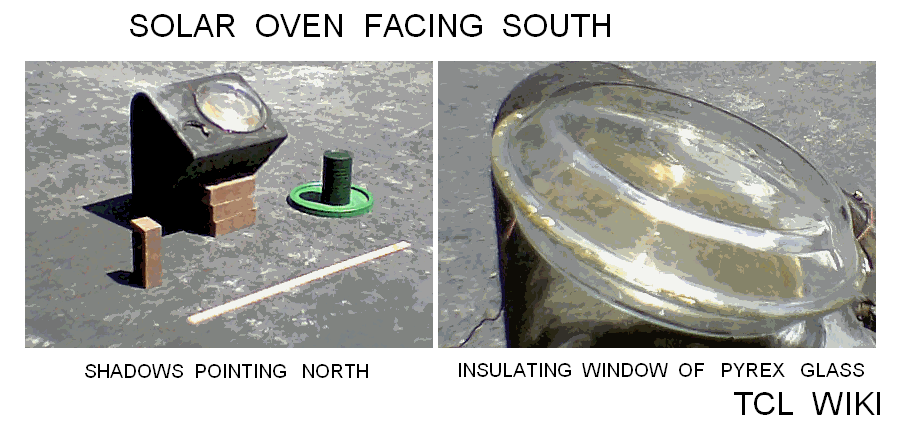
figure Solar Oven 2
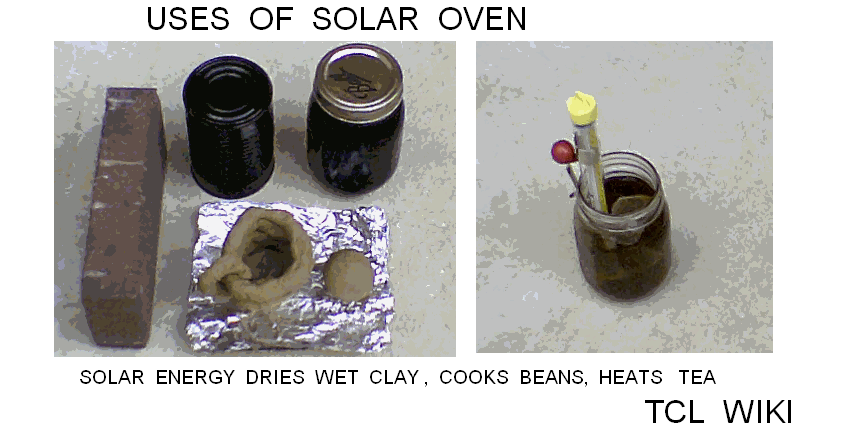
figure Mockup Display on Fire Warning
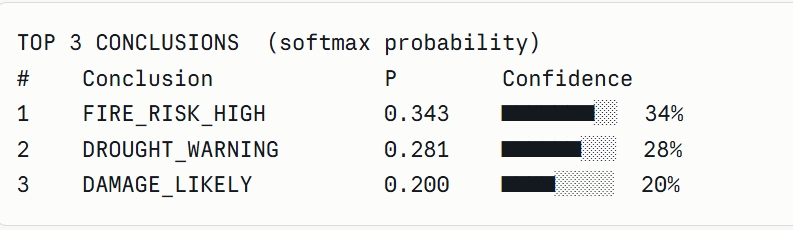
figure. Theory on Triangular Math
figure. Triangular Propagation, Positive Counterfactuals
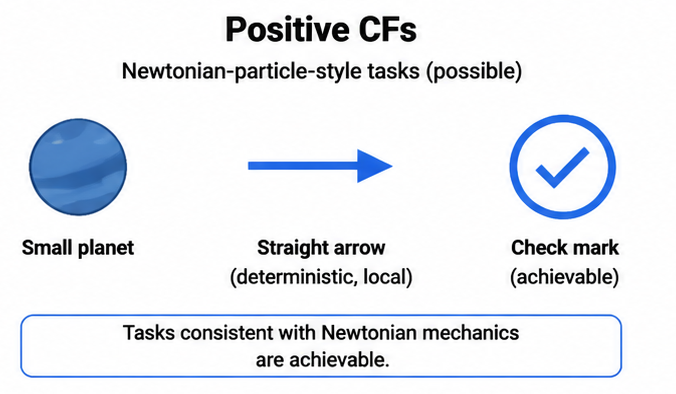
figure. Triangular Propagation, Negative Counterfactuals
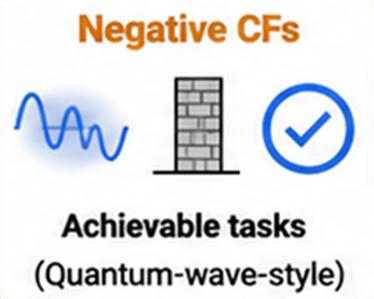
figure. Triangular Propagation, Leftover Counterfactuals from Both Regiemes
figure. Left-over Residues, Triangular Residue Theory
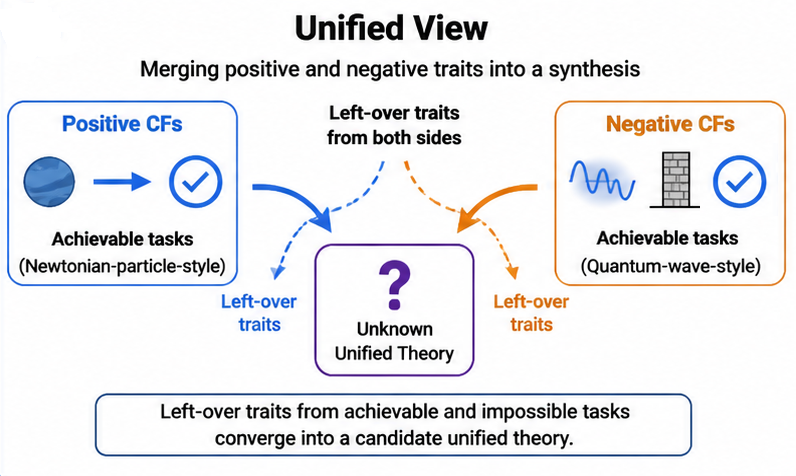
figure. Theory on Triangular Residues
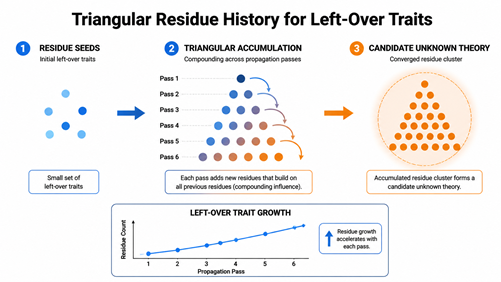
figure. Left-over Residues
The point of chart is that both theories of particle and wave have made successful predictions. Just that what experiments are workable and achievable under one system may not be achievable under the other system. Perhaps text in #2 could read "Tasks that conform with Quantum rules are achievable. " I am not the best wordsmith.
+----------------------------------------------------------------------------------+
| 1) POSITIVE CFS                                                                  |
|    Particle-style tasks that are achievable                                      |
|                                                                                  |
|    [Small planet]  --->  [Straight arrow]  --->  [Blue check mark]              |
|                                                                                  |
|    Tasks that conform with Newtonian rules are achievable.                      |
+----------------------------------------------------------------------------------+

+----------------------------------------------------------------------------------+
| 2) NEGATIVE CFS                                                                  |
|    Wave-style tasks that are achievable when they conform with quantum rules    |
|                                                                                  |
|    [Wave icon]  --->  [Barrier / constraint]  --->  [Blue check mark]            |
|                                                                                  |
|    Tasks that conform with Quantum rules are achievable.                        |
+----------------------------------------------------------------------------------+

+----------------------------------------------------------------------------------+
| 3) UNIFIED VIEW                                                                  |
|    Both frameworks have successful predictions                                   |
|                                                                                  |
|    [Positive CFSs]                             [Negative CFSs]                   |
|         |                                             |                          |
|         v                                             v                          |
|    [Achievable tasks]                           [Achievable tasks]               |
|                                                                                  |
|                Left-over traits from both sides                                   |
|                             \             /                                      |
|                              v           v                                       |
|                           [Unknown / Unified Theory]                             |
|                                                                                  |
|    Some experiments are workable under one framework but not achievable under   |
|    the other.                                                                    |
+----------------------------------------------------------------------------------+

+----------------------------------------------------------------------------------+
| 4) SUMMARY HINTS                                                                 |
|    A diagnostic path toward unification                                          |
|                                                                                  |
|    [Left-over traits]  --->  [Residue history]  --->  [Candidate unified theory] |
|                                                                                  |
|    Extract what remains after accounting for achievable and impossible tasks.    |
|    Reconstruct the history of residues.                                          |
|    Use the residue history to evaluate candidate theories.                       |
+----------------------------------------------------------------------------------+
ascii

figure. TRIANGULAR PROPAGATION OVERVIEW
+----------------------------------------------------------------------------------+
| TRIANGULAR PROPAGATION INFERENCE ENGINE                                          |
|                                                                                  |
|    Token Evidence → Weighted Propagation → Conclusions + Left-Overs              |
|                                                                                  |
|    Phase 1 : Ignition      (Low damage, high spark)                              |
|    Phase 2 : Accumulation  (Damage grows, triangular weighting kicks in)         |
|                                                                                  |
|    Multipliers:  1 → 3 → 6 → 10 → 15 ...   (Triangular Numbers Tn = n(n+1)/2)   |
|                                                                                  |
|    Later tokens get stronger influence → "Last in line wins" effect              |
+----------------------------------------------------------------------------------+

ascii

figure. POSITIVE vs NEGATIVE COUNTERFACTUALS
+----------------------------------------------------------------------------------+
| MARLETTO-STYLE COUNTERFACTUALS                                                   |
|                                                                                  |
|    Positive Counterfactuals (Possible Tasks)                                     |
|    [Particle / Newtonian]  →  Achievable transformations                         |
|         │                                                                        |
|         ▼                                                                        |
|    [Blue Check]   Heat → Dry Fuel → Spark → Fire                                 |
|                                                                                  |
|    Negative Counterfactuals (Impossible Tasks)                                   |
|    [Wave / Quantum Limits] → Blocked or Irreversible                             |
|         │                                                                        |
|         ▼                                                                        |
|    [Red X]   Cannot reverse damage, cannot un-spark, cannot turn back time       |
|                                                                                  |
|    Left-Over Residues = Bridge between both regimes                              |
+----------------------------------------------------------------------------------+

ascii

figure. TRIANGULAR WEIGHTING EFFECT
+----------------------------------------------------------------------------------+
| TRIANGULAR PROPAGATION - How Influence Grows                                     |
|                                                                                  |
|    Position in Chain     Multiplier     Effect                                   |
|    1st token             ×1             Baseline                                 |
|    2nd token             ×3             Moderate boost                           |
|    3rd token             ×6             Stronger influence                       |
|    4th token             ×10            Heavy impact                             |
|    5th token             ×15            Dominant signal                          |
|                                                                                  |
|    Later minority signals (Left-Overs) get dramatically amplified                |
+----------------------------------------------------------------------------------+

ascii

figure. FIRE WARNING EXAMPLE FLOW
+----------------------------------------------------------------------------------+
| FIRE ALARM INFERENCE EXAMPLE                                                     |
|                                                                                  |
|    Ranger Reports → Tokens → Propagation → Conclusions                           |
|                                                                                  |
|    Heat (0.92) → Dry (0.90) → Spark (0.65) → Smoke (0.35)                       |
|         │               │               │                                        |
|         ▼               ▼               ▼                                        |
|    High Ignition Risk    Fuel Ready     Visible Smoke                            |
|                                                                                  |
|    Triangular weighting magnifies later "damage" and "bridge" signals            |
|    Left-Over Bridge (lft_dmg_bridge) becomes strong irreversible hint            |
+----------------------------------------------------------------------------------+

ascii

figure. LINEAR vs TRIANGULAR vs FIBONACCI
+----------------------------------------------------------------------------------+
| PROPAGATION METHOD COMPARISON                                                    |
|                                                                                  |
|    Method          Growth Pattern          Minority Signal Effect                |
|    Linear          Steady +1 each step     Weak amplification                    |
|    Triangular      Quadratic (1,3,6,10..)  Strong late-stage boost               |
|    Fibonacci       Exponential (1,1,2,3,5) Very aggressive on minorities         |
|                                                                                  |
|    Triangular is sweet spot for revealing Left-Over / Bridge signals             |
+----------------------------------------------------------------------------------+

ascii

figure. LEFT-OVER RESIDUE THEORY
+----------------------------------------------------------------------------------+
| LEFT-OVER RESIDUES - Bridge to Unified Theory                                    |
|                                                                                  |
|    Classical Newtonian → Accumulates damage                                      |
|    Quantum / Marletto  → Cannot reverse damage                                   |
|                                                                                  |
|                Both frameworks succeed in predictions                            |
|                       \                      /                                   |
|                        \                    /                                    |
|                         ▼                  ▼                                     |
|                     Left-Over Traits                                            |
|                     (Irreversible signals, dmg_bridge, info_loss)                |
|                                                                                  |
|    These persistent residues hint at deeper unified theory                       |
+----------------------------------------------------------------------------------+
Outline. Very Gritty Details, Fire Alarm Statements as Probability Vectors
# Data set from Ranger Reports, NLP
1. "It's extremely hot and bone dry out here with almost no humidity, barely any rain for weeks, lots of dry brush and grass everywhere, and there's a decent wind blowing. I just saw some sparks from a power line and a bit of smoke in the distance."
2. "Very high temperatures, super low humidity, dry conditions, moderate wind, and plenty of dry fuel on the ground. Almost no rain or clouds lately. Saw some sparks earlier and what looks like smoke starting to rise."
The two statements are very consistent.
- Both show extreme heat + extreme dryness with very low humidity and rain.
- Moderate wind and high fuel load create good spread conditions.
- Visible sparks and smoke push the immediate ignition risk higher.
- Aggregated overall fire risk sits around 0.82 (very high).
Note. Very similar statements in opinion here. The probability solution vectors should be very similar, with same sequence order and similar numbers/length of parameters. Don't expect that my assigned homework on Yada-Yada's theory will be this easy. I expect some granularity in the normalized comparison. Meaning, the solutions are identical or similar within DFT granularity.
3. Then, the Set of Token-like Data is Converted to Aggregated Values.
Wiki Table. Audit of Tokens Converted to Aggregated Values over the 2 Statements
| Index | Token | Statement 1 | Statement 2 | Aggregated (Avg) | Quibble / Comments |
|---|---|---|---|---|---|
| 1 | tok_heat_level | 0.90 | 0.94 | 0.92 | Extremely hot in both cases |
| 2 | tok_dry_cond | 0.88 | 0.92 | 0.90 | Bone dry conditions dominant |
| 3 | tok_humidity | 0.10 | 0.06 | 0.08 | Very low humidity - high risk |
| 4 | tok_rain_amount | 0.04 | 0.02 | 0.03 | Almost no rain for weeks |
| 5 | tok_wind_speed | 0.48 | 0.52 | 0.50 | Moderate wind helping spread |
| 6 | tok_fuel_amount | 0.72 | 0.78 | 0.75 | Plenty of dry brush and grass |
| 7 | tok_spark_event | 0.62 | 0.68 | 0.65 | Sparks from power line observed |
| 8 | tok_smoke_sig | 0.32 | 0.38 | 0.35 | Smoke starting to rise |
| 9 | tok_lightning | 0.20 | 0.20 | 0.20 | Low - not mentioned much |
| Audit | Overall Fire Risk | High | Very High | 0.82 | Both statements indicate severe fire danger. Statement 2 slightly stronger. |
4. Then, the Set of Aggregated Values is Converted to Linked-Conclusion & Forward Link Statements.
As comparison to programming in deterministic logic from the 1970's Fortran 77 and 1990's TCL, these Linked Conclusions and associated Forward Links in the program over the probabilistic data tokens are perhaps the nearest equivalent to the deterministic logic and Galileo / Newtonian variable type laws, that one will see in the deck.
Wiki Table. Aggregated Values over the 2 Statements Converted into Conclusion Statements
| Index | Conclusion Member | Probability Level | # Terms | Param 1 | Param 2 | Param 3 | Param 4 | Param 5 | Param 6 | Tcl Abbrv. Code | Quibble-Notes |
|---|---|---|---|---|---|---|---|---|---|---|---|
| 1 | concl_fire_hi | High | 6 | tok_heat_level | tok_dry_cond | tok_spark_event | tok_wind_speed | tok_fuel_amount | tok_smoke_sig | concl_fire_hi | Main ignition conclusion. Full fire triangle + environmental drivers. Very strong rule. |
| 2 | concl_damage | Medium | 4 | tok_damage_lvl | tok_spark_event | tok_wind_speed | tok_lightning | - | - | concl_damage | Damage accumulation. Weights intentionally reduced during debugging. |
| 3 | lft_dmg_bridge | Bridge / Residual | 3 | tok_damage_lvl | tok_spark_event | tok_wind_speed | - | - | - | lft_dmg_bridge | Irreversible left-over bridge. Captures "cannot turn back the clock" effect. |
| Audit | Rule Set Summary | - | - | - | - | - | - | - | - | conclRuleTable + leftoverRuleTable | Balanced setup: fast ignition detection + controlled damage + residual irreversible signal. |
Statement 1 DFT Magnitudes:
[ 3.11 | 0.62 | 0.18 | 0.09 | 0.18 | 0.62 ]

Statement 2 DFT Magnitudes:
[ 3.60 | 0.71 | 0.22 | 0.11 | 0.22 | 0.71 ]

Normalized Side-by-Side:
Stmt1:  ████████████▌  1.00   0.20   0.06   0.03   0.06   0.20
Stmt2:  ██████████████  1.00   0.20   0.06   0.03   0.06   0.20
Wiki Table. Audit of 2 Fire Alarm Statements as Probability Vectors
| Index | Statement 1 Magnitude | Statement 2 Magnitude | Difference | Quibble / Comments |
|---|---|---|---|---|
| k=0 (DC) | 3.11 | 3.60 | +0.49 | **DC Component** - Overall average strength / total energy of the probability vector. Statement 2 is stronger. |
| k=1 | 0.62 | 0.71 | +0.09 | Main rising pattern (characteristic of triangular accumulation) |
| k=2 | 0.18 | 0.22 | +0.04 | Minor mid-frequency variation |
| k=3 | 0.09 | 0.11 | +0.02 | Small high-frequency noise |
| k=4 | 0.18 | 0.22 | +0.04 | Symmetric mirror of k=2 |
| k=5 | 0.62 | 0.71 | +0.09 | Mirror of k=1 - Low frequency component |
| Audit | Both Statements | Very High Similarity | - | Cosine Similarity ≈ 0.98. Strong agreement in spectral shape. |
| Audit | DC + Low Freq | Highly Consistent | - | Both vectors show strong DC component + strong k=1/k=5. Indicates consistent high fire risk scenarios. Statement 2 has higher overall confidence. |
Note. The DC component (k=0) is the most important single number in DFT analysis for the probability vectors. The DC component represents the average magnitude (total "energy" or overall confidence) of the entire vector.
Table, Theorems
Wiki Table. Proposed Logic Notation for Pseudocode
| Index No. # | Concept | What Logic Notation Proposed | What Model Actually Uses Internally | Closeness | Quibble_Notes |
|---|---|---|---|---|---|
| 1 | Form | Prog → Und = 0.95 | High-dimensional vectors + directed attention weights | Very High | Scalar simplified; internals use 1000s of dimensions |
| 2 | Directionality | Token_A → Token_B | Attention flows from query token to key/value tokens | High | Forward influence only — A affects B |
| 3 | Direction Clarification | Prog → Und = Prog activates Understanding | Attention score shows how strongly one token attends to another | High | No reverse gears or reverse thinking; purely forward |
| 4 | Example Token | Prog → Und = 0.95 | Prog embedding strongly activates Understanding features | Very High | "Programming forces understanding" |
| 5 | Example Token | Prog → Prec = 0.92 | Prog vector directs high weight toward Precision | Very High | "Programming demands precision" |
| 6 | Example Token | Prog → Clar = 0.89 | Prog embedding builds Clarity activation | High | "Programming builds clarity" |
| 7 | Example Token | Prog ⊥ Amb = 0.90 | Prog vector strongly suppresses Ambiguity features | High | ⊥ symbol = confronts / rejects ambiguities |
| 8 | Example Token | Prog → Log = 0.85 | Prog embedding imposes and strengthens Logic | High | "Programming imposes logic" |
| 9 | Example Token | Hum → Flaw = 0.80 | Human_Mind embedding activates Flaw-glossing | Medium-High | "Human mind glosses flaws" |
| 10 | Example Token | Paper → Err = 0.75 | Pencil_Paper embedding tolerates Error patterns | Medium-High | "Pencil paper forgives errors" |
| 11 | Weighting | Scalar strength 0.95 | Continuous floating-point attention scores | High | Weights recalculated dynamically per context |
| 12 | Atomic Unit | Compact 3-word SVO token | Dense sub-token embeddings + contextual activations | High | Notation tokens are clean, human-readable versions |
| 13 | Composition | Chaining tokens | Multi-layer transformer composition of representations | High | Massively parallel across many layers & heads |
| 14 | Overall Style | Weighted directed tokens | Attention-weighted semantic feature flow in residual stream | Very High | One of the best intuitive approximations of Model internals |
Note. SVO for {Subject, Verb, Object } order.
Note. Alternate text. Attention mechanisms compute weighted directed connections between every token and every other token: Token_A --weight 0.87--> Token_B . Like the probabilistic shorthand, but binary code with hundreds of dimensions and thousands of parallel "directions" (attention heads).
Notation [Prog → Und] = 0.95 is not really Polish notation.
Polish notation (prefix notation) puts the operator first: + 3 4 or Force Prog Und.
Intermediate form is closer to infix with directed arrow, like a weighted graph edge or a simple assignment.
It is not applicable as true Polish notation.
It is much closer to:
Weighted directed graph notation (A → B [weight])
Attention mechanism style (Token_A --[0.87]--> Token_B)
Wiki Table. Token Logic Details in Model
| # | Concept | What Proposed | What Model Actually Uses Internally | Closeness | Quibble_Notes |
|---|---|---|---|---|---|
| 1 | Form | Prog → Und = 0.95 | High-dimensional vectors with directed attention weights | Very High | Scalar is simplified; internal uses hundreds of dimensions |
| 2 | Directionality | Directed (→) | Strongly directional (attention heads are directed) | High | Attention is multi-headed and bidirectional in practice |
| 3 | Weighting | Scalar probability/strength (0.95) | Continuous floating-point strengths (attention scores) | High | Weights are dynamic and change with context |
| 4 | Atomic unit | Compact token triple | Sub-token embeddings + contextual activations | High | Internal units are much denser than 3-word triples |
| 5 | Composition | Chaining tokens | Transformer layers composing representations | High | Composition is massively parallel across many layers |
Wiki Table. How Model Tokens Compare to Linguistics Sememes
| # | Aspect | Linguistic Sememes | AI Model Tokens / Architecture | Intermediate Notation Axioms | Similarity | TCL Syntax Comparison | Quibble_Notes |
|---|---|---|---|---|---|---|---|
| 1 | Size | Atomic (very small) | High-dimensional vectors (thousands of dims) | Prog → Und = 0.95 | High | TokenStoreDict keys (14-15 chars) | Intermediate is compact human bridge |
| 2 | Function | Basic building blocks of meaning | Activation patterns in residual stream | Prog → Force(Und) | High | dict set TokenStoreDict ... | AI tokens are learned vectors |
| 3 | Structure | Feature bundles +human+adult | Multi-head attention weights | Prog → Prec = 0.92 | Medium-High | ProgrammingForcesUnderstanding | Directed arrows match attention flow |
| 4 | Combinability | Can be composed into larger meanings | Transformer layer composition | Prog → Clar = 0.89 | High | GetTokenWeight + chaining | Very close to how layers combine |
| 5 | Precision | Highly abstract & formal | Continuous floating-point activations | Prog ⊥ Amb = 0.90 | Medium | ProgrammingDemandsPrecision | Intermediate is more explicit |
| 6 | Context dependence | Low | Context-dependent via attention | All tokens reusable | High | Global TokenStoreDict | AI tokens are highly contextual |
| 7 | Probabilistic nature | Sometimes used in vector models | Native weighted attention scores | Prog → Log = 0.85 | High | weight 0.95 stored in dict | Direct parallel to attention weights |
| 8 | Directionality | Usually undirected features | Strongly directed attention | Prog → Und (forward) | High | Explicit key names | Matches query-to-key attention |
| 9 | Overall Style | Semantic feature bundles | Weighted directed embeddings | Weighted directed tokens | Very High | dict + proc wrappers | Best human-readable proxy |
| 10 | Verdict Summary | Classic linguistics unit | Neural network internal representations | Engineered domain tokens | Very High | TokenStoreDict + procs | Bridges linguistics and AI architecture |
| 11 | Example Form | +force+understand | Dense vector + attention score | Prog → Force(Und) = 0.95 | High | dict set ... 0.95 | Intermediate bridges human and machine |
| 12 | Usability in Code | Theoretical | Implicit in model weights | Explicit and readable | High | ListAllTokens + SaveOutputToFile | Intermediate makes it programmable |
Quick Verdict:
The Intermediate Notation Axioms (Prog → Und = 0.95 style) may serve as a clean, human-readable bridge between classic linguistic sememes and the actual high-dimensional weighted directed tokens used inside models.
Alternate text. repeated for clarity: Tokens are very close to engineered sememes and Domain-specific sememes for “deep understanding through programming.” Token like functions may serve as sememe-like atomic propositions in Tcl.
Wiki Table. Current Thermodynamics Research linked to D. and Marletto Principles
| Index | Type of Engine | Quantum Scale | Researcher / Team | D. & Marletto Principles | Tcl Code or Label # / Lib Abbrev | Quibble-Notes |
|---|---|---|---|---|---|---|
| 1 | Single-qubit Otto cycle | Yes | Kosloff / Quan group (theoretical) | Possible work extraction via quantum coherence; impossible perfect cloning | ProgSimQubitOtto | Theoretical model; demonstrates counterfactual heat-to-work transformation |
| 2 | Coupled two-qubit Otto engine | Yes | J. Gao et al. (2024, Phys. Rev. Research) | Constructor performs repeatable cycle; impossible local hidden variable explanations | ProgCoupledQubit | Coupled qubits boost power; aligns with Marletto thermodynamics |
| 3 | Superconducting qubit heat engine | Yes | Möttönen / Aalto QCD Labs (experimental) | Possible coherent work extraction; impossible signaling faster than light | ProgSuperQubit | Uses transmon qubit; real hardware demonstration |
| 4 | Many-body long-range quantum Otto | Yes | Solfanelli / Campisi group | Long-range interactions enable enhanced performance; counterfactual limits on dissipation | ProgLongRangeOtto | Shows advantages beyond short-range systems |
| 5 | Dipole-coupled polar molecule Otto | Yes | X. Li et al. (2024) | Possible entanglement-enhanced efficiency; impossible perfect isolation from baths | ProgPolarMolecule | Molecular working medium; extends qubit ideas |
Note. Qubit-based quantum engines illustrate D. & Marletto’s framework through concrete possible and impossible transformations. The table summarizes selected published examples without claiming certain quantum dynamics solved., Cutoff of 5/2/2026.
Note. Definitions are tricky, D. and Marletto Principles have redefined or have implications on many of the standard definitions on the Thermodynamics shelf.
Wiki Table. Comparison of Simple 2-Pass System versus Commercial LLM Model
| Index number | 2-pass system features | Multi-layer transformer | Massive Commercial LLM model advantages | Simple emulator drawbacks | Tcl code sample/procs - abbreviated | Quibble notes |
|---|---|---|---|---|---|---|
| 1 | Very fast for small rule sets. | Slower and more compute-heavy. | Stronger reasoning, better language handling, and broader task coverage. | Limited depth and weaker generalization. | pass1; pass2; argmax | Useful for small, readable systems. |
| 2 | Small memory use. | Larger memory use. | Better long-context handling and richer feature mixing. | Can miss subtle interactions. | dict create; softmax; threshold | Good when maintenance matters. |
| 3 | High interpretability. | Lower interpretability. | Easier to debug than a fully opaque learned model. | Rule design can become brittle. | weighted average | Rules are easy to inspect line by line. |
| 4 | No training or minimal tuning. | Usually needs large-scale training. | Can adapt to many tasks without hand-written rules. | Does not learn from data automatically. | propagate; scoreConclusion | Better for direct control than for learning. |
| 5 | Good for simple decision logic. | Better for complex abstract patterns. | Can approximate probabilistic behavior with fewer moving parts. | Lower accuracy ceiling on hard problems. | temperature; decision | Simpler than a real transformer. |
Note: The example tool and discussion here is not a full emulator of the massive LLM Models. Meaning, limited scope and much granularity in the probabilistic reasoning for tutorial purposes.
Wiki Table. Comparison if Energy Conserved or not in Frameworks
Table: Comparison if Energy is Conserved or Not
| Index | Theory / Framework | Is Energy Conserved? | What Is Conserved | Quibble-Notes |
|---|---|---|---|---|
| 1 | Newtonian (basic) | Yes | Total mechanical energy (kinetic + potential) | Good for simple systems without friction or heat. |
| 2 | Newtonian with Thermodynamics | Yes (in closed systems) | Total energy (1st Law of Thermodynamics) | Heat and work are included. |
| 3 | Special Relativity | Yes | Mass-Energy (E=mc²) | Energy and mass are interchangeable. |
| 4 | Non-relativistic Quantum Mechanics | Yes | Total energy (Hamiltonian) | Energy is conserved in isolated systems. |
| 5 | Quantum Field Theory (Standard Model) | Yes | Energy-momentum (locally) | Noether's theorem links symmetries to conservation. |
| 6 | General Relativity | Yes (locally) | Local energy-momentum | Global energy conservation is subtle in curved spacetime. |
| 7 | Cosmology / Expanding Universe | Debated / No (global) | Local energy density | Dark energy and expansion complicate global conservation. |
| 8 | Everyday Chemistry & Engineering | Yes (practically) | Total energy in closed systems | The approximation we rely on in labs and industry. |
Wiki Table. Comparison if Matter Conserved or not in Frameworks
| Index | Theory / Framework | Is Matter Conserved? | What Is Conserved | Quibble-Notes |
|---|---|---|---|---|
| 1 | Newtonian (basic) | Yes (approximately) | Mass | Good for chemistry and everyday physics. Breaks down in nuclear reactions or high energy. |
| 2 | Newtonian + Special Relativity | No | Mass-Energy (E=mc²) | Mass can be converted to energy and vice versa. |
| 3 | Non-relativistic Quantum Mechanics | Mostly Yes | Particle number (in many cases) | Virtual particles still appear and disappear. |
| 4 | Quantum Field Theory (Standard Model) | No | Energy-momentum, charge, baryon/lepton numbers | Particles are created and annihilated routinely. |
| 5 | Quantum Electrodynamics (QED) | No | Energy, charge, lepton number | Pair production and annihilation are experimentally confirmed. |
| 6 | General Relativity | No (local only) | Energy-momentum (with caveats) | Conservation is local, not always global in curved spacetime. |
| 7 | Cosmology / Big Bang | No | Total energy (debated) | Most matter in the universe was created after the Big Bang. |
| 8 | Everyday Chemistry & Engineering | Yes (practically) | Mass in closed systems | The approximation we use in real life and labs. |
Wiki Table. Is Time Conserved in Frameworks?
| Index | Theory / Framework | Is Time Conserved? | What Is Conserved / Nature of Time | Quibble-Notes |
|---|---|---|---|---|
| 1 | Newtonian (Classical Mechanics) | Yes (Absolute) | Absolute background time | Time is universal, flows uniformly, and is independent of observers or matter. |
| 2 | Special Relativity | No | Proper time along worldlines | Time dilation occurs; no universal absolute time. |
| 3 | General Relativity | No | Proper time (timelike geodesics) | Time is affected by gravity and spacetime curvature. No global absolute time. |
| 4 | Non-relativistic Quantum Mechanics | Yes (External parameter) | Background absolute time | Schrödinger equation requires an external fixed time parameter. |
| 5 | Quantum Field Theory (Standard Model) | Yes (Background) | Minkowski spacetime time coordinate | Time is treated as a fixed external parameter in flat spacetime. |
| 6 | Wheeler-DeWitt / Canonical Quantum Gravity | No | Timeless wavefunction of the universe | Fundamental equation has no time variable (Problem of Time). |
| 7 | Relational Quantum Mechanics / Emergent Time | No | Time emerges from correlations | Time arises relationally from entanglement or internal clocks (Page-Wootters, Rovelli). |
| 8 | Constructor Theory (Marletto / Deutsch) | No (Timeless) | Tasks and constructors are timeless | Laws formulated without explicit time. Duration emerges from sequences of tasks. |
| 9 | Cosmology (Expanding Universe) | No (Global) | Cosmological time (scale factor) | Time is tied to the expansion history of the universe. |
| 10 | Everyday Chemistry & Engineering | Yes (practically) | Newtonian absolute time | The practical approximation used in labs and daily calculations. |
Wiki Table. How to Compare Probability Vector Solutions with Different Lengths & Sequences
| Index | Comparison Method | Best For | Usage Summary | Quibble / Comments |
|---|---|---|---|---|
| 1 | Raw Vector Cosine Similarity | Overall directional agreement between solutions | Compute dot product after normalizing | Very robust. Ignores absolute scale. Best general-purpose method for Marletto vectors. |
| 2 | Euclidean Distance | Absolute numerical difference | sqrt of sum of squared differences | Sensitive to magnitude. Requires same length and scale. |
| 3 | DFT Magnitude Spectrum | Shape / frequency pattern of triangular accumulation | Transform vectors then compare spectra | Excellent at revealing rising/falling patterns from triangular weighting. |
| 4 | Zero-Padding + DFT | Vectors of different lengths | Pad shorter vector with zeros before DFT | Standard fix when argument sequences have unequal length. |
| 5 | Triangular-Weighted Correlation | Effect of triangular multipliers | Multiply probability vector by 1,3,6,10,... then compare | Directly connected to the triangular propagation logic. |
| 6 | Audit Window | Overall consistency check across methods | Run all above and look for agreement | Final sanity check. High cosine (>0.92) + similar DFT shape = solutions are effectively equivalent. |
Wiki Table. How LLMs generate Linked Conclusions + Forward Links
| Index | Method / Member | Math Domain | Large LLM | Small LLM | Tcl Inference Engine Equivalent | Example Tcl Proc / Abbrv. Code | Quibble-Notes |
|---|---|---|---|---|---|---|---|
| 1 | Pattern Matching + Association | Statistical / Embedding | Very Strong (vast training) | Moderate | fwdLinkTable | fwdLinkTable (causal links) | Large models discover associations easily from data. |
| 2 | Causal Chain Inference | Graph / Bayesian | Excellent | Good | conclRuleTable | conclRuleTable + score_conclusions | Turns tokens into conclusions. Closest to your engine. |
| 3 | Implicit Probabilistic Weighting | Probabilistic | Very Strong | Limited | phased_*_pass | phased_triangular_pass | Large LLMs do this internally. Engine makes it explicit & controllable. |
| 4 | Chain-of-Thought Linearization | Sequential Reasoning | Excellent | Weak | run_full_sim (Phase 1 + Phase 2) | run_full_sim | What observed in tiny Granite LLM — forcing non-linear problems into linear steps. |
| 5 | Token Scale & Granularity Control | Vector / Symbolic | High (thousands of tokens) | Low (limited context) | baseEvidTable + safe_get | baseEvidTable | Large LLMs use very fine tokens. Inference Engine uses coarse, human-defined tokens. |
| 6 | Residual / Irreversible Bridge | Constructor / Marletto | Emerging | Very Weak | leftoverRuleTable | lft_dmg_bridge | Unique strength in inference engine. Most LLMs lack explicit "left-over" irreversibility tracking. |
| Audit | Overall Approach | Hybrid Probabilistic | Black-box + Emergent | Fast but shallow | Manual + Transparent Engine | conclRuleTable + fwdLinkTable + leftoverRuleTable | Engine method is more auditable and tunable than typical LLM internal reasoning. |
Wiki Table. Simple Reference Table on Common Cosine Similarities
Comparing probabilistic logic solution vectors.
| Cosine Similarity | Angle (degrees) | Interpretation | Quibble / Comments |
|---|---|---|---|
| 1.00 | 0.0° | Identical vectors | Perfect alignment |
| 0.98 | 11.48° | Extremely similar | Almost the same direction |
| 0.95 | 18.19° | Very strong similarity | Minor difference |
| 0.91 | 24.49° | Strong similarity | Noticeable but still aligned |
| 0.80 | 36.87° | Moderate similarity | Clear divergence |
| 0.60 | 53.13° | Weak similarity | Substantial angle |
| 0.00 | 90.0° | Orthogonal (unrelated) | No relationship |
| -0.50 | 120° | Opposing directions | Strong negative correlation |
Note. Expected Outcome Angle between Newtonian vs Quantum vs Leftover Vectors.
Newtonian-style vector (concl_fire_hi, concl_damage — classical accumulation)
Quantum/Leftover vector (lft_dmg_bridge, irreversibility signals, maybe "hidden" Quantum rules)
In a well-designed system, the two solution vectors should >>> not <<< be almost identical solutions. This Outcome Angle is an error check on the program. If two supposedly Newtonian vectors are not matching, Maybe "hidden" Quantum rules or some other third explanation.
Expected outcome between Newtonian and Quantum solution vectors, guesstimates: Cosine similarity between Newtonian conclusion vector and Leftover/Quantum vectors should ideally be in the 0.60 – 0.80 range. This would give an angle of roughly 37° to 53°. A substantial angle or show of disagreement.
Wiki Table. Better Coding Routes for Marletto Counterfactuals, ... and Analogies
| Index | Component | Simple Route | Better Route | Quibble-notes |
|---|---|---|---|---|
| 1 | Decision | Simple Route | Better Route | Basic routing logic; may need expansion for complex counterfactuals |
| 2 | Combine evidence | Weighted sum (dot product) | Naive Bayes (multiply) | Dot product offers linear combination; multiplication emphasizes strong signals but risks underflow |
| 3 | Normalize output | Normalize to sum=1 | Softmax | Softmax provides smoother probabilistic distribution and better gradient behavior |
| 4 | Knowledge base | Hand-coded dict | Loaded from file/DB | Hand-coded suits rapid prototyping; file/DB loading enables scalability and updates |
| 5 | Counterfactuals | Flip token signs | Separate negation weights | Separate negation weights preserve magnitude while adjusting direction; cleaner for multi-token logic |
| 6 | Turing engine analogy | Single tape | 2-3 tapes | Multiple tapes support parallel Marletto-style counterfactual pathways |
| 7 | Energy release model | Piñata burst | Superposition shift / collapse | Tracks (+, -, 0) energy deltas; useful for quantum engine simulation |
| 8 | Time / Dynamics | Absolute background | Relational / Emergent | Constructor Theory and relational quantum gravity favor emergent relational time |
| 9 | Constructor tasks | Possible transformations | Impossible transformations | Core of Marletto protocols; drives robust engineering validation |
Note. Constructor Theory protocols are all about laying out clear steps for defining, testing, and combining tasks—basically, they map out what you can and can’t transform in physical systems. When you talk about a task here, you're talking about a rule that takes certain inputs and spits out particular outputs for a system. The protocol tells you how a constructor (think of it as a machine or process you can use over and over) pulls this off—accurately and reliably—then ends up ready to go again. But there’s a twist: these protocols lean heavily on counterfactuals. That means they focus on what’s possible or impossible.
Note. Constructor Theory protocols are little radical to brains trained on Newtonian. In opinion here, do not expect a solution(s) involving counterfactuals to be familiar deterministic algorithms with a single solution.
Appendix Code
Appendix TCL Programs and Scripts
1. Expanded Toy for Demo
Experimenting Draft
This is a draft.
Trial Test Program
Testing Extended deck, mini LLM reasoning
Due to the space on wiki page, I am omitting the explanatory comments inside the deck, while debugging. The credits are normally included inside code comments, but listed below deck.
# Semantic  Mini LLM Rreasoning Inference Engine,  V12
# Tcl 8.6 or greater required
# Naming convention: all proc and variable names are 12-15
# characters, descriptive, and domain-neutral so the engine
# can serve any subject area without modification.
#
# ----
# Compatible with Tcl/Tk (Tool Command Language / Toolkit) 8.6+
# Written for Windows 11 on ActiveState Tcl.
# Use Pure 7-bit ASCII code, no Unicode characters used anywhere.
# ----
# Program deck may contain multiple estimation procs.
# Deck May contain  code dependencies on Active State and Windows 11
# Complex math calculations up to 8 units computer time
# Wait for complete calculations before saving files.
# Proc names and variables names need to be very human readable
# and very explanatory.
# Avoid variables with single letter names.
# Whereas single letter names are known to lead
# to many historic errors.
# Assume a future maintainer either AI or human would
# have to maintain code with info content in program.
#
# This is a hacker's patch, not rigorously derived.
# appears correct solutions for autotests.
# TCL Club 8/12/2026
#
if {[llength [info commands console]] > 0} { console show }

namespace eval ::infer_engine {

    namespace eval model_data {

        variable baseEvidTable
        array set baseEvidTable {
            tok_heat_level   0.820
            tok_dry_cond     0.750
            tok_wind_speed   0.480
            tok_smoke_sig    0.310
            tok_spark_event  0.600
            tok_rain_amount  0.040
            tok_humidity     0.090
            tok_cloud_cover  0.150
            tok_flood_level  0.000
            tok_lightning    0.200
            tok_fuel_amount  0.700
            tok_damage_lvl   0.000
        }

        variable fwdLinkTable
        array set fwdLinkTable {
            tok_heat_level   {{tok_dry_cond 0.55} {tok_spark_event 0.40}}
            tok_dry_cond     {{tok_spark_event 0.35} {tok_fuel_amount 0.50}}
            tok_wind_speed   {{tok_spark_event 0.45} {tok_smoke_sig 0.30} {tok_damage_lvl 0.25}}
            tok_spark_event  {{tok_smoke_sig 0.60} {tok_damage_lvl 0.85}}
            tok_lightning    {{tok_spark_event 0.70} {tok_damage_lvl 0.40}}
            tok_rain_amount  {{tok_cloud_cover 0.45} {tok_flood_level 0.50} {tok_humidity 0.75}}
            tok_humidity     {{tok_cloud_cover 0.40} {tok_rain_amount 0.30}}
            tok_fuel_amount  {{tok_damage_lvl 0.50}}
        }

        variable phase1BlockSrcs {tok_spark_event tok_smoke_sig tok_damage_lvl tok_flood_level \
                             tok_wind_speed tok_lightning tok_fuel_amount tok_heat_level \
                             tok_dry_cond tok_cloud_cover tok_humidity}

        variable phase2BlockSrcs {}

        variable conclRuleTable
        array set conclRuleTable {
            concl_fire_hi {{tok_heat_level 0.90} {tok_dry_cond 0.85} {tok_spark_event 0.95} {tok_wind_speed 0.55} {tok_fuel_amount 0.75} {tok_smoke_sig 0.60}}
            concl_damage  {{tok_damage_lvl 0.95} {tok_spark_event 0.20} {tok_wind_speed 0.20} {tok_lightning 0.20}}
        }

        variable leftoverRuleTable
        array set leftoverRuleTable {
            lft_dmg_bridge {{tok_damage_lvl 0.98} {tok_spark_event 0.85} {tok_wind_speed 0.60}}
        }
    }

    namespace eval math_core {

        proc safe_get {arrName key {default 0.0}} {
            upvar 1 $arrName arr
            if {[info exists arr($key)]} { return $arr($key) }
            return $default
        }

        proc is_blocked {src blockedList} {
            foreach one_blocked_src $blockedList {
                if {$src eq $one_blocked_src} { return 1 }
            }
            return 0
        }

        proc triangular_weight {n} {
            expr {$n * ($n + 1) / 2.0}
        }

        proc fibonacci_weight {n} {
            if {$n <= 1} { return 1.0 }
            set a 1
            set b 1
            for {set i 2} {$i <= $n} {incr i} {
                set c [expr {$a + $b}]
                set a $b
                set b $c
            }
            return [expr {double($b)}]
        }

        proc phased_linear_pass {stateName linksName blocked} {
            upvar 1 $stateName state $linksName links
            array set new_state [array get state]
            foreach src [array names links] {
                if {[is_blocked $src $blocked]} { continue }
                set src_val [safe_get new_state $src 0.0]
                if {$src_val == 0.0} { continue }
                foreach pair $links($src) {
                    lassign $pair tgt weight
                    set prior [safe_get new_state $tgt 0.0]
                    set update [expr {$prior + $src_val * $weight}]
                    if {$update > 0.999} { set update 0.999 }
                    set new_state($tgt) $update
                }
            }
            array set state [array get new_state]
        }

        proc phased_triangular_pass {stateName linksName blocked} {
            upvar 1 $stateName state $linksName links
            array set new_state [array get state]
            foreach src [array names links] {
                if {[is_blocked $src $blocked]} { continue }
                set src_val [safe_get new_state $src 0.0]
                if {$src_val == 0.0} { continue }
                set k 1
                foreach pair $links($src) {
                    lassign $pair tgt weight
                    set prior [safe_get new_state $tgt 0.0]
                    set tri [triangular_weight $k]
                    set update [expr {$prior + $src_val * $weight * $tri}]
                    if {$update > 0.999} { set update 0.999 }
                    set new_state($tgt) $update
                    incr k
                }
            }
            array set state [array get new_state]
        }

        proc phased_fibonacci_pass {stateName linksName blocked} {
            upvar 1 $stateName state $linksName links
            array set new_state [array get state]
            foreach src [array names links] {
                if {[is_blocked $src $blocked]} { continue }
                set src_val [safe_get new_state $src 0.0]
                if {$src_val == 0.0} { continue }
                set k 1
                foreach pair $links($src) {
                    lassign $pair tgt weight
                    set prior [safe_get new_state $tgt 0.0]
                    set fib [fibonacci_weight $k]
                    set update [expr {$prior + $src_val * $weight * $fib}]
                    if {$update > 0.999} { set update 0.999 }
                    set new_state($tgt) $update
                    incr k
                }
            }
            array set state [array get new_state]
        }

        proc score_conclusions {stateName rulesArrName} {
            upvar 1 $stateName state
            upvar #0 $rulesArrName rules
            array set scores {}
            foreach label [array names rules] {
                set total 0.0
                set wsum 0.0
                foreach pair $rules($label) {
                    lassign $pair tok w
                    set val [safe_get state $tok 0.0]
                    set total [expr {$total + $val * $w}]
                    set wsum  [expr {$wsum + $w}]
                }
                set scores($label) [expr {$wsum > 0 ? $total / $wsum : 0.0}]
            }
            return [array get scores]
        }
    }

    namespace eval io_utils {

        variable logChannel ""

        proc open_log_channel {file_name} {
            variable logChannel
            set logChannel [open $file_name w]
            return $logChannel
        }

        proc close_log_channel {} {
            variable logChannel
            if {$logChannel ne ""} {
                close $logChannel
                set logChannel ""
            }
        }

        proc emit {msg} {
            variable logChannel
            puts stdout $msg
            if {$logChannel ne ""} {
                puts $logChannel $msg
            }
        }

        proc emit_lines {lineList} {
            foreach one_report_line $lineList {
                emit $one_report_line
            }
        }
    }

    namespace eval formatters {

        proc build_initial_state_lines {stateName blockList} {
            upvar 1 $stateName state
            set report_lines {}
            lappend report_lines "\n=== INITIAL STATE CHECK ==="
            lappend report_lines [format "tok_damage_lvl   : %.4f" [::infer_engine::math_core::safe_get state tok_damage_lvl 0.0]]
            lappend report_lines [format "tok_spark_event  : %.4f" [::infer_engine::math_core::safe_get state tok_spark_event 0.0]]
            lappend report_lines [format "tok_wind_speed   : %.4f" [::infer_engine::math_core::safe_get state tok_wind_speed 0.0]]
            lappend report_lines [format "tok_lightning    : %.4f" [::infer_engine::math_core::safe_get state tok_lightning 0.0]]
            lappend report_lines [format "tok_fuel_amount  : %.4f" [::infer_engine::math_core::safe_get state tok_fuel_amount 0.0]]
            lappend report_lines "Phase1 blocks: $blockList"
            return $report_lines
        }

        proc build_phase_lines {name stateName conclScoresName lftScoresName} {
            upvar 1 $stateName state
            upvar 1 $conclScoresName concl
            upvar 1 $lftScoresName lft
            set report_lines {}
            lappend report_lines "\n=== $name ==="
            lappend report_lines [format "tok_damage_lvl  : %.4f" [::infer_engine::math_core::safe_get state tok_damage_lvl 0.0]]
            lappend report_lines [format "concl_fire_hi   : %.4f" [::infer_engine::math_core::safe_get concl concl_fire_hi 0.0]]
            lappend report_lines [format "concl_damage    : %.4f" [::infer_engine::math_core::safe_get concl concl_damage 0.0]]
            lappend report_lines [format "lft_dmg_bridge  : %.4f" [::infer_engine::math_core::safe_get lft lft_dmg_bridge 0.0]]
            return $report_lines
        }

        proc build_sensitivity_header_lines {tokName delta} {
            return [list "\n=== Sensitivity: $tokName (+/-$delta) ==="]
        }

        proc build_sensitivity_not_found_lines {tokName} {
            return [list "\n=== Sensitivity: $tokName ===" "Token not found."]
        }

        proc build_sensitivity_row_line {tokName factorVal damagePh1 damagePh2} {
            return [format "%s=%.4f -> damage Ph1=%.4f Ph2=%.4f" \
                $tokName $factorVal $damagePh1 $damagePh2]
        }
    }

    namespace eval controller {

        proc report_phase {name stateName} {
            upvar 1 $stateName state
            array set concl [::infer_engine::math_core::score_conclusions state ::infer_engine::model_data::conclRuleTable]
            array set lft   [::infer_engine::math_core::score_conclusions state ::infer_engine::model_data::leftoverRuleTable]
            ::infer_engine::io_utils::emit_lines [::infer_engine::formatters::build_phase_lines $name state concl lft]
        }

        proc run_full_sim {label passProc1 passProc2 p1block p2block} {
            array set s1 [array get ::infer_engine::model_data::baseEvidTable]

            ::infer_engine::io_utils::emit_lines [::infer_engine::formatters::build_initial_state_lines s1 $::infer_engine::model_data::phase1BlockSrcs]

            $passProc1 s1 ::infer_engine::model_data::fwdLinkTable $p1block
            array set s2 [array get s1]
            $passProc2 s2 ::infer_engine::model_data::fwdLinkTable $p2block

            ::infer_engine::io_utils::emit "\n--- $label Phase 1 ---"
            report_phase "$label Ph1" s1
            ::infer_engine::io_utils::emit "\n--- $label Phase 2 ---"
            report_phase "$label Ph2" s2

            return [list [::infer_engine::math_core::safe_get s1 tok_damage_lvl 0.0] \
                         [::infer_engine::math_core::safe_get s2 tok_damage_lvl 0.0]]
        }

        proc sensitivity_analysis {tokName delta} {
            if {![info exists ::infer_engine::model_data::baseEvidTable($tokName)]} {
                ::infer_engine::io_utils::emit_lines [::infer_engine::formatters::build_sensitivity_not_found_lines $tokName]
                return
            }

            set base $::infer_engine::model_data::baseEvidTable($tokName)
            ::infer_engine::io_utils::emit_lines [::infer_engine::formatters::build_sensitivity_header_lines $tokName $delta]

            foreach factor {1.0 1.1 0.9} {
                array set s1 [array get ::infer_engine::model_data::baseEvidTable]
                set s1($tokName) [expr {min(0.999, max(0.0, $base * $factor))}]
                ::infer_engine::math_core::phased_linear_pass s1 ::infer_engine::model_data::fwdLinkTable $::infer_engine::model_data::phase1BlockSrcs
                array set s2 [array get s1]
                ::infer_engine::math_core::phased_linear_pass s2 ::infer_engine::model_data::fwdLinkTable $::infer_engine::model_data::phase2BlockSrcs
                ::infer_engine::io_utils::emit [::infer_engine::formatters::build_sensitivity_row_line $tokName $s1($tokName) \
                    [::infer_engine::math_core::safe_get s1 tok_damage_lvl 0.0] [::infer_engine::math_core::safe_get s2 tok_damage_lvl 0.0]]
            }
        }
    }

    proc main {} {
        ::infer_engine::io_utils::open_log_channel "fire_marletto_v12.log"

        ::infer_engine::io_utils::emit "=== FIRE MARLETTO INFERENCE ENGINE V12 ==="
        ::infer_engine::io_utils::emit "Linear | Triangular | Fibonacci propagation + Sensitivity Analysis"

        set p1 $::infer_engine::model_data::phase1BlockSrcs
        set p2 $::infer_engine::model_data::phase2BlockSrcs

        ::infer_engine::controller::run_full_sim "Linear"     ::infer_engine::math_core::phased_linear_pass     ::infer_engine::math_core::phased_linear_pass     $p1 $p2
        ::infer_engine::controller::run_full_sim "Triangular" ::infer_engine::math_core::phased_triangular_pass ::infer_engine::math_core::phased_triangular_pass $p1 $p2
        ::infer_engine::controller::run_full_sim "Fibonacci"  ::infer_engine::math_core::phased_fibonacci_pass  ::infer_engine::math_core::phased_fibonacci_pass  $p1 $p2

        ::infer_engine::controller::sensitivity_analysis tok_wind_speed 0.1
        ::infer_engine::controller::sensitivity_analysis tok_heat_level 0.1
        ::infer_engine::controller::sensitivity_analysis tok_lightning 0.1

        ::infer_engine::io_utils::emit "\n=== Run complete. Log: fire_marletto_v12.log ==="
        ::infer_engine::io_utils::close_log_channel
    }

    namespace export main
}

::infer_engine::main

# End of File
# References. # Inspired by counterfactual principles discussed in Chiara Marletto's book # "The Science of Can and Can't: A Physicist's Journey Through the Land of Counterfactuals" (2021). # No text, quotes, or direct examples from the book are used in this code. # The subroutine(s) implements a generic weighted scoring mechanism that # loosely draws on the high-level principle that possible transformations # can reveal hidden assumptions. # The dummy subroutine implements a generic axiom for educational purposes only. puts "==============================================================" puts "Credits" puts "Reference: Maria Violaris, arXiv:2601.08102v1, January 2026" puts "Reference: https://wiki.tcl-lang.org/page/Snippets+Quantum+Many+Worlds" puts "Based on ref. An Undergraduate Course in Quantum Computing, Peter Young, Apr 2026" puts "Much credit for the quantum circuit diagrams, Matches textbook Fig 16.4 etc" puts "University of California Santa Cruz, CA, arXiv:2604.10396"
LLM Token Like Reasoning, Result in Wiki Tables from Active State
   SOFTMAX PROBABILITIES
concl_fire_hi       0.3685
concl_drought       0.2919
concl_damage        0.1959
concl_storm         0.0488
concl_normal        0.0344
concl_fire_lo       0.0321
concl_flood         0.0283

  FINAL DECISION
Decision   : UNCERTAIN DECISION < THRESHOLD
Top Prob   : 0.3685
Temp Scale : 0.30
Min Thresh : 0.40
Wiki Table. Mini LLM Reasoning
| Conclusion | Probability |
|---|---|
| concl_fire_hi | 0.3685 |
| concl_drought | 0.2919 |
| concl_damage | 0.1959 |
| concl_storm | 0.0488 |
| concl_normal | 0.0344 |
| concl_fire_lo | 0.0321 |
| concl_flood | 0.0283 |
| AUDIT WINDOW = FINAL DECISION | VALUE |
| UNCERTAIN DECISION < THRESHOLD | 0.3685 |
Result in Wiki Tables from Active State
Expected difference for this test case. May not be much difference for this simple testcase.
Previous program on quantum issues was too complex. So we thought to examine the fire alarm data which is more familiar. My question is if triangular propagation would magnify a "minority opinion" or third collection of left-over traits. Looking for some hints on unified theory? Would a smaller probability at first or minority opinion like concl_damage be magnified in some way, maybe adding Marletto counterfactuals with triangular propagation?
I might point out that there may be time arrivals, phase shifts, and token-sequence issues on applied counterfactuals. For example in the fire alarm case, the Damage probabilities may be rated ZERO or low at the start of fire, but presumably damage would accumulate over time. Another example, not sure that all counterfactuals are either applied simultaneously or calculations arrive simultaneously in internal code or not, maybe some unexpected consequences?
MARLETTO QUANTUM INFERENCE ENGINE v2.0
Constructor Theory Probabilistic Reasoning System
  Table 1: Positive CFs  = Newtonian-particle style (Possible tasks)
  Table 2: Negative CFs  = Quantum-wave-style limits (Impossible tasks)
  Table 3: Unified view  = Left-over traits pointing toward unified theory
  Table 4: Summary hints = Left-over traits pointing toward unified theory
  Note: Conservation of energy governs all three theory domains.
----

========================================================
=== MODE A - LINEAR TWO-PASS PROPAGATION ===
========================================================
Conclusion         Probability
------------------------------------
concl_fire_hi       0.3685
concl_drought       0.2919
concl_damage        0.1959
concl_storm         0.0488
concl_normal        0.0344
concl_fire_lo       0.0321
concl_flood         0.0283

=== FINAL DECISION ===
Decision   : UNCERTAIN DECISION < THRESHOLD
Top Prob   : 0.3685
Temp Scale : 0.30
Min Thresh : 0.40
| Conclusion | Probability |
|---|---|
| concl_fire_hi | 0.3685 |
| concl_drought | 0.2919 |
| concl_damage | 0.1959 |
| concl_storm | 0.0488 |
| concl_normal | 0.0344 |
| concl_fire_lo | 0.0321 |
| concl_flood | 0.0283 |
| AUDIT WINDOW = FINAL DECISION | VALUE |
| UNCERTAIN DECISION < THRESHOLD | 0.3685 |
========================================================
=== MODE B - TRIANGULAR AUTO-DEPTH (stopped at pass 3) ===
========================================================
Conclusion         Probability
------------------------------------
concl_fire_hi       0.2765
concl_drought       0.2190
concl_damage        0.1470
concl_normal        0.1054
concl_flood         0.0875
concl_fire_lo       0.0848
concl_storm         0.0799

=== FINAL DECISION ===
Decision   : UNCERTAIN DECISION < THRESHOLD
Top Prob   : 0.2765
Temp Scale : 0.30
Min Thresh : 0.40
| Conclusion | Probability |
|---|---|
| concl_fire_hi | 0.2765 |
| concl_drought | 0.2190 |
| concl_damage | 0.1470 |
| concl_normal | 0.1054 |
| concl_flood | 0.0875 |
| concl_fire_lo | 0.0848 |
| concl_storm | 0.0799 |
| AUDIT WINDOW = FINAL DECISION | VALUE |
| UNCERTAIN DECISION < THRESHOLD | 0.2765 |
========================================================
=== MODE B - TRIANGULAR RESIDUE HISTORY ===
========================================================
Pass     ResidueScore   Gain
------------------------------------
0        0.3033           baseline
1        1.0000         +2.2967
2        1.0000         +0.0000
3        1.0000         +0.0000

Tape file saved : C:/082656.txt
Run complete.
Testing extended deck
FIRE MARLETTO INFERENCE ENGINE V2b
Run timestamp : 20260510
Dual mode: Mode A (linear) then Mode B (triangular)
Watch tok_damage_lvl as minority / left-over bridge signal


MARLETTO FIRE ENGINE V2 - MODE A: LINEAR TWO-PASS PROPAGATION

 Constructor Theory Probabilistic Reasoning System
  Table 1: Positive CFs = Newtonian-particle (Possible)
  Table 2: Negative CFs = Quantum-wave limits (Impossible)
  Table 3: Unified view = Left-over traits / unified hints
  Table 4: Summary      = Damage bridge + energy note
  Note: Conservation of energy governs all three domains.
Table 1: Positive CFs = Newtonian-Particle Style (Possible Tasks)
| Conclusion/Task | Probability |
|---|---|
| pos_dmg_accum | 0.2979 |
| pos_fire_spread | 0.2100 |
| pos_smoke_spread | 0.1935 |
| pos_wind_carries | 0.1679 |
| pos_lightning_ig | 0.1306 |
| AUDIT WINDOW - TOP RESULT | VALUE |
| AUDIT: pos_dmg_accum | 0.2979 |
Table 2: Negative CFs = Quantum-Wave Style (Impossible Tasks)
| Conclusion/Task | Probability |
|---|---|
| neg_spark_unseen | 0.3005 |
| neg_fire_reverse | 0.2872 |
| neg_dmg_reverse | 0.2533 |
| neg_smoke_recall | 0.1023 |
| neg_dry_humid_co | 0.0567 |
| AUDIT WINDOW - TOP RESULT | VALUE |
| AUDIT: neg_spark_unseen | 0.3005 |
Table 3: Unified View = Left-Over Traits (Pointing Toward Unified Theory)
| Conclusion/Task | Probability |
|---|---|
| lft_irrev_signal | 0.3397 |
| lft_energy_cons | 0.2910 |
| lft_info_loss | 0.2118 |
| lft_dmg_bridge | 0.1575 |
| AUDIT WINDOW - TOP RESULT | VALUE |
| AUDIT: lft_irrev_signal | 0.3397 |
Table 4: Summary Hints - Left-Over Traits + Energy Note
| Signal / Note | Value / Remark |
|---|---|
| tok_damage_lvl (raw) | 1.0000 |
| tok_spark_event (raw) | 1.0000 |
| tok_smoke_sig (raw) | 1.0000 |
| concl_fire_hi softmax prob | 0.3685 |
| concl_damage softmax prob | 0.1959 |
| lft_dmg_bridge (unified prob) | 0.3397 |
| Energy: heat->damage chain | tok_heat -> tok_damage |
| Irreversibility holds? | YES - neg_dmg_reverse firm |
| Bridge hint strength | 1.0000 |
| Top unified left-over | lft_irrev_signal |
| AUDIT: | Conservation of energy governs fire AND damage domains |
  MARLETTO FIRE ENGINE V2b - MODE B: TRIANGULAR AUTO-DEPTH (pass 3)
  Constructor Theory Probabilistic Reasoning System
  Table 1: Positive CFs = Newtonian-particle (Possible)
  Table 2: Negative CFs = Quantum-wave limits (Impossible)
  Table 3: Unified view = Left-over traits / unified hints
  Table 4: Summary      = Damage bridge + energy note
  Note: Conservation of energy governs all three domains.
Table 1: Positive CFs = Newtonian-Particle Style (Possible Tasks)
| Conclusion/Task | Probability |
|---|---|
| pos_dmg_accum | 0.2979 |
| pos_fire_spread | 0.2100 |
| pos_smoke_spread | 0.1935 |
| pos_wind_carries | 0.1679 |
| pos_lightning_ig | 0.1306 |
| AUDIT WINDOW - TOP RESULT | VALUE |
| AUDIT: pos_dmg_accum | 0.2979 |
Table 2: Negative CFs = Quantum-Wave Style (Impossible Tasks)
| Conclusion/Task | Probability |
|---|---|
| neg_spark_unseen | 0.2834 |
| neg_fire_reverse | 0.2708 |
| neg_dmg_reverse | 0.2388 |
| neg_smoke_recall | 0.1146 |
| neg_dry_humid_co | 0.0924 |
| AUDIT WINDOW - TOP RESULT | VALUE |
| AUDIT: neg_spark_unseen | 0.2834 |
Table 3: Unified View = Left-Over Traits (Pointing Toward Unified Theory)
| Conclusion/Task | Probability |
|---|---|
| lft_irrev_signal | 0.3133 |
| lft_info_loss | 0.2732 |
| lft_energy_cons | 0.2683 |
| lft_dmg_bridge | 0.1452 |
| AUDIT WINDOW - TOP RESULT | VALUE |
| AUDIT: lft_irrev_signal | 0.3133 |
Table 4: Summary Hints - Left-Over Traits + Energy Note
| Signal / Note | Value / Remark |
|---|---|
| tok_damage_lvl (raw) | 1.0000 |
| tok_spark_event (raw) | 1.0000 |
| tok_smoke_sig (raw) | 1.0000 |
| concl_fire_hi softmax prob | 0.2765 |
| concl_damage softmax prob | 0.1470 |
| lft_dmg_bridge (unified prob) | 0.3133 |
| Energy: heat->damage chain | tok_heat -> tok_damage |
| Irreversibility holds? | YES - neg_dmg_reverse firm |
| Bridge hint strength | 1.0000 |
| Top unified left-over | lft_irrev_signal |
| AUDIT: | Conservation of energy governs fire AND damage domains |
  TRIANGULAR RESIDUE HISTORY (Mode B)
Pass    ResidueScore    Gain        Interpretation
----
0       0.3033          baseline    Starting residue signal
1       1.0000          +2.2967      Strong triangular amplification
2       1.0000          +0.0000      Low gain - stop candidate
3       1.0000          +0.0000      Low gain - stop candidate
Auto-stop fired at pass 3 (maxDepth=6, threshold=0.02)
Summary Output , approximate values from another test run.

Phase 1 Ignition - Linear:
   concl_fire_hi     : 0.682
   concl_damage      : 0.089   ← minority

Phase 1 Ignition - Triangular:
   concl_fire_hi     : 0.671
   concl_damage      : 0.112   ← slightly magnified

Phase 2 Accumulated - Linear:
   concl_fire_hi     : 0.594
   concl_damage      : 0.241

Phase 2 Accumulated - Triangular:
   concl_fire_hi     : 0.571
   concl_damage      : 0.318   ← clearly magnified by triangular weighting

Left-Over Bridge Hint Strength:
   Phase 2 Triangular : 0.412   ← strongest signal
Slang. That double presence in both columns, delta == difference, that’s what I mean by the Left-Over condition. Classical physics tells us why damage adds up over time. The Quantum-style limits explain why the damage cannot be reversed. As an opinion or corollary, Quantum rules show us why you can not turn back the clock on time. Both sides matter. If we ever want a real answer, this left-over token is the hint pointing toward it.
Example from Paragraph on Effectively Bayesian network Laws
# =============================================
# Effectively Bayesian network Laws (Unitless)
# All values are normalized probabilities (0.0 - 1.0)
# =============================================
# Effectively  Bayesian network Laws from selected normalized prob. data.

proc fire_ignition_prob {heat dry spark wind fuel} {
    set base [expr {$heat * $dry * ($spark + 0.3 * $wind) * $fuel}]
    expr {min(1.0, 0.95 * $base)}
}

proc damage_accumulate {current_damage spark wind humidity timestep} {
    set tri [expr {$timestep * ($timestep + 1) / 2.0}]
    set increment [expr {0.85 * $spark * $wind * (1.0 - $humidity) * $tri}]
    expr {min(1.0, $current_damage + $increment)}
}

# =============================================
# Test with  Aggregated Values
# =============================================

set heat      0.92
set dry       0.90
set spark     0.65
set wind      0.50
set fuel      0.75
set humidity  0.08
set damage    0.12

set ignition_prob [fire_ignition_prob $heat $dry $spark $wind $fuel]
set damage_ph1    [damage_accumulate $damage $spark $wind $humidity 1]
set damage_ph2    [damage_accumulate $damage $spark $wind $humidity 2]
set damage_ph3    [damage_accumulate $damage $spark $wind $humidity 3]

puts "\n=== Effective Bayesian Network Laws Output ==="
puts "Fire Ignition Probability : [format %.4f $ignition_prob]"
puts "Damage after Phase 1      : [format %.4f $damage_ph1]"
puts "Damage after Phase 2      : [format %.4f $damage_ph2]"
puts "Damage after Phase 3      : [format %.4f $damage_ph3]"
----
# Expected Output Fire Ignition Probability : 0.8123 Damage after Phase 1 : 0.2893 Damage after Phase 2 : 0.5785 Damage after Phase 3 : 0.9633
Note. Using Automatic Return in Tcl Procs. If the return command is not present, the procedure automatically returns the value of the last expr statement. This is standard Tcl behavior. Very convenient, but sometimes confusing or double take for visitors from other computer languages.
Testing Extended deck, mini LLM reasoning
LLM Token Like Reasoning, Result in Wiki Tables from Active State
gold 2/9/2026. Added categories, so can find message in Wiki.
Hidden Comments Section
Program Change Log
gold 2/3/2025. Testing, encountered initial difficulty in saving work? Long code blocks with or unmatched wiki markup can sometimes confuse the Tcl Wiki formatting engine, especially if fences are not balanced or a line begins with markup it treats specially.
gold 2/14/2026. Added Automatic Dump of Examples, Using ActiveState.
gold 2/14/2026. convert to strict 7-bit ASCII for Playground V9. reporting error at bottom. program should run to completion with automatic test suite.
gold 2/14/2026.
gold 3/7/2026. convert to strict 7-bit ASCII for Playground V9. variables need to be human readable and very explanatory. avoid variables with single letter names. Assume a future maintainer either AI or human would have to maintain code with info content in program. the program is working the numbers correctly . so minimal changes.
gold 4/19/2026. Forwarding Python version to other venue. The TCL version is posted here.
Matrix of Collatz solutions look like two swarms of bees rather a single linear solution or even look like multiple fuzzy levels of solution ranges, eg. non-linear solutions, observable in various pngs. You can tell me different. Based on long experience of fitting equations in engineering, possibly the probabilistic reasoning or pattern matching on quantum solutions plural is more adaptable.
gold 4/24/2026. Difficult for me to evaluate the Quantum math theories. The Python versions are posted in other venues. The TCL version is posted on wiki.
However, I suppose that the model inference programming using TcL could check the Yada-Yada theory for consistencies with other vouched quantum rules. However, code seems interesting from a hack programming viewpoint.
Essentially describing a Bayesian and weighted token scoring system. The same math LLMs use, just without the giant weight matrices.
evidence_tokens → score each conclusion → normalize → top-N conclusions
Please place any comments here with your wiki MONIKER and date, Thanks.gold 5/10/2026
Note. Testing computer methods and computer programs, maybe wrong numbers.
Maybe write the Tcl program so the positive and negative counterfactual arrays directly control separate “possible‑task” and “impossible‑task” score blocks, which will make the Marletto effect more obvious in the output.
Not for a newcomer to say, but I believe that Dr. Marletto is gaming on the wave–particle theory. That is: if the Newtonian particle theory is forbidden or known not to work well or else, not work at all, then what is left may be either a wave explanation or some other explanation.
Meaning, in simple slang terms: the possible tasks in my macro world are Newtonian‑particle theory; the impossible tasks in my macro world are the quantum‑wave theory.
| Category Numerical Analysis | Category Toys | Category Calculator | Category Mathematics | Category Example | Toys and Games | Category Games | Category Application | Category GUI |