Weighted Decision and example eTCL demo calculator, numerical analysis
Weighted Decision and eTCL demo example calculator, numerical analysis
This page is under development. Comments are welcome, but please load any comments in the comments section at the bottom of the page. Please include your wiki MONIKER in your comment with the same courtesy that I will give you. Its very hard to reply intelligibly without some background of the correspondent. Thanks,gold
- Weighted Decision and eTCL demo example calculator, numerical analysis
- Pseudocode Section
- Appendix Code
- Draft Figures, ASCII Diagrams
- figure. WEIGHTED DECISION METHOD: BASIC CONCEPT
- figure. WEIGHTED DECISION CALCULATION EXAMPLE
- figure. eTCL WEIGHTED DECISION CALCULATOR DEMO
- figure. STEPS IN WEIGHTED DECISION ANALYSIS
- figure. WEIGHTED DECISION vs SIMPLE AVERAGE
- figure. eTCL CONSOLE EXAMPLE FOR WEIGHTED DECISION
- figure. SUMMARY: WEIGHTED DECISION METHOD
- Comments Section
gold Here is some eTCL starter code for weighted decision in calculator shell.
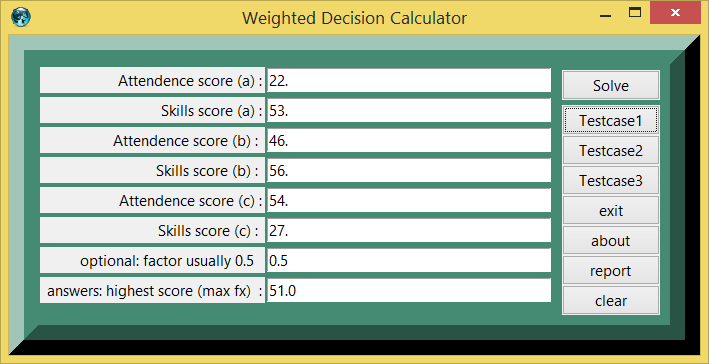
A piano teacher rates three students based on attendence and skills on a half and half basis. Student a has an attendence of 22.0 and a skill score of 53.0 , giving 0.50*22.0+ 0.50*53.0, 37.5 weighted score. Student b has an attendence of 46.0 and a skill score of 56.0 , giving 0.50*46.0+ 0.50*56.0, 51.0 weighted score. Student c has an attendence of 54.0 and a skill score of 27, giving 0.50*54.0+ 0.50*27.0, 40.5 weighted score. The highest rating was max < a)37.5 b)51.0 c)40.5 >= 51 max rating of weighted scores.
Pseudocode Section
       # using pseudocode
       # possible problem instances,
      initialize algorithm_result = 1.
      check algorithm
      f(solution) =? initial product
      check_sum = a+b+c+d+e = original real estate
      set answers and printout with resulting values
      pseudocode: need test cases > small,medium, giant
      pseudocode: need testcases within range of expected operation.
      pseudocode: are there any cases too small or large to be solved?
Testcases Section
In planning any software, it is advisable to gather a number of testcases to check the results of the program. The math for the testcases can be checked by pasting statements in the TCL console. Aside from the TCL calculator display, when one presses the report button on the calculator, one will have console show access to the capacity functions (subroutines).
Testcase 1
| table 1 | printed in | tcl wiki format |
|---|---|---|
| quantity | value | comment, if any |
| 1: | testcase_number | |
| 22.0 : | Attendence score (a) | |
| 53.0 : | Skills score (a) | |
| 46.0 : | Attendence score (b) | |
| 56.0 : | Skills score (b) | |
| 54.0 : | Attendence score (c) | |
| 27.0 : | Skills score (c) | |
| 0.5 : | optional: factor usually 0.50 | |
| 37.5 : | score (a) | |
| 51.0 : | score (b) | |
| 40.5 : | score (c) | |
| 43.0 : | average score per item (a+b+c)/3 | |
| 51.0 : | answer: highest score (max fx) |
Testcase 2
| table 2 | printed in | tcl wiki format |
|---|---|---|
| quantity | value | comment, if any |
| 2: | testcase_number | |
| 33.0 : | Attendence score (a) | |
| 54.0 : | Skills score (a) | |
| 42.0 : | Attendence score (b) | |
| 50.0 : | Skills score (b) | |
| 59.0 : | Attendence score (c) | |
| 23.0 : | Skills score (c) | |
| 0.5 : | optional: factor usually 0.50 | |
| 43.5 : | score (a) | |
| 46.0 : | score (b) | |
| 41.0 : | score (c) | |
| 43.5 : | average score per item (a+b+c)/3 | |
| 46.0 : | answer: highest score (max fx) |
Testcase 3
| table 3 | printed in | tcl wiki format |
|---|---|---|
| quantity | value | comment, if any |
| 3: | testcase_number | |
| 25.0 : | Attendence score (a) | |
| 50.0 : | Skills score (a) | |
| 45.0 : | Attendence score (b) | |
| 50.0 : | Skills score (b) | |
| 64.0 : | Attendence score (c) | |
| 25.0 : | Skills score (c) | |
| 0.5 : | optional: factor usually 0.50 | |
| 37.5 : | score (a) | |
| 47.5 : | score (b) | |
| 44.5 : | score (c) | |
| 43.166 : | average score per item (a+b+c)/3 | |
| 47.5 : | answer: highest score (max fx) |
Screenshots Section
figure 1.
References:
- Taking a Weighted Average, Dr Math, mathforum.org/dr.math, dated 03/20/2003
- google <Weighted Average, Dr Math>, mathforum.org/dr.math
- Using Weighted Criteria to Make Decisions, Dr Math>, mathforum.org/dr.math, dated 07/18/2008
- google <Weighted sum product model Decision >
- Oneliner's Pie in the Sky
- One Liners
- Category Algorithm
- Babylonian Number Series and eTCL demo example calculator
- Brahmagupta Area of Cyclic Quadrilateral and eTCL demo example calculator
- Gauss Approximate Number of Primes and eTCL demo example calculator
Appendix Code
appendix TCL programs and scripts
        # pretty print from autoindent and ased editor
        # Weighted Decision calculator
        # written on Windows XP on eTCL
        # working under TCL version 8.5.6 and 1.0.1
        # gold on TCL WIKI, 25feb2017
        package require Tk
        package require math::numtheory
        namespace path {::tcl::mathop ::tcl::mathfunc math::numtheory }
        set tcl_precision 17
        frame .frame -relief flat -bg aquamarine4
        pack .frame -side top -fill y -anchor center
        set names {{} { Attendence score (a) :} }
        lappend names { Skills score (a) :}
        lappend names { Attendence score (b) : }
        lappend names { Skills score (b) : }
        lappend names { Attendence score (c) :}
        lappend names { Skills score (c) : }
        lappend names { optional: factor usually 0.5  }
        lappend names { answers: highest score (max fx)  :}
        foreach i {1 2 3 4 5 6 7 8} {
            label .frame.label$i -text [lindex $names $i] -anchor e
            entry .frame.entry$i -width 35 -textvariable side$i
            grid .frame.label$i .frame.entry$i -sticky ew -pady 2 -padx 1 }
        proc about {} {
            set msg "Calculator for Weighted Decision
            from TCL WIKI,
            written on eTCL "
            tk_messageBox -title "About" -message $msg }
       proc calculate {     } {
            global answer2
            global side1 side2 side3 side4 side5
            global side6 side7 side8
            global a_score b_score c_score average_score
            global testcase_number
            incr testcase_number
            set side1 [* $side1 1. ]
            set side2 [* $side2 1. ]
            set side3 [* $side3 1. ]
            set side4 [* $side4 1. ]
            set side5 [* $side5 1. ]
            set side6 [* $side6 1. ]
            set side7 [* $side7 1. ]
            set side8 [* $side8 1. ]
            # initialize placeholder answer
            set maximum_score_rating 1.
            set score_rating 0.5
            set score_rating $side7
            set a_score [+ [* $score_rating $side1 ] [* $score_rating $side2 ] ]
            set b_score [+ [* $score_rating $side3 ] [* $score_rating $side4 ] ]
            set c_score [+ [* $score_rating $side5 ] [* $score_rating $side6 ] ]
            set average_score [/ [+ $a_score $b_score $c_score ] 3. ]
            set maximum_score_rating [max $a_score $b_score $c_score ]
            set side8 $maximum_score_rating
                    }
        proc fillup {aa bb cc dd ee ff gg hh} {
            .frame.entry1 insert 0 "$aa"
            .frame.entry2 insert 0 "$bb"
            .frame.entry3 insert 0 "$cc"
            .frame.entry4 insert 0 "$dd"
            .frame.entry5 insert 0 "$ee"
            .frame.entry6 insert 0 "$ff"
            .frame.entry7 insert 0 "$gg"
            .frame.entry8 insert 0 "$hh"
             }
        proc clearx {} {
            foreach i {1 2 3 4 5 6 7 8 } {
                .frame.entry$i delete 0 end } }
        proc reportx {} {
            global side1 side2 side3 side4 side5
            global side6 side7 side8
            global a_score b_score c_score average_score
            global testcase_number
            console show;
            puts "%|table $testcase_number|printed in| tcl wiki format|% "
            puts "&| quantity| value| comment, if any|& "
            puts "&| $testcase_number:|testcase_number | |& "
            puts "&| $side1 :|Attendence score (a)   |   |&"
            puts "&| $side2 :|Skills score (a)| |& "
            puts "&| $side3 :|Attendence score (b) | |& "
            puts "&| $side4 :|Skills score (b)| |&"
            puts "&| $side5 :|Attendence score (c) | |&"
            puts "&| $side6 :|Skills score (c) |  |&"
            puts "&| $side7 :|optional: factor usually 0.50  |  |&"
            puts "&| $a_score :|score (a) |  |&"
            puts "&| $b_score :|score (b) |  |&"
            puts "&| $c_score :|score (c) |  |&"
            puts "&| $average_score :|average score per item (a+b+c)/3 |  |&"
            puts "&| $side8 :|answer: highest score (max fx) |  |&"
            }
        frame .buttons -bg aquamarine4
        ::ttk::button .calculator -text "Solve" -command { calculate   }
        ::ttk::button .test2 -text "Testcase1" -command {clearx;fillup 22.  53.   46. 56.  54.  27. 0.5 51.0}
        ::ttk::button .test3 -text "Testcase2" -command {clearx;fillup 33.  54.  42.  50.  59.  23. .5 46.0 }
        ::ttk::button .test4 -text "Testcase3" -command {clearx;fillup 25. 50. 45. 50. 64.  25. 0.5 47.5 }
        ::ttk::button .clearallx -text clear -command {clearx }
        ::ttk::button .about -text about -command {about}
        ::ttk::button .cons -text report -command { reportx }
        ::ttk::button .exit -text exit -command {exit}
        pack .calculator  -in .buttons -side top -padx 10 -pady 5
        pack  .clearallx .cons .about .exit .test4 .test3 .test2   -side bottom -in .buttons
        grid .frame .buttons -sticky ns -pady {0 10}
               . configure -background aquamarine4 -highlightcolor brown -relief raised -border 30
        wm title . "Weighted Decision Calculator"
Pushbutton Operation
For the push buttons, the recommended procedure is push testcase and fill frame, change first three entries etc, push solve, and then push report. Report allows copy and paste from console.
For testcases in a computer session, the eTCL calculator increments a new testcase number internally, eg. TC(1), TC(2) , TC(3) , TC(N). The testcase number is internal to the calculator and will not be printed until the report button is pushed for the current result numbers. The current result numbers will be cleared on the next solve button. The command { calculate; reportx } or { calculate ; reportx; clearx } can be added or changed to report automatically. Another wrinkle would be to print out the current text, delimiters, and numbers in a TCL wiki style table as
  puts " %| testcase $testcase_number | value| units |comment |%"
  puts " &| volume| $volume| cubic meters |based on length $side1 and width $side2   |&"
Draft Figures, ASCII Diagrams
gold 7/2/2026. These ASCII Diagrams are Visual heuristics and may contain engineering rules of thumb, but not pure math proofs.
figure. WEIGHTED DECISION METHOD: BASIC CONCEPT
+----------------------------------------------------------------------------------+
| WEIGHTED DECISION METHOD: BASIC CONCEPT                                        |
|                                                                                  |
|    The Weighted Decision Method helps engineers compare multiple options       |
|    by assigning different levels of importance to each criterion.              |
|                                                                                  |
|    Process:                                                                    |
|      1. List decision criteria                                                 |
|      2. Assign a weight to each criterion (weights sum to 1.0 or 100%)         |
|      3. Score each option against every criterion                              |
|      4. Calculate weighted score = weight × raw score                          |
|      5. Sum weighted scores to rank options                                    |
|                                                                                  |
|    This numerical approach reduces bias in complex engineering decisions.      |
+----------------------------------------------------------------------------------+
figure. WEIGHTED DECISION CALCULATION EXAMPLE
+----------------------------------------------------------------------------------+
| WEIGHTED DECISION CALCULATION EXAMPLE                                          |
|                                                                                  |
|    Decision: Choose a new laptop                                               |
|                                                                                  |
|    Criteria          | Weight | Option A | Option B | Option C |                  |
|    -----------------+--------+----------+----------+----------+                  |
|    Performance       | 0.40   | 8        | 9        | 7        |                  |
|    Battery Life      | 0.25   | 7        | 6        | 9        |                  |
|    Price             | 0.20   | 9        | 7        | 8        |                  |
|    Build Quality     | 0.15   | 8        | 8        | 6        |                  |
|    -----------------+--------+----------+----------+----------+                  |
|    Total Weighted Score |     | 8.00     | 7.75     | 7.55     |                  |
|                                                                                  |
|    Option A ranks highest in this example.                                     |
+----------------------------------------------------------------------------------+
figure. eTCL WEIGHTED DECISION CALCULATOR DEMO
+----------------------------------------------------------------------------------+
| eTCL WEIGHTED DECISION CALCULATOR DEMO                                         |
|                                                                                  |
|    Inputs: Criteria names, weights, and scores for each option                 |
|    Output: Weighted total score and ranking                                    |
|                                                                                  |
|    Example Output:                                                             |
|      Option A: 8.15                                                            |
|      Option B: 7.45                                                            |
|      Option C: 8.70  ← Best choice                                             |
|                                                                                  |
|    The calculator supports any number of criteria and options.                 |
+----------------------------------------------------------------------------------+
figure. STEPS IN WEIGHTED DECISION ANALYSIS
+----------------------------------------------------------------------------------+
| STEPS IN WEIGHTED DECISION ANALYSIS                                            |
|                                                                                  |
|    1. Define the decision goal clearly                                         |
|    2. List all important criteria                                              |
|    3. Assign relative weights (sum must equal 1.0)                            |
|    4. Score each option on every criterion (usually 1–10 scale)                |
|    5. Multiply score by weight for each cell                                   |
|    6. Sum weighted scores for each option                                      |
|    7. Rank options and review sensitivity                                      |
|                                                                                  |
|    This systematic method improves engineering decision quality.               |
+----------------------------------------------------------------------------------+
figure. WEIGHTED DECISION vs SIMPLE AVERAGE
+----------------------------------------------------------------------------------+
| WEIGHTED DECISION vs SIMPLE AVERAGE                                            |
|                                                                                  |
|    +-------------------+----------------------+--------------------------+     |
|    | Method            | Advantage            | Limitation               |     |
|    +-------------------+----------------------+--------------------------+     |
|    | Simple Average    | Easy to compute      | Treats all criteria      |     |
|    |                   |                      | as equally important     |     |
|    | Weighted Decision | Reflects real        | Requires careful         |     |
|    |                   | importance           | weight assignment        |     |
|    +-------------------+----------------------+--------------------------+     |
|                                                                                  |
|    Weighted decisions better match real-world engineering priorities.          |
+----------------------------------------------------------------------------------+
figure. eTCL CONSOLE EXAMPLE FOR WEIGHTED DECISION
+----------------------------------------------------------------------------------+
| eTCL CONSOLE EXAMPLE FOR WEIGHTED DECISION                                     |
|                                                                                  |
|    # Simple weighted score function                                            |
|    proc weighted_score {weights scores} {                                      |
|        set total 0                                                             |
|        foreach w $weights s $scores {                                          |
|            set total [expr {$total + $w * $s}]                                 |
|        }                                                                       |
|        return $total                                                           |
|    }                                                                           |
|                                                                                  |
|    puts [weighted_score {0.4 0.3 0.3} {8 7 9}]   → 8.0                        |
|                                                                                  |
|    Students can easily extend this for multiple options.                       |
+----------------------------------------------------------------------------------+
figure. SUMMARY: WEIGHTED DECISION METHOD
+----------------------------------------------------------------------------------+
| SUMMARY: WEIGHTED DECISION METHOD                                              |
|                                                                                  |
|    The Weighted Decision Method provides a structured numerical approach      |
|    for comparing engineering alternatives.                                     |
|                                                                                  |
|    Engineers assign importance weights and calculate total scores.             |
|    The eTCL calculator makes this technique quick and interactive.             |
|                                                                                  |
|    This tool helps students and professionals make more objective decisions.   |
+----------------------------------------------------------------------------------+
Comments Section
Please place any comments here, Thanks.
| Category Numerical Analysis | Category Toys | Category Calculator | Category Mathematics | Category Example | Toys and Games | Category Games | Category Application | Category GUI |